


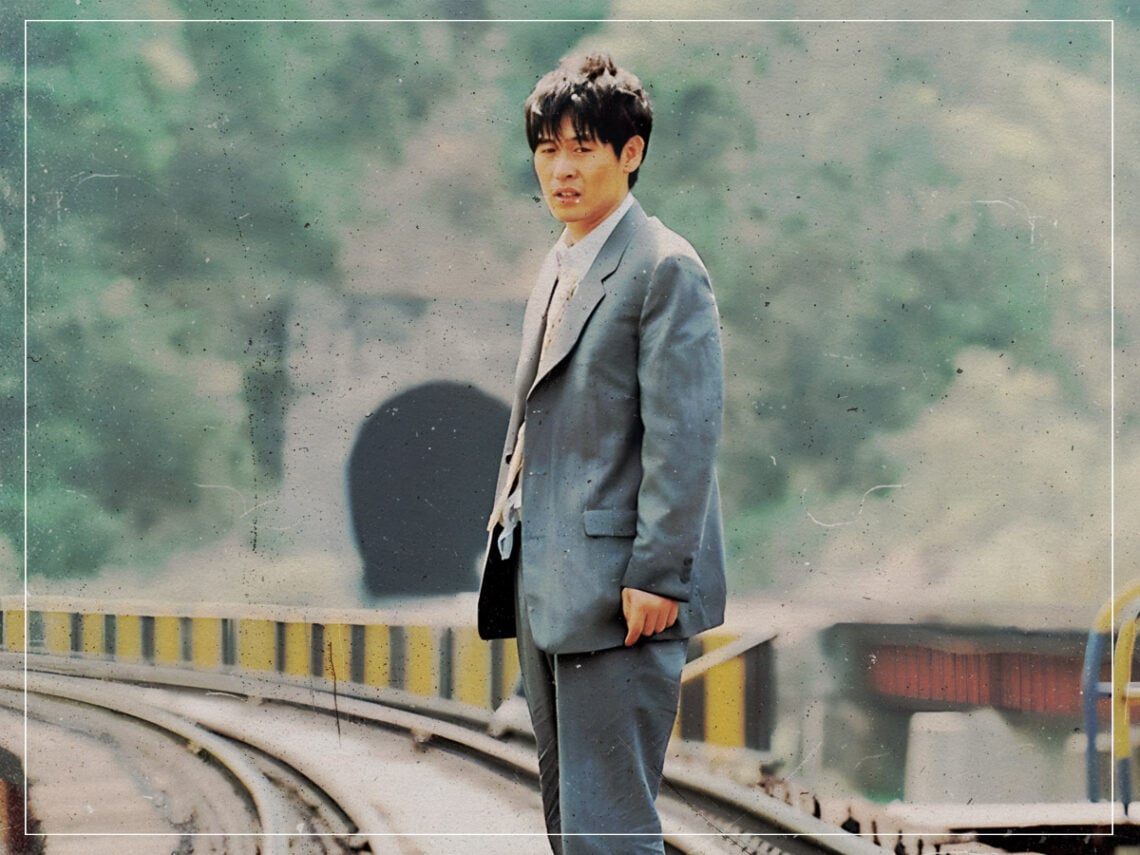
How ‘Peppermint Candy’ details the major events in Korea’s 20th-century history

While Lee Chang-dong might be best known for his Academy Award-nominated 2018 psychological thriller film Burning, he has several other acclaimed works to his name, such as 2010’s Poetry and 1999’s Peppermint Candy. The latter film, starring Sol Kjung-gu, Moon So-ri and Kim Yeo-jin, was Lee’s second directorial feature and serves as a crucial work in the canon of Korean cinema.
Lee’s film not only charts the downfall of a man in reverse chronological order but also serves as a powerful exploration of the major events in Korea’s tricky history. It begins with its protagonist, Young-ho, who arrives on screen in a state of disillusionment, anger and depression, committing suicide, indicating that he’s previously lived a life of pain and difficulty.
From there, Young-ho’s story is revealed backwards in time, starting just three days before his suicide when he hears of the reunion of his group of friends on the radio. After buying a gun with the last of his money, showing further the impact of his life thus far, Young-ho is invited to visit his first love, Sun-im, who is dying in hospital, and they trade gifts that remind one another of their former relationship.
The film then flashes back to the mid-1990s, which represents the period of rapid industrialisation and economic growth that was experienced in Korea. Young-ho is depicted as a successful businessman even though we know that he later loses his job, which mirrors the subsequent Asian financial crisis of the decade, and Young-ho’s tumultuous domestic life with his wife also plays into this chaotic period of Korea’s history.
Going further back, we witness the moment at which Young-ho loses his childhood innocence as a police officer, peer pressured into torturing a criminal suspect – an act we know that he will become comfortable with in just a few years. This growing attitude of violence and cynicism arguably represents the kind of stricter control the Korean military government began to showcase as the 1980s waned on, though what came before was undoubtedly worse.
The early 1980s were a period of social unrest and political turmoil in Korea, marking the height of the military’s control over the country’s inhabitants, with strict censorship, rife repression and the abuse of citizen rights. At this point, Young-ho, visited by Sun-im, is giving his mandatory military service and is sent to deal with the student uprisings that led to the Gwangju Democratisation Movement massacre.
Injured during the demonstrations, a harmless student approaches, but as his comrades return to help, not wanting them to see him let a student protestor go free, he shoots randomly, hoping to trick his fellow soldiers. But the bullets hit the young girl, kill her and Young-ho is left to be eternally traumatised by the incident – embracing the dead body on the floor crying – haunted by the authoritarian military regime.
This inevitable trauma inflicted on many Korean civilians during the 1980s is then counterposed with a moment of freedom, hope and promise in the late 1970s. Young-ho arrives at a student picnic, where he meets Sun-im and tells her of his dreams of becoming a photographer. The location – which Young-ho claims to have dreamed of – is the very same place at which he will kill himself 20 years later.
Lee delivers a heart-wrenching narrative that serves as a sweeping detail of Korea’s recent difficult history, noting the hopes and dreams that were shattered by a series of political and financial occurrences towards the end of the 20th century. By mirroring these instances with the tragic journey of its protagonist, Peppermint Candy arrives as an exploration of fate and the frequent limitations of human choice.
Check out the film’s trailer below.
