


Paul McCartney has been running a marathon since 1971: “Being the best has got to wear you out”

The Beatles. Just the name alone is enough to have you humming tunes, imagining screaming crowds of fans, and bowing down to the most influential band on the planet.
Everything you like in music, at some point, was a by-product of The Beatles. Yet, there are still those who try to dumb down their influence. Hang out around your local venues long enough, and you’ll find that annoying listener who calls them overrated or rubbish. Pay them no mind, they’re only lying to themselves.
The issue is that a lot of people listen to The Beatles’ music and judge it solely from how it sounds, but there’s a lot more to it than that. Yes, to the idle ear, a song like ‘I Want To Hold Your Hand’ comes across as merely a happy little pop song and nothing more, but it’s the time at which it came about, and the way it travelled around the world that made it one of the biggest tracks to ever hit the airwaves.
When The Beatles first started rising to fame, and their songs began climbing to the top of the charts, Britain had never been more desperate for something to feel joyful about. Life in the UK after the war was incredibly difficult, as different Prime Ministers came and went, people like Winston Churchill, Clement Attlee and Harold Wilson all tried to get the country back on its feet, but it only seemed to dip further and further into decline.
The public was lost. They had seen horrors on the battlefield, and now the country they had fought for was crumbling. Happiness was hard to come by, people were working dead-end jobs, and misery was commonplace. These four lads from Liverpool were more than just musicians; they were beacons of light, who got the UK back up and dancing, and encouraged everyone to enjoy themselves again.
Ozzy Osbourne put it best. When he was talking about the profound impact the band had on him, it was more than just liking the music; it was waking up in the morning and not resenting the fact that another day had passed. The sun shone a little brighter with that band in the world, and when people walked down the street, they did so with a spring in their step.
“The only way I can describe it,” said Osbourne, “Is like this, ‘Imagine you go to bed today and the world is black and white and then you wake up, and everything’s in colour. That’s what it was like!’ That’s the profound effect it had.”
Of course, the band’s success wasn’t just domestic. It travelled to the US, which was also unheard of at the time. There were a few artists here and there who managed to have hits in the States, such as Cliff Richard, but none of them had the kind of longevity or impact that The Beatles did. The Fab Four didn’t just have a hit song out there; they established themselves as one of the biggest bands in the country and provided a blueprint that other acts crossing the pond could follow. Enter: the Stones, Dave Clark Five, The Who, and every other group from the British Invasion.
“There was no real future for a British band before The Beatles appeared on The Ed Sullivan Show in February 1964,” said Rolling Stones manager Andrew Loog Oldham. “That was the turning point, after which there was an avalanche. It totally transformed the possibilities, and as usual The Beatles were the frontrunners. In music, there is The Beatles and then there is everybody else.”
Finally, the reason The Beatles didn’t just rise to fame and then fizzle out is that they kept making great albums that differed wildly from one another. You can chalk these differences down to a few things: their personal lives at the time, the kind of music that was speaking to them outside the band, and even the drugs that they were on. Having the public eye on you and then constantly moving the goal posts for what great music was gave the charts and other artists the freedom to do whatever they wanted. If The Beatles were doing it, why not them?
Every album from Please Please Me to Let It Be brought with it something different, something which didn’t just resonate with the public but shaped modern music as we know it. And then, in 1970, the band split up. The world didn’t stop turning, and the sun kept shining, but nothing was ever the same.
Each band member then went out and started working on solo projects, with a lot of them potentially hitting career highs. George Harrison was finally recognised as the amazing songwriter he always was, thanks to the excellent record All Things Must Pass. Meanwhile, John Lennon was able to pen lyrics that were a much more honest reflection of himself with tracks like ‘Mother’. McCartney, on the other hand, continued trying to write pop songs, the thing he was good at, and wound up achieving both highs and lows in the process.
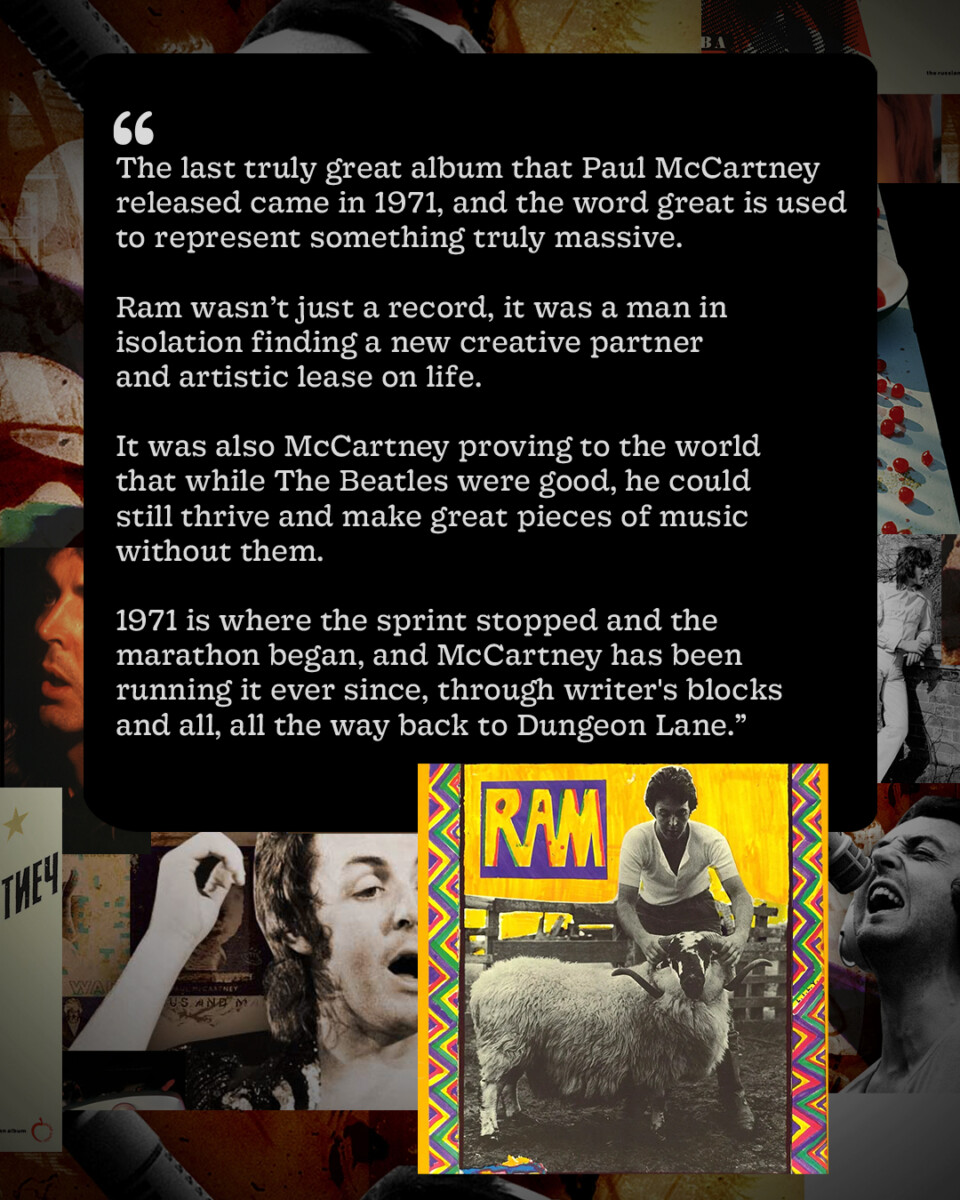
In 1971, he released Ram, a record he wrote with his wife, Linda McCartney. By the time The Beatles had gone through their messy break-up, McCartney felt as though he had lost his friends and no longer had anyone he could be creative with. The first solo album he made was aptly called McCartney, which was just him stretching his creative muscles, working entirely in isolation, and it shows throughout the record. It’s not a bad listen, but it’s not exactly McCartney at his most engaged.
He realised when making that album that he had very little intention of being a solo artist, and so started collaborating with Linda. It’s here that the idea for Wings was born, but before that, they made Ram. This is a record that sees McCartney engage with his full creative prowess once again, as he was given a new artistic lease on life. Even now, at over 50 years old, Ram still holds up against any of The Beatles’ records.
At some point, when you’re a revolutionary artist, you have to stop chasing great and start settling for good. This is no slight on those artists; it’s simply the way that the public perceives them. You can only reinvent the wheel so many times and still use it to travel from A to B. McCartney has released some bad songs, sure, but they’re few and far between. Most of what he puts out has an unmistakable air of quality to it, but after a while, the bar is set so high that everything he released from there on out was always going to either sit just below it or level to it. It was good, it wasn’t great.
“The sprint is cool – the marathon is better”.
Steve Van Zandt
Steve Van Zandt once touched upon this when talking about Eric Clapton. The E Street Band guitarist doesn’t hold back when it comes to declaring Clapton as one of the greatest six-string aficionados of all time. He always admired his ability to merge the playing styles of different generations and present it as something cohesive. However, he also recognised that at some point, Clapton had to stop being this revolutionary guitarist and start simply being a good one. Essentially, these artists who hit the ground running at exceptional speeds eventually realise that a career in music is a marathon, not a sprint.
“’Layla’ was, for me, the last time everything – the singing, songwriting and guitar playing – were all at the same high-intensity level,” said Van Zandt, “It’s Clapton’s most original interpretation of the blues because the hellhounds on his trail had a face: unrequited love.”
He continued, “He had seven years of the most extraordinary, historic guitar playing ever – and 40 years of doing good work […] Being the best has got to wear you out. So he pulled back, like Dylan and Lennon did. The sprint is cool – the marathon is better. Clapton has followed in the footsteps of his mentors: He’s become a journeyman.”
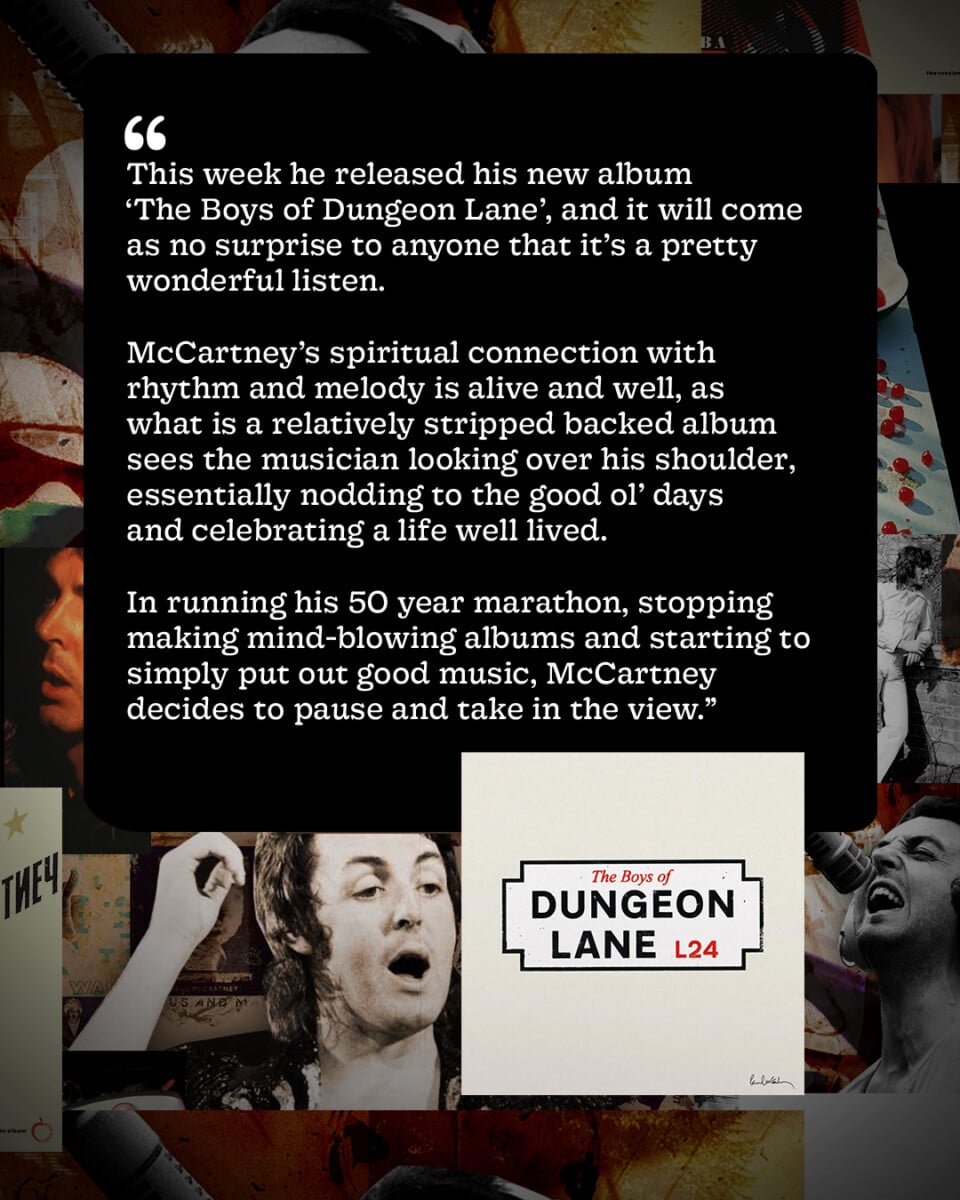
The same can be said for McCartney. Just this week, he released his new album The Boys of Dungeon Lane, and it will come as no surprise to anyone that it’s a pretty wonderful listen. McCartney’s spiritual connection with rhythm and melody is alive and well. It’s a relatively stripped-backed album that sees the musician looking over his shoulder, essentially nodding to the good ol’ days and celebrating a life well lived.
“So this next song is very much a memory song for me,” said McCartney when talking about the track ‘Days We Left Behind’. “I was thinking just that, about the days I left behind, and I do often wonder if I’m just writing about the past, but then I think, how can you write about anything else?”
In running his 50-year marathon, stopping making mind-blowing albums and starting to simply put out good music, McCartney decides to pause and take in the view. “It’s a lot of memories of Liverpool for me, and that involves a little in the middle about John, Forthlin Road, a street I used to live in, this is where the title of the album, The Boys of Dungeon Lane, came from,” he said, “Dungeon Lane is near there. I used to live in a place called Speke, which is quite working class.”
The last truly great album that Paul McCartney released came in 1971, and the word great is used to represent something truly massive. Ram wasn’t just a record; it was a man in isolation finding a new creative partner and artistic lease on life. It was also McCartney proving to the world that while The Beatles were good, he could still thrive and make great pieces of music without them. 1971 is where the sprint stopped and the marathon began, and McCartney has been running it ever since, through writer’s blocks and all, all the way back to Dungeon Lane.
“If you ever get a block, just steamroll through it and fix it later,” said the great songwriter, “Ram on!”

Never Miss A Beat
The Far Out Beatles Newsletter
All the latest stories about The Beatles from the independent voice of culture.
Straight to your inbox.