


The Cover Uncovered: George Harrison’s fresh start on ‘All Things Must Pass’

When the dawn of 1970 broke, and the individual members of The Beatles were set free, culture critics wiped their tears, accepted the new reality and desperately waited to hear how Paul McCartney and John Lennon would fare on their own.
Liberated from the shackles of their increasingly toxic relationship and given respective studio spaces to explore their own ideas, the world wondered how this new era of their songwriting would manifest, but their attention was misplaced, because while 1970 brought with it change, it didn’t come with a heightened curiosity over Lennon and McCartney’s greatness. That much was already solidified.
Instead, the focus should have been on George Harrison. In the latter years of The Beatles, the spiritual songwriter had been stifled by his more dominant bandmates and felt as though his creative awakening had nowhere to be released. It’s all the more frustrating when you realise that some of the best songs in the final releases were written by the quieter Beatle.
‘Taxman’ and ‘While My Guitar Gently Weeps’ began to shift the tectonic plates of power, showcasing Harrison as a mighty fine writer himself, before Abbey Road saw them lock into place altogether, with his announcing himself as someone who could lead the songwriting. On that final record, he delivered two songs that could feasibly be considered the album’s very best in ‘Something’ and ‘Here Comes The Sun’.
With that in mind, The Beatles’ break-up became somewhat of a blessing for Harrison and the quiet legion of devoted fans he had amassed. The 1970s beckoned, and so did an album that boasted more of that Abbey Road genius. Wasting no time to deliver it, he released All Things Must Pass in that very first year of the decade and triumphantly showcased what the band had been missing all these years.
While the record was compiled of tracks originally written for the Fabs, it serves as more than just a collection of offcuts. Once recorded individually, with the help of Phil Spector, they became the soundtrack to Harrison’s liberation from the band and full blooded immersion into his own spirituality.
Tracks like ‘Wah-Wah’ were appropriately cutting for a man freed of intra-band toxicity, while ‘My Sweet Lord’ became the rightful anthem of an artist determined to lace his music with spiritualism and philanthropy.

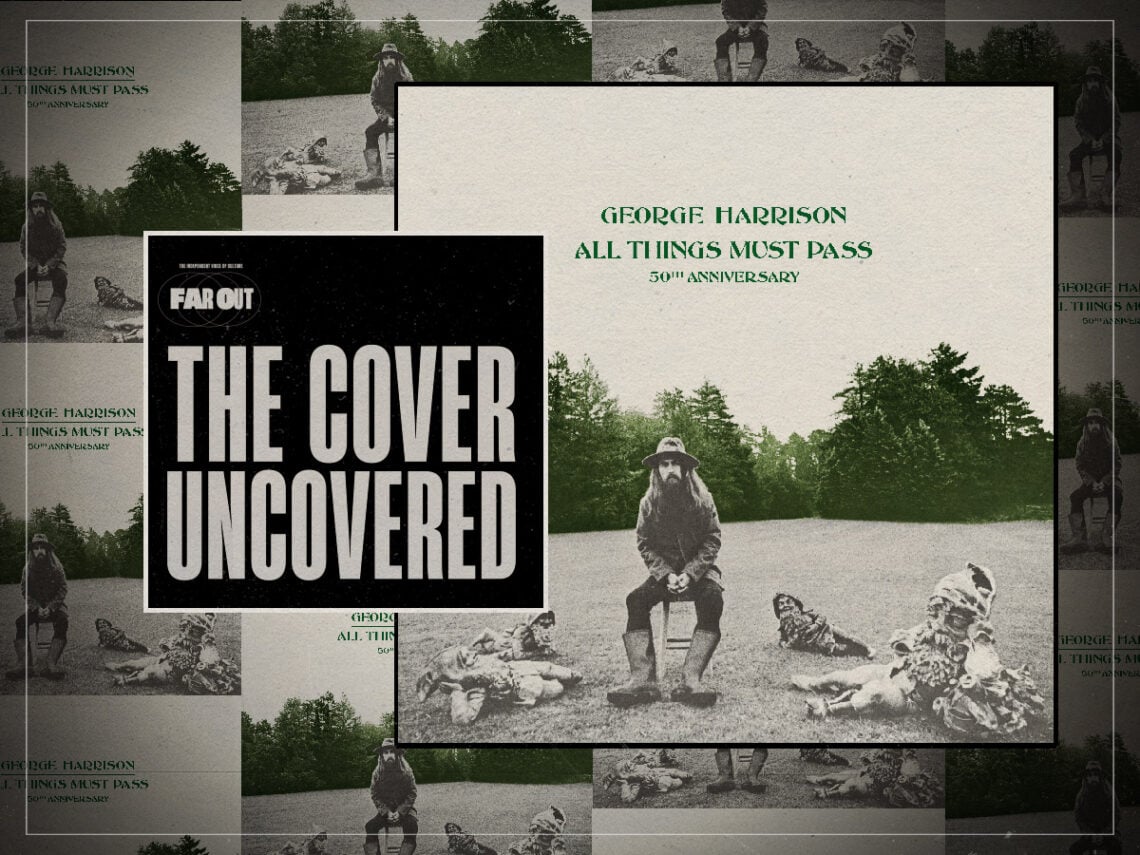
So naturally, the album needed a cover that similarly juxtaposed this idea of pointed liberation. Underneath the appropriately titled All Things Must Pass, sat a solo George Harrison, in the somewhat liberated backdrop of a garden, with four garden gnomes tumbled around him.
Shot by Barry Feinstein, this single image was designed to capture all of the narratives that swirled around Harrison’s release at the time. Firstly, there was the environment, which, according to Chris Murray, the man who co-wrote George Harrison: Be Here Now, with Feinstein himself, was the perfect place to announce a new solo, Harrison.
“George took great pleasure in gardening,” says Murray, “It made a lot of sense to me, because when people were having higher consciousness and spiritual realisations at that time through meditation, or psychedelics, or whatever, nature became such an important thing.”
Within that simple image of an at-peace Harrison sitting outside, exists so much of the spiritualism that defined his music within this record, but given the wider context, he felt as though it had to reference The Beatles in some manner and so Feinstein and Harrison decided to include the four gnomes, whimsically sitting around him, watching on as he steps forward into the limelight.
During a Q&A, he explained, “Originally, when we took the photo, I had these old Bavarian gnomes, which I thought I would put there. Like kinda… John, Paul, George and Ringo”.
But there was no animosity in how they composed that photo. Sure, being reduced to a garden gnome may have its disrespect to the average person, but through the lens of The Beatles’ playfulness, it is anything but. More importantly, those gnomes sit around a rather content Harrison, who, on this record, had finally found a sense of individuality, and so together they could all warmly buy into the mission statement of the album itself, that All Things Must Pass.

Never Miss A Beat
The Far Out Beatles Newsletter
All the latest stories about The Beatles from the independent voice of culture.
Straight to your inbox.