


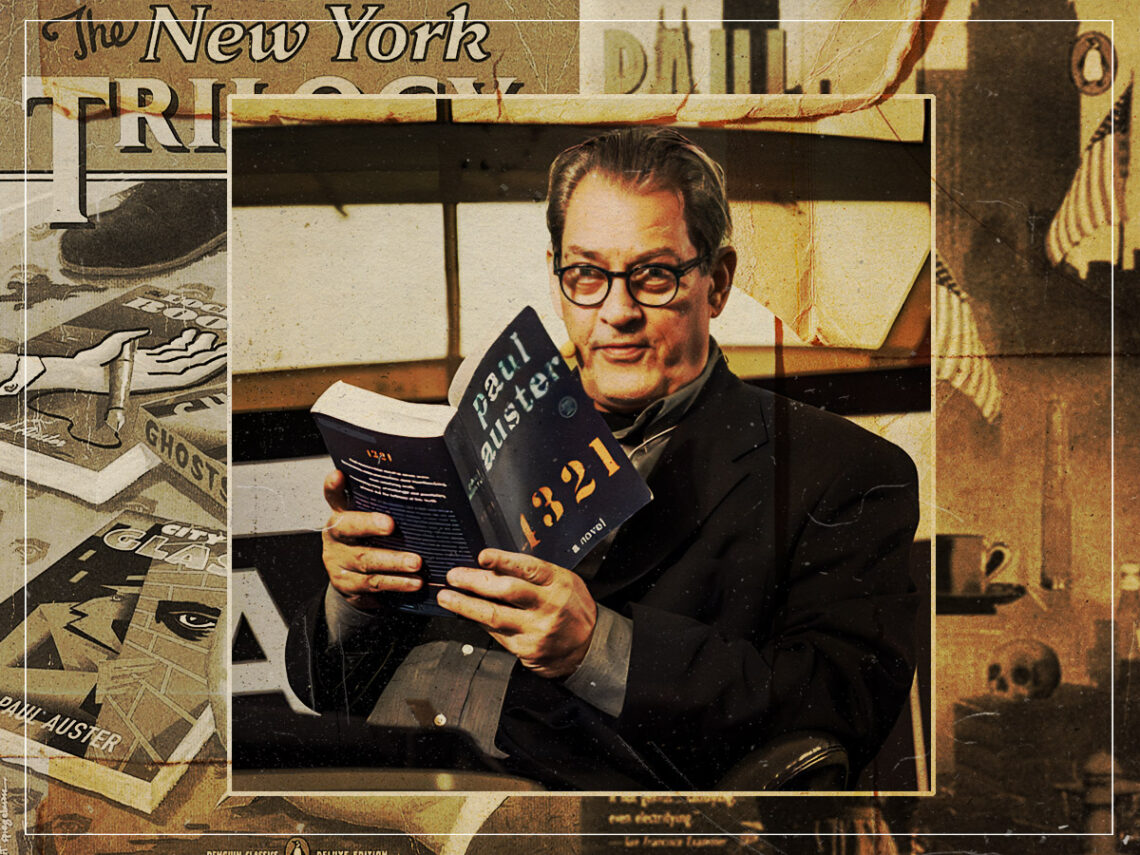
How Paul Auster subverts detective fiction in ‘The New York Trilogy’

At its core, it might seem that Paul Auster’s collection of novels The New York Trilogy – comprised of City of Glass, Ghosts and The Locked Room – is a forthright trio of stories of the detective fiction genre. Still, upon closer inspection, it’s revealed that Auster merely uses the tropes and motifs of mystery literature to explore the deeper philosophical meaning of human life.
City of Glass tells of Daniel Quinn, an author of detective fiction who becomes a private investigator, with Auster exploring the nature of identity and reality. Several mixed identities occur with an undoubted essence of the postmodernist “meta”, as in Paul Auster, a novelist character in the book, and Paul Auster, the detective guise of Quinn, while there are also two characters called Peter Stillman, whom Quinn is investigating.
While detective fiction sees an element of power in the detective and the narrator, City of Glass turns the narrative into a world of madness, whereby truth is always on the precipice of being attained and yet is always out of reach. Rather than allow Quinn to accomplish his investigation, Auster keeps him within a prison of detection, providing a rumination on the nature of identity.
Ghosts also sees its protagonist, Blue, descend into an existential nightmare. Tasked with following and detailing the actions and movements of a man called Black, Auster asks his audience to consider how our lives are defined by the mundane tasks we complete daily and how our comparisons with others are often our undoing. Blue’s realisation at the end of Ghosts is one that had him confront his dreamlike reality in the world, whereby his life is shown to be non-sensical, despite it occurring within a detective story, where information is typically meant to add to normative understanding.
The trilogy is completed by The Locked Room, in which Auster tells of a young man who investigates the disappearance of his childhood friend, Fanshawe. There’s a blurring of reality and fiction present, one that comes to light when the protagonist explores the unpublished writing work of Fanshawe, discovering that he seems to be a character within the fictive world.
Without a doubt, Auster provides a postmodernist reimagining of detective fiction, and by subverting its central trope of the relationship between clue, journey and discovery, the author can weave metatextual narratives that explore the madness of identity. The persons we so happen to be are understood to be transient instead of permanent, and our lives are defined by the infinite number of possibilities that could happen to us, as Auster’s protagonists duly discover.
In an interview with Literary Hub, Auster admitted that while detection plays a crucial role in The New York Trilogy, he doesn’t accept that it falls into the detective fiction genre. Discussing the work’s origins, he said, “The idea of a wrong number intrigued me, and because it happened to concern a detective agency, it somehow seemed inevitable that my story should have a detective element to it.”
“It’s not in any way a crucial part of the story, and it was always irritating to me to hear these books described as detective novels,” the author added. “They’re not that in the least.” Indeed, The New York Trilogy is not about detection nor mystery but instead uses the genre to explore the deeper meaning of solipsistic human life.
Auster’s debut work of fiction deconstructs detective fiction, language and literature itself to detail what it is to be a human being and what it means to actually write fiction. Novel writing is akin to a mystery in its own right, with endless layers of truth demanding to be linked to one another while allowing readers to piece together a story’s meaning of their own accord.
In that light, The New York Trilogy is the work of a master author in complete control of his medium despite its existentially anxious nature. In diving into the strange worlds of its protagonists where fiction and reality collide, Auster invites us to evaluate our own lives and become the detectives of our identities. Human life itself is uncertain – Auster has often examined the nature of fate in many of his other works – but by confronting that very uncertainty, we can hopefully come to better know ourselves and see the precarious world in which we live with just a shade more clarity.
