


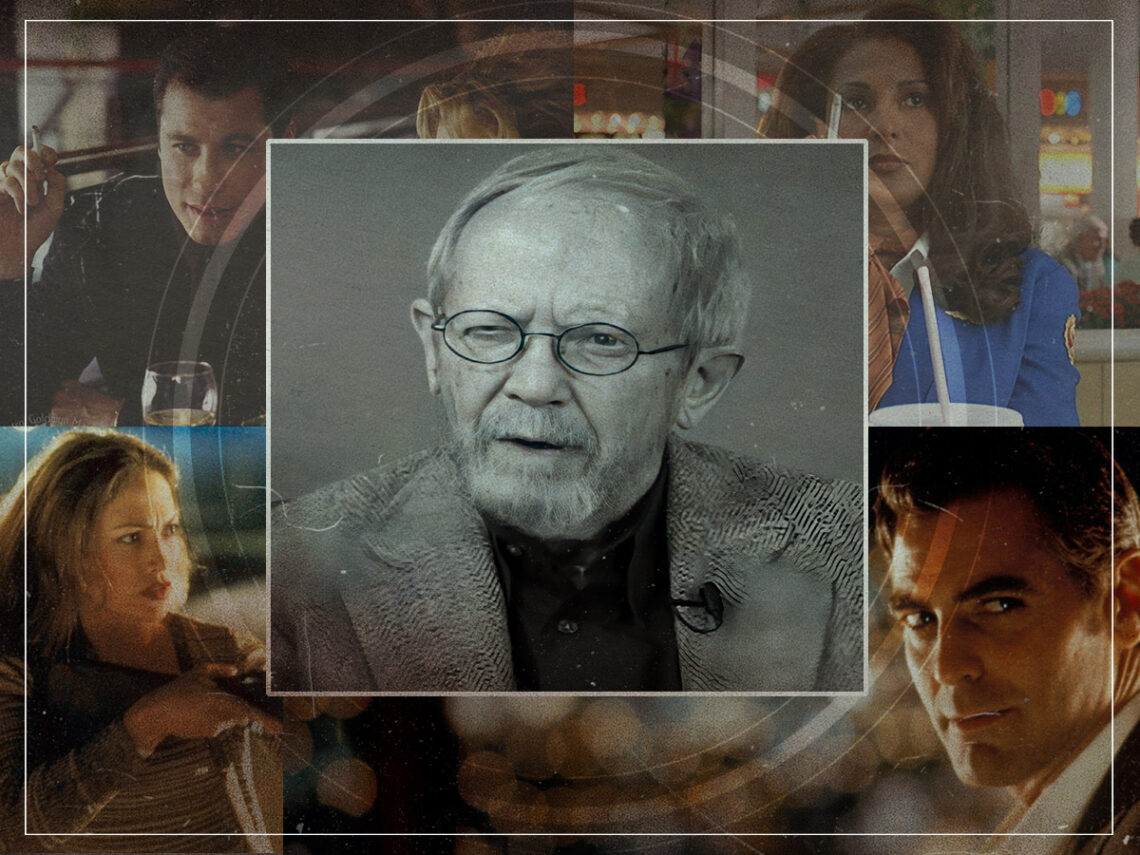
Criminal obsession: The three years Elmore Leonard ruled Hollywood

Sometimes called the “Dickens of Detroit”, Elmore Leonard was one of the most significant names in the world of American crime fiction, having delivered a series of novels that possessed intense narratives, characters that leapt off the page, and dialogue that could at once shock and titillate.
Leonard simply understood the importance of using everyday speech within his stories, which gave them a deep sense of authenticity and led to a widespread fanbase and following. Through detailing the underground occurrences of criminals, con artists and antiheroes, Leonard created gritty worlds that kept his readers on tenterhooks.
As is often the case with many of the best writers, Leonard’s works were considered good money for film adaptations and his short story 3:10 to Yuma was adapted into a widely celebrated 1957 movie version, as were the likes of The Big Bounce, Hombre and Stick. However, few periods of cinema relied on Leonard as much as the years 1995 to 1998 in Hollywood.
It was during that time that three well-regarded movies based on Leonard’s work were all released, proving a sudden interest in the legendary crime writer’s work. It all began with Barry Sonnenfeld’s gangster comedy film Get Shorty, starring John Travolta, Gene Hackman, Rene Russo and Danny DeVito, telling of a Miami gangster who finds himself involved in a Hollywood feature film production.
A couple of years later, Quentin Tarantino followed up on his early Reservoir Dogs and Pulp Fiction success with Jackie Brown, which was based on Leonard’s 1992 novel Rum Punch. Pam Grier stars in the titular role of a flight attendant who smuggles drug money between Mexico and the United States, and the film boasts supporting performances from the likes of Samuel L. Jackson and Robert De Niro.
Then, in 1998, Out of Sight, the crime comedy film directed by Steven Soderbergh, also serving as the first of many collaborations between the director and George Clooney, was released. It tells of a career bank robber who breaks out of jail only to experience a romantic connection with the US Marshall he has kidnapped. Michael Keaton ended up reprising his character from Jackie Brown in a moment of Leonard cultural melding.
In an interview with Entertainment, Soderbergh opened up about the difficulty of adapting Leonard. “The trick with dealing with Elmore Leonard as an idea is not to try and copy him,” the director said. “That’s where you get into trouble. In the case of Out of Sight, there’s a significant amount of new material in the screenplay that doesn’t exist in the book.”
Soderbergh went on to explain how Out of Sight’s screenwriter, Scott Frank, who also wrote Get Shorty, was able to masterfully capture Leonard’s authorial voice in the films. “Scott Frank’s great accomplishment was his ability to recreate Leonard’s voice in a very seamless way,” he said. “Now, Scott had adapted Get Shorty years before and brought a pretty significant skillset to the table.”
Though Leonard’s works had indeed been adapted before, it was the mid-late 1990s that proved a sudden cultural fascination with his stories. The ’90s in Hollywood was indeed a time rife with crime stories in cinema, and it’s more than understandable that screenwriters and producers suddenly turned to one of the genre’s masters for inspiration and direct narratives.
The truth is that each of the Leonard films was of high quality, too. Jackie Brown remains one of Tarantino’s best and most unique works, and Soderbergh’s Out of Sight earned an Academy Award for ‘Best Adapted Screenplay’. The talent on offer across the three films, which each boast a terrific cast, proves that actors simply wanted to be involved in Leonard’s adaptations, so far-reaching was his influence.
In addition, each of the films varies somewhat despite having a similar subject matter of criminal dealing gone wrong, which shows Leonard himself to have been an extremely versatile writer rather than a one-dimensional one. Leonard’s name subsequently exploded in bookshops following the respective films’ release, and his excellent crime novels suddenly found a swathe of new younger fans.
Prior to the 1990s, Leonard had been considered a true master of crime fiction, but by the time the decade finished, he’d become a key proponent of adaptive cinema, too. The respective brilliance of Get Shorty, Jackie Brown and Out of Sight all have come indirectly from the mind of Elmore Leonard, the American writer who has forever woven himself into the rich history of American cinema itself.
