


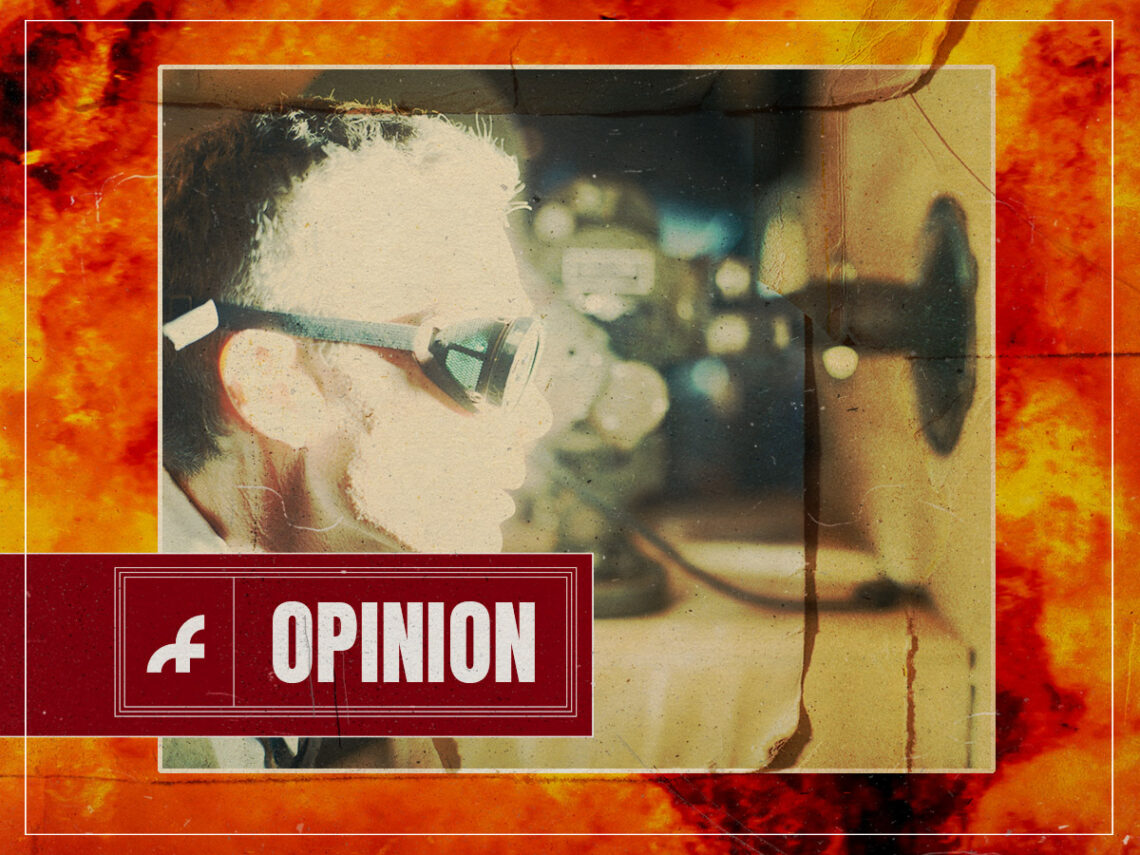
Hear Me Out: The ‘Oppenheimer’ explosion should have used CGI

When it comes to spectacular cinematic vision, only a few filmmakers can hark back to the golden age of Stanley Kubrick and Steven Spielberg, namely Christopher Nolan and Denis Villeneuve. Cinematic purists, such as those aforementioned directors, often shoot on film and place the sanctity of the moving image on a pedestal, prioritising the spectacle of the theatre experience while stripping back an over-reliance on computer-generated effects that have been detrimental in the progress of the contemporary art form.
Such filmmakers most certainly still toy with CGI, but both Nolan and Villeneuve often play down the importance of it in their movies, with the latter using an abundance of miniatures where possible throughout his adaptation of Dune. Meanwhile, Nolan opted to be a stickler for analogue cinema, revealing that no CGI shots were used at all in the making of his latest star-studded biopic about the creator of the atomic bomb, J. Robert Oppenheimer.
While any other biopic, which essentially retreads the ground of reality, would not need CGI in large quantities, Nolan’s film faced a variety of challenges if it was to use strictly practical means of cinematic grandeur. After all, it wasn’t like Nolan could simply drop and film the explosion of an atomic bomb for his Hollywood flick, even if stranger things have happened in the pursuit of art.
“Recreating the Trinity test without the use of computer graphics was a huge challenge to take on,” the director stated when promoting the film before its billion-dollar box-office success in 2023. Continuing, he added: “Andrew Jackson – my visual effects supervisor, I got him on board early on — was looking at how we could do a lot of the visual elements of the film practically, from representing quantum dynamics and quantum physics to the Trinity test itself … there were huge practical challenges”.
But let’s not forget, Nolan isn’t exactly a martyr for the cinematic cause, with the majority of his spectacular flicks using an abundance of CGI, and while Oppenheimer didn’t need such digital attention, it could have done with a hand during the much-discussed Trinity test scene.
Coming at the end of the second act of Nolan’s three-hour epic, the scene shows the very first time the atomic bomb was properly tested at the military base in Los Alamos, New Mexico, during WWII. The culmination of two hours of densely packed cinema and years of real-life effort back in the 1940s, this scene is the focal point of the movie, where the moral quandary of the title scientist lies and where the violence of a nuclear future stems.
There is, indeed, a responsibility to bottle such a sequence with all the anxieties, violence and existential fear that the thought of nuclear warfare brings, and instead of ensuring the existence of such feelings, Oppenheimer’s ‘bang’ is something of an anti-climax. While it should be noted that the soundscape well allocates this guttural terror, the visuals feel like the product of an indie film trying to recreate a ‘massive explosion’ with minimal resources.
The final result is acceptable but doesn’t quite match up with the reaction of the various army officials and scientists who watch on in jubilation and bewilderment. After all, the distant explosion looks similar to that of a mere oversized hand grenade. While such makes for a curiously underwhelming pivotal scene, it also speaks to a disrespect regarding the sheer impact of the weapon of mass destruction itself and, arguably, of the victims, with the US army going on to kill between 129,000 and 226,000 people when they dropped the bombs on Hiroshima and Nagasaki in August 1945.
CGI could have, quite easily, been used to replicate the sheer size and impact of the bomb, with countless cheaper movies having used similar effects in the past to a great degree of realism. Such a choice would have given the scene the weight it deserved and would have provided the remainder of the film with real gravity to the substance of Oppenheimer’s moral quandaries.
For a comparison, just consider the vision David Lynch achieved during ‘Part 8’ of Twin Peaks: The Return, creating an unbearable vision of the same Trinity test using CGI that took us directly into the heart of darkness. Drawing a strange number of parallels with Nolan’s film in how the atoms and particles are pictured furiously dancing around one another, Lynch manages to swirl a tempest of anxiety, drama and violence, transporting us into a new reality where chaos reigns, and humanity is at the will to the omnipotence of scientific might.
Purposefully avoiding the use of CGI as if that gave him some sort of bragging rights, Nolan’s inability to harness the power of visual effects to convey the impact of one of modern history’s most significant moments demonstrates his shortcomings as a filmmaker. For a director who is usually so effortlessly proficient at exploiting cinema’s every bell and whistle, his Oppenheimer centrepiece comes up embarrassingly short.
