


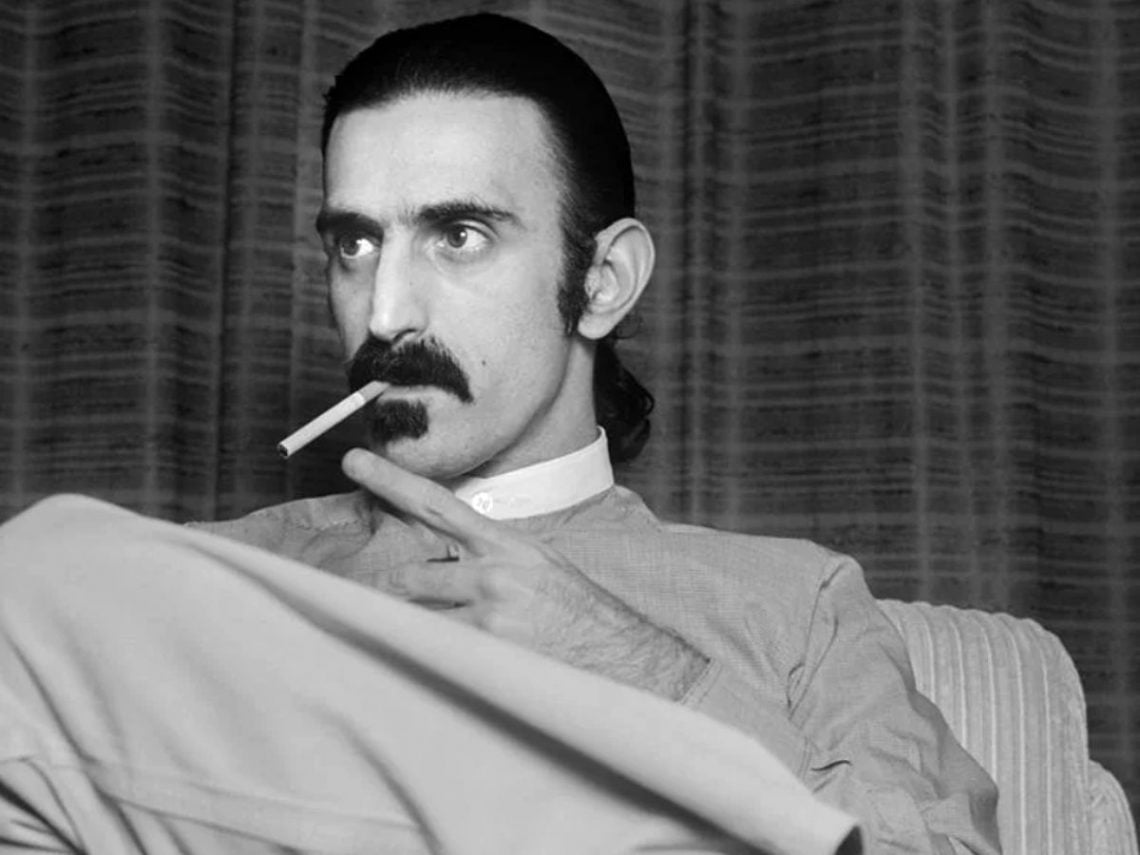
The only band Frank Zappa seemed to genuinely admire: “I’d give it a 98”

Frank Zappa didn’t become an iconoclast to make a stir among the loving music scene of the 1960s—his shunning of the rose tint on so many rock glasses was far more natural than that.
It appears that he was simply born with contrarian taste and not a lot of care to begin with. Thus, in the era of peace and love, there was only one song he greatly admired, and it just so happened to be the ultimate counterculture anthem: Bob Dylan’s ‘Like a Rolling Stone’.
“When I heard ‘Like a Rolling Stone’,” Zappa told the writer Clinton Heylin, “I wanted to quit the music business.” That is quite a statement considering that when it was unleashed in July 1965, Zappa was yet to release an official studio album, and he would go on to grace us with 62 of his own.
He continued: “I felt [that] if this wins and it does what it’s supposed to do, I don’t need to do anything else.” The song heralded the same sort of mirror to the world and societal incision that Zappa would champion throughout his career. Filled with wry disdain, Dylan purveyed the scene that he was privy to and offered up some soulful damnation while casting a spiritual life ring into the choppy waters that the song wades through.
That sardonic way of spearing culture is something that Steely Dan would soon make a living out of. With that in mind, it perhaps isn’t all that surprising that the like-minded Zappa was a fan of their work while a million other artists failed to gain his dismissive approval. “They’re one of my favourite groups,” he proudly told Rolling Stone in 1974 in a brief break from playing with the media.

That kind of praise was exceptionally rare coming from Zappa. Throughout his career, he was famously dismissive of most mainstream rock acts, often criticising musicians for being creatively stagnant or intellectually shallow. Even many of the biggest names of the era failed to impress him, which made his admiration for Steely Dan stand out all the more. He recognised in Becker and Fagen the same refusal to simplify their music purely for commercial appeal.
There was also a perfectionist streak that linked both camps together. Steely Dan became notorious for obsessing over studio precision, cycling through elite session musicians until every chord change and rhythmic accent landed exactly where they wanted it.


Zappa operated with a similarly uncompromising mindset, expecting near-impossible standards from the musicians in his orbit. Beneath the sarcasm and absurd humour, both artists approached composition with the mentality of jazz arrangers rather than traditional rock stars, which explains why the mercurial musician saw something kindred in Steely Dan that he rarely found elsewhere
However, he wasn’t just interested in their wonderfully wry scathing nature—the Dan, like Zappa, were experts at weaving avant-garde influences into their work to bring a new dynamic to pop. While on the surface Steely Dan might sound like lounge-laden toe-tappers, a study of their musicology betrays the central tenet of jazz. In essence, even the simplest Steely Dan tune always proves surprisingly hard to play with a slew of tweaked chords and wavering time structures thrown in as casually as maracas in a Happy Mondays track.
So, Zappa opined, “I like their modality, their melodicism. Their lyrics aren’t bad in that vein they’re working, that downer surrealism,” which in truth is a close neighbour to Zappa’s subversive absurdity. He concluded: “As relaxing listening music, I’d give it a 98. One person in our band, Ruth Underwood, would give them about a 120. She really fetishes them. She’s usually got their cassette rammed into her ear.”
That might show in Underwood’s melody-driven percussion, but the influence of Zappa is readily apparent in Steely Dan’s work too, proving to be an ironic love-in among the sarky acts. “When Walter [Becker] and I met, we had a constellation of enthusiasms,” Steely Dan frontman Donald Fagen recalled. “Science fiction, jazz, black humour, novels by Thomas Berger, Terry Southern, Philip Roth, Vladimir Nabokov, Kurt Vonnegut, especially. That certainly influenced the lyric writing.”
Continuing: “We also liked comic songwriting, like Tom Lehrer. He was a piano player and songwriter who wrote these grim, funny songs. And then we were both fans of Frank Zappa and the Fugs.” Their use of humour as a way of not only alleviating the hardships this world inflicts but also illuminating them was a key factor that turned the jazzy duo into their work. Zappa could make you laugh with a ridiculous track that actually conveys the ‘beware of all poseurs missing the point’ message of ‘Like a Rolling Stone’ in technicolour idiocy.
In fact, Zappa was the main source of Becker and Fagen’s desire to colour their songbook with comedy. “The only comic rock and roll I remember was Frank Zappa, really,” Fagen said. “The Fugs were comic also, but their music was so primitive. I remember the Fugs used to play free in Tompkins Square Park in the 1960s, and at one point, they were really the kings of the Lower East Side.”
That Lower East Side had seen it all come and go and was happy to wallow in the gutter of world-weary hard-knocks, a few reality trips away from the usual platitudes of peace and love residing a few postcodes closer to Tin Pan Alley, a stupid street that the silly Steel Dan and zany Zappa had no intention of wandering towards.
