


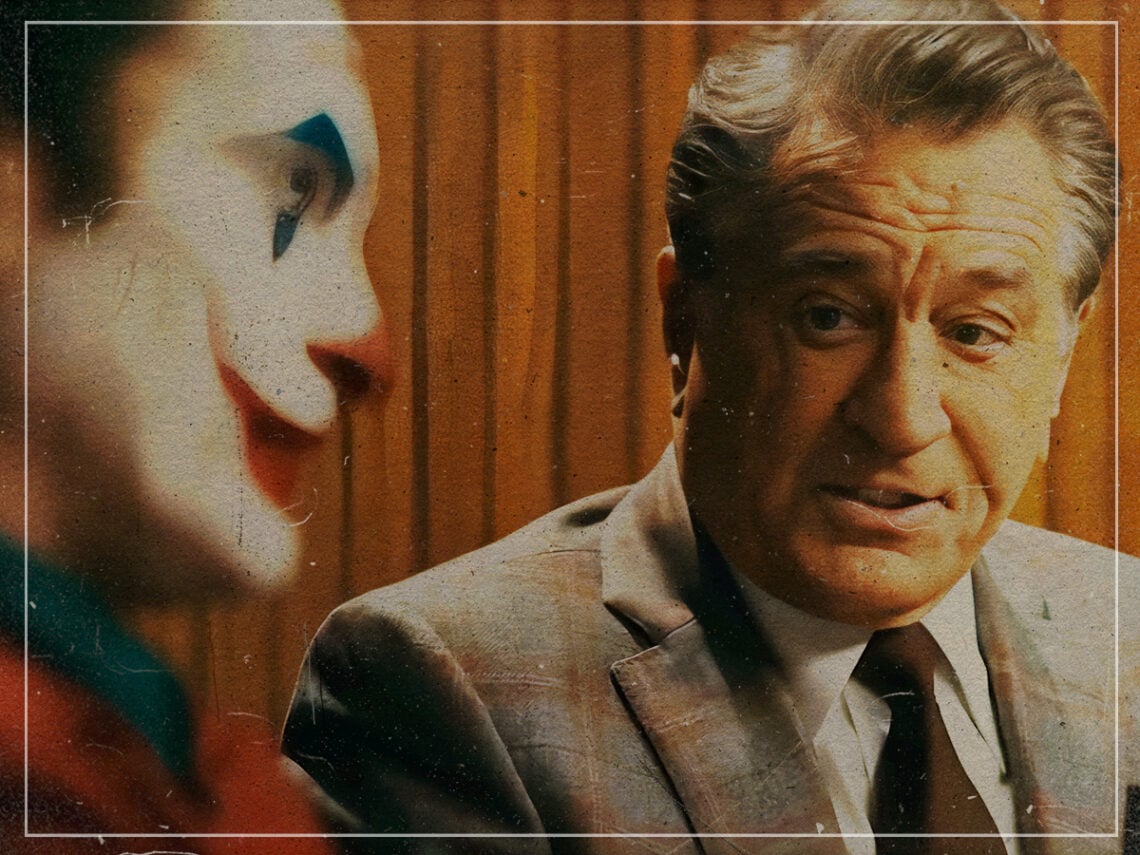
Everyone’s a clown: the entirely one-sided affair between Martin Scorsese and Todd Phillips’ ‘Joker’ movies

It’s clear to anyone who’s seen Todd Phillips’ Joker that outside of DC Comics, the single biggest influence on the movie is Martin Scorsese. Nobody’s really tried to hide it, but there’s an air of desperation that comes from pandering so heavily to an icon who couldn’t care less in the grand scheme of things.
As the single highest-grossing R-rated movie in the history of cinema, the Academy Award-winning comic book adaptation is clearly a very popular film. Joaquin Phoenix deserved his ‘Best Actor’ flowers for yet another transformative performance, but Joker wouldn’t exist at all or carry the thematic undertones that it did were it not for Scorsese’s back catalogue.
The easiest way to describe the comic book psychological thriller to anyone who either isn’t interested in watching it or has been living under a rock since October 2019 is that it’s essentially the result of what would happen were Taxi Driver‘s Travis Bickle parachuted into The King of Comedy, with Robert De Niro along for the ride to further the unsubtle and innumerable Scorsese influences.
Not that Phillips has ever shied away from the comparisons, though, with the legendary filmmaker always being named as one of the biggest inspirations behind the project. Scorsese was even loosely attached to Joker as a producer, too, but he ended up washing his hands of it to such an extent he hasn’t even bothered to get around to watching a massive smash hit that bears so much of his DNA.
It wouldn’t be unreasonable to believe his famous distaste for superheroes has played into his thinking, but the dynamic between Scorsese and Joker has always seemed like that of an infatuated would-be love interest who continually leaves flowers at the door, only for the object of their affection to sit idly by and let them wither on the doorstep.
When asked why he flirted with producorial duties before jumping ship, The Departed architect was typically forthright about it. He simply said he “didn’t have time for it,” although he did admit the character’s origins were something he could never get on board with. “For me, ultimately, I don’t know if I could make the next step,” he said. “Which is to this character developing into a comic book character.”
Gone but not forgotten, then, Scorsese’s spirit was still present in virtually every frame of Joker. Having become the most obvious touchstone for an Oscar-winning billion-dollar hit, what did he make of the finished feature? Nobody knows, because he didn’t get around to seeing it in full. “I saw clips of it,” he informed The New York Times. “I know it. So it’s like, why do I need to? I get it. It’s fine.”
Instead of acting like a spurned and jilted lover, Phillips has instead doubled down on singing from the Scorsese songbook, quite literally in the case of the upcoming sequel Joker: Folie à Deux. Heavily touted as a romantic musical fantasy with a musical element, it doesn’t require six degrees of separation to get from Phoenix’s Arthur Fleck and Lady Gaga’s Harley Quinn belting out showstoppers as star-crossed lovers to De Niro and Liza Minnelli in New York, New York.
If anyone wants to dig a little deeper, then consider the ‘Clown Prince of Crime’ first meets his paramour within the confines of Arkham Asylum per their shared history on the printed page. Based on what happened in the first film, there’s a distinct possibility the entire romance – and its subsequent song-and-dance numbers – could be taking place entirely within the Joker’s mind. Has Scorsese ever directed a movie where a troubled main character gradually discovers they’re trapped in a reality of their own making while being held in a psychiatric facility? Of course, he has, it’s called Shutter Island.
There’s nothing wrong with using one of the industry’s most revered creative minds as a repeated influence, but Scorsese has showcased such a complete and utter disinterest in anything even remotely Joker-related that the love affair has become so one-sided it’s hovering perilously close to desperate. If the online phenomenon of the ‘pick-me girl’ had a cinematic equivalent, then it might just be Phillips and the ‘Jester of Genocide’ taking such a hagiographic approach to Scorsese, only to see it falling on deaf ears.
