


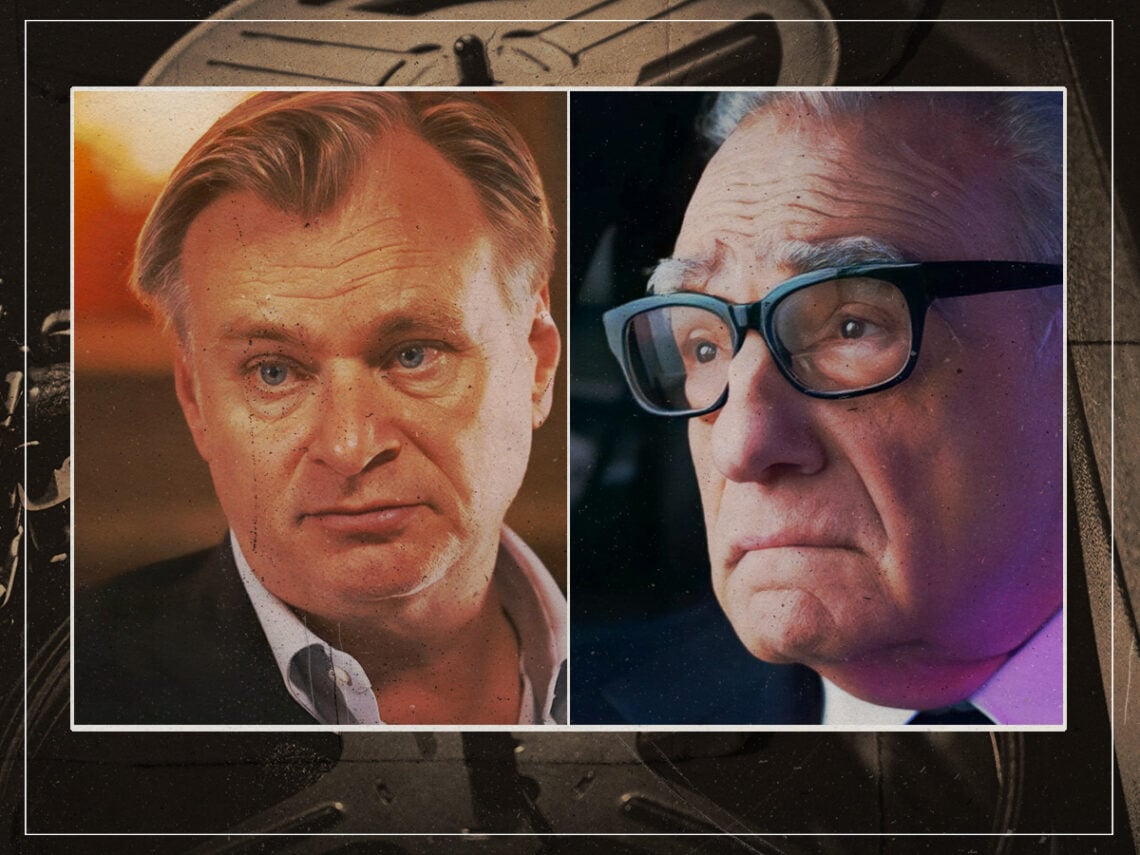
A necessary evil: Why Christopher Nolan and Martin Scorsese disagree on the merits of superhero movies

There’s a not-insignificant level of irony in Martin Scorsese calling upon Christopher Nolan to save the film industry from the perils of the superhero genre, and it’s not just because it’s an arena that helped transform the latter into the Hollywood powerhouse he is today.
That was definitely the case, though, with the overwhelming success and acclaim to greet the Dark Knight trilogy cementing Nolan’s evolution from a supremely talented writer and director to somebody with levels of freedom and autonomy – both creatively and budgetary – that few in Hollywood can ever dream of attaining.
In addition to his three-film stint helming Batman blockbusters, Nolan hailed Zack Snyder’s Watchmen as being ahead of its time, developed the story and produced Snyder’s Man of Steel, executive produced both Batman v Superman: Dawn of Justice and Justice League and called Robert Downey Jr’s decade-long stint as the Marvel Cinematic Universe’s Iron Man “one of the greatest casting decisions in the history of movies”.
That isn’t somebody who peers down the comic book adaptation with resentment, even though he and Scorsese exist on a similar plane. They’re both among the finest directors in the industry, they’ve got Academy Awards for ‘Best Director’, they’ve helmed ‘Best Picture’ winners, and their name alone is often more than enough to secure the green light for any project of their choosing.
However, they’ve recently been experiencing vastly different commercial fortunes, which gives off the impression that Scorsese is feeling increasingly backed into a corner and left behind by the continued dominance of franchise fare. His last five features have cost roughly $750million to produce but haven’t come anywhere close to recouping those numbers at the box office, even if an asterisk should be placed next to Netflix exclusive The Irishman and the Apple-backed Killers of the Flower Moon.
Nolan, meanwhile, has racked up a similar level of production costs across his most recent quintet, which have conspired to earn close to $3.5 billion. In the grand scheme of things, Marvel Studios has earned significantly more than both of their illustrious filmographies combined, but whereas Scorsese continues to rail against it as the death of cinema and the crushing oppression of art in the name of commerce, Nolan appreciates them for what they are; a necessary evil.
Speaking to the Associated Press, the Oppenheimer steward explained how “a healthy ecosystem in Hollywood is about a balance between the two things and always has been” when asked for his position on Scorsese’s repeated railings against spandex-clad crimefighters. It’s “always been a big part of the economics of Hollywood” that nobody can really do anything about on a grassroots level to incite a sea change, but on the other hand, “it pays for lots of other types of films to be made and distributed.”
Of course, that doesn’t strictly apply to Marvel and parent company Disney, but other major studios like Warner Bros, Paramount, Universal, 20th Century, and Sony rely on their biggest properties – including DC Comics, Transformers, Fast & Furious, and Spider-Man – to generate maximum revenue that eventually trickles further down the ladder and gives rise to smaller, auteur-driven projects.
To illustrate that point, of the last 30 movies to have been nominated for ‘Best Picture’ at the Oscars, 16 of them have either been produced or distributed by one of the aforementioned outfits or a subsidiary, which includes Nolan’s Oppenheimer and Scorsese’s Killers of the Flower Moon. Superheroes have been the most lucrative game in town for more than 20 years at that point, and that’s something that’s not going to change unless the bubble bursts in spectacular fashion.
Nolan appreciates it for what it is; a means to put butts in seats, bring in billions of dollars in ticket sales, and keep the industry ticking along through trickle-down economics. Scorsese, however, continues struggling to reconcile with the changing tastes of audiences and the difference between what an ‘event movie’ was 20-30 years ago and what it is now. There’s a happy medium and a middle ground to be found, and to round things off with another twist of irony, it’s one that both of them continue to play in despite everything that goes on around them and their opposing views on the matter.
