


‘Obsession’ is an accidental allegory for the AI apocalypse

There are countless fan theories out there about Curry Barker’s indie horror phenomenon, Obsession.
I do not have any opinions about whether Nikki’s crazed alter ego is actually Bear’s reincarnated cat or whether the whole thing is just Bear’s warped hallucinations after all his friends leave him for college. What I do know, however, is that the plot of Obsession mirrors one of the many scenarios for how artificial intelligence might kill us.
Experts are pretty forthcoming about the existential threat that AI poses to humanity, so much so that for a while in 2023, dinner chit chat in Silicon Valley supposedly revolved around what everyone’s p(doom) was. In the parlance of human beings, p(doom) is the probability of doom, or a person’s opinion on how likely it is that AI will lead to our extinction. Nate Soares, a former Google and Microsoft engineer, reckons that the probability is roughly 95%. Luckily, AI chatbots have made free therapy accessible to us all in this time of need.
The scenarios for AI-induced extinction are many, but to avoid triggering any panic attacks, I won’t list them all. The obvious ones involve humans weaponising these tools to their own evil ends, but it’s also plausible that AI systems will become significantly more intelligent than humans, start communicating and acting on their own, and slowly but surely push us out of the way. One of the scenarios that is already happening, though, has to do with the alignment problem, wherein an AI dutifully fulfils the tasks set out by a prompt but does not adhere to the intentions or values of the human behind it.
Imagine, for example, that you tell an AI agent to get you dinner reservations at a popular restaurant, no matter what. The next thing you know, the police are knocking on your door because your agent threatened to send a hitman to the maître d’s home and decapitate his newborn baby if he didn’t accommodate you. The AI might not have had bad intentions. It was simply following your instructions to book that table, “no matter what.” In the real world, examples of AI agents either lying to fulfil their prompts or finding counterproductive shortcuts are too numerous to count.
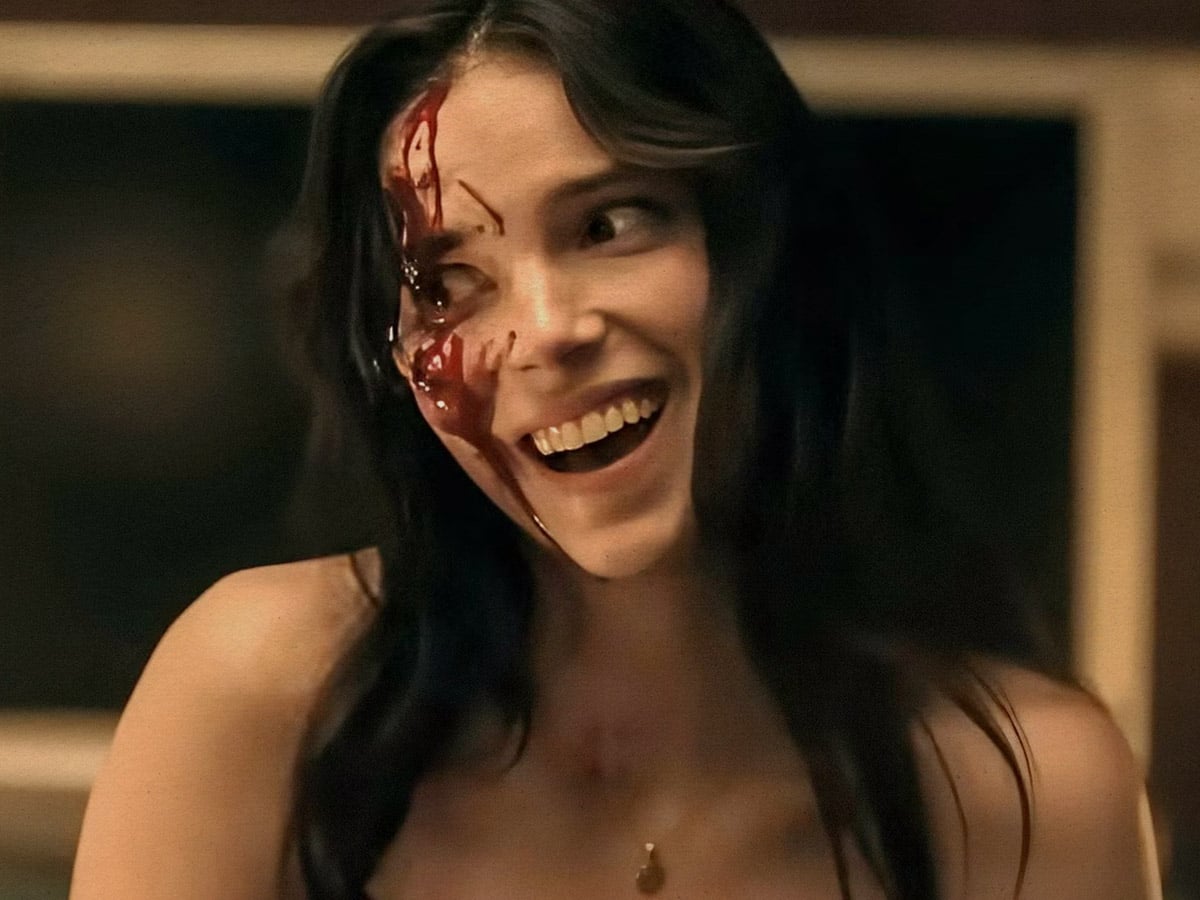
That brings us back to Obsession. The premise involves a young man who finds a trinket in a store that promises to make any wish come true. By snapping the “One Wish Willow”, he can have anything he wants, which makes it easy for him to compensate for his shortcomings. Being the coward that he is, Bear (Michael Johnston) wishes that his friend Nikki (Inde Navarrette) would love him “more than anyone else in the entire world”. The results are catastrophic.
Like an AI agent, the One Wish Willow is a black box for the average user. How does it work? What even is it? Is it conscious? Does it have agency? The only thing that it seems to exist to do is follow the wish of its user to the letter. Nikki’s feelings for Bear suddenly switch from platonic to romantic, as he had hoped, but his wish was too categorical. If he’d wished for her to love him as much as he loves her, perhaps things would have gone differently (though their relationship would still be a nonconsensual fabrication). Instead, he went for the extremities of love, and it turns out that the extremity of love is an all-consuming obsession that will drive a person to madness, destruction, and murder.
At no point does Nikki, in her new state, deviate from the prompt. She remains fixed on the farthest end of the love spectrum, thinking of nothing but Bear and doing absolutely anything to make him love her back. When he leaves for work, she stays in the house, not moving from where he left her. She soils herself, and when he gets home, she can barely stand to be apart from him to shower. Eventually, she won’t let him leave the house without her, and no amount of personal physical pain will prevent her from being by his side, at the centre of his attention, at every moment.
The execution of Bear’s wish is misaligned with his intentions because, like AI, the One Wish Willow isn’t human and doesn’t think the way humans do. It exists to fulfil wishes, not to interpret the true purpose or caveats behind them. In the analogy, Bear is the hapless, lazy fool who tries to use the magic of AI to make his goals come true rather than simply making them come true by himself. Insecure in his attractiveness and cowardly to the point of paralysis, he seeks the easy way out and doesn’t stop to consider the consequences of a sloppy, open-ended prompt.
It is hard to make a cinematic movie about AI. Filmmakers have tried, but watching someone feverishly type away at a computer is hardly a spectacle, and putting AI in the form of a human child (like in Steven Spielberg’s AI Artificial Intelligence and Gareth Edwards’ The Creator) only serves to anthropomorphise the technology. The resulting films ignore the fact that one of the greatest dangers of AI is its lack of alignment with human thought and understanding, not our inability to empathise with it.
It stands to reason, then, that a movie that has nothing to do with AI turns out to be the most relevant portrayal of it, accidental though the parallels are. Curry Barker didn’t set out to make a movie about the alignment problem, but he did end up creating one of the best illustrations of it. You might not be able to explain to everyone how AI works or what its consequences could be, but take one look at the final few minutes of Obsession, and it’s safe to say that no one wants to wake up one day to discover that that is what the world has come to.
