


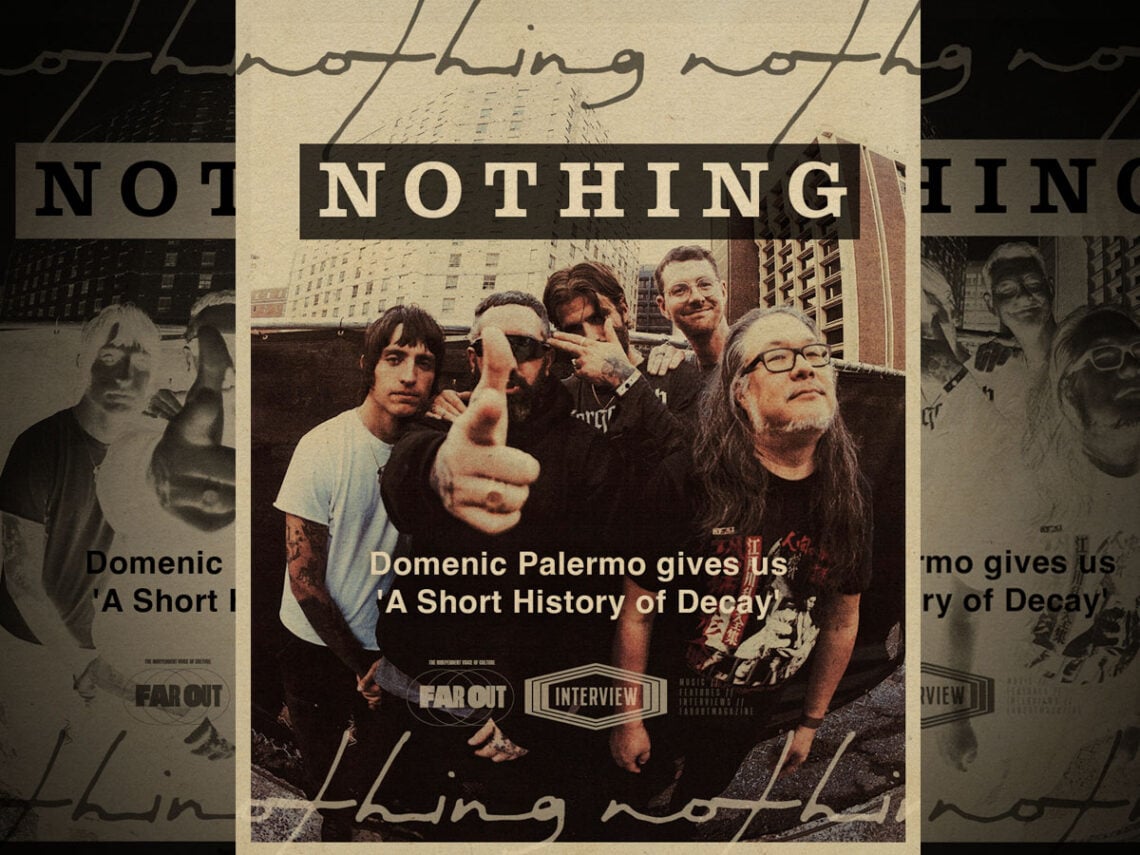
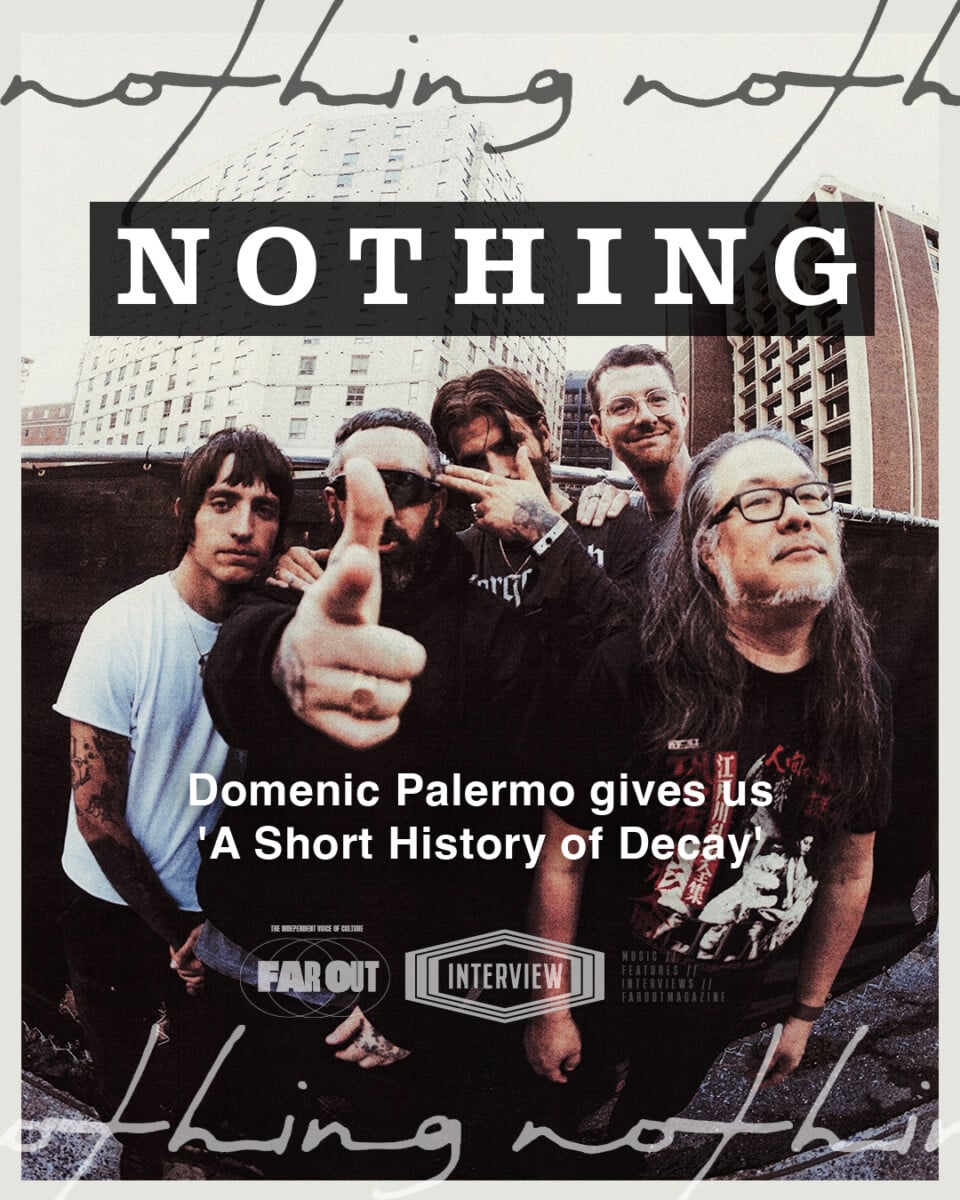
“If it can happen, it will to us”: Nothing’s Domenic Palermo gives us ‘A Short History of Decay’

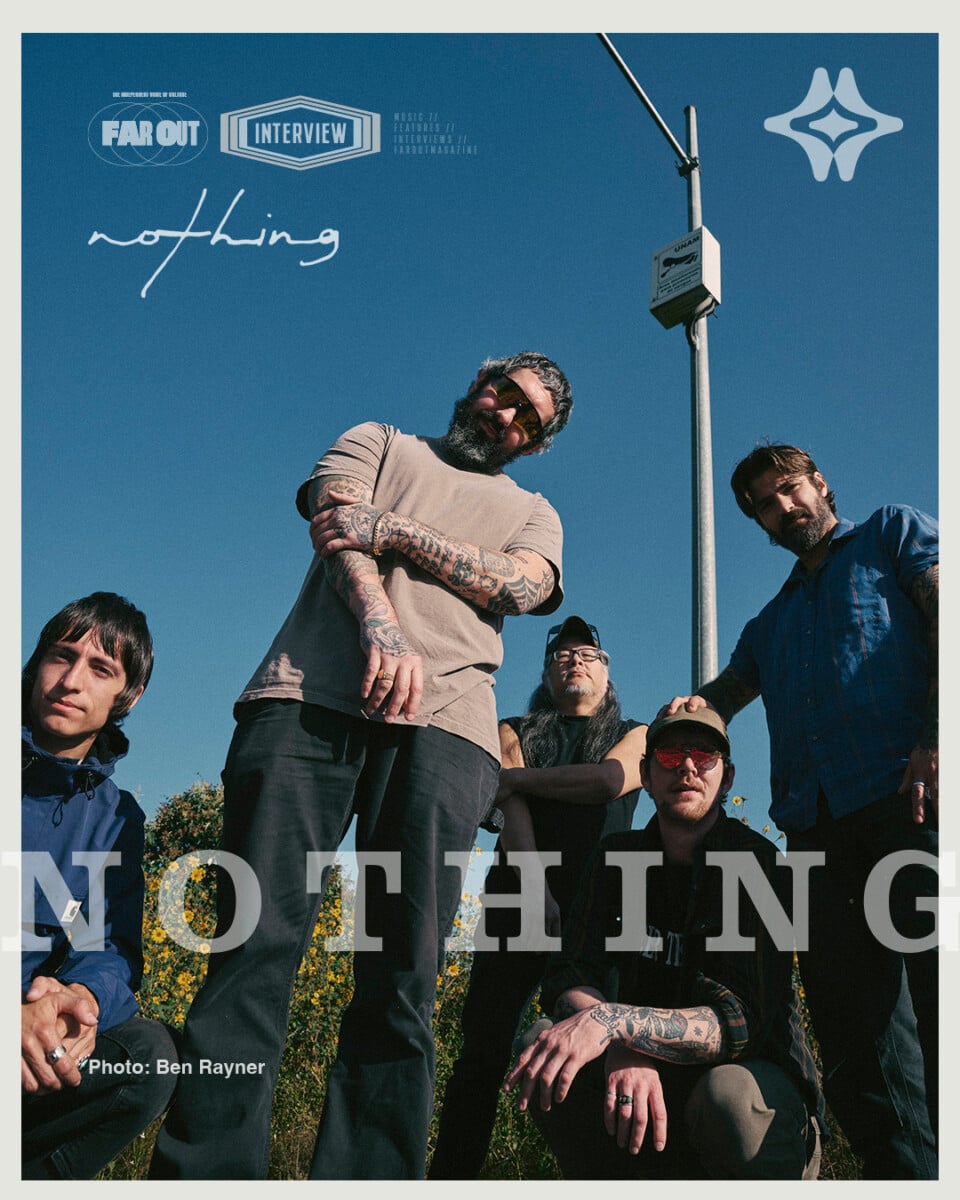
“Sorry, man, I just got a new puppy, and she’s peed all over the floor.” This isn’t exactly how I expected my introduction to Nothing frontman Domenic ‘Nicky’ Palermo to start off, but aside from toilet training issues with his new best friend, Bug, he appears to be in good spirits despite the overwhelmingly bleak backstory behind their new record, A Short History of Decay.
If the name of the band’s fifth record doesn’t already hint at there being an air of darkness, then its exploration of grief, addiction, recovery and chronic illness over the course of its nine tracks will hammer home the message in an unrelenting fashion typical of the Philadelphia group. Landing upon this particular name to sum up everything that they wanted to explore felt like a natural decision for Palermo.
“I’ve had that title on the back burner for a long time,” he explains. “It’s a book by one of my favourite authors, Emil Cioran. Really uplifting stuff, as the title suggests.” Despite having toyed with the idea of using another of Cioran’s titles, The Trouble With Being Born, he elaborates by saying that this particular novel does its best to tie up the contextual themes of the record. “Looking at the career of Nothing, it’s been a significant amount of my life at this point,” he hastens to add. “This record felt like a short history lesson on the band, myself, and everything I’ve been speaking about for 15 years.”
15 years might not sound like an enormous amount of time in the grand scheme of things, but plenty has happened in Palermo’s life to the point where the passing of time becomes more apparent and visible. “Fatigue and time kind of go hand in hand,” he ponders. “The effects are quite obvious for me, from mentally to physically, and when you start to look at yourself in the mirror as you’ve been sitting around and getting older, it’s got easier to write about things that normally I would shy away from.”
It’s not as though his band’s previous outings haven’t delved into darker territory or covered Palermo’s introspective side, but rather than making simple allusions to the tougher aspects of his life, he approached A Short History in a head-on fashion, which didn’t hold back. “One of the first things when you’re faced with that kind of situation is to look inward a little bit more and to be honest,” he notes of the decision to be more direct in his approach. “That’s the first step in the direction of being authentic, and I think authenticity has always been a big point of Nothing.”
However, it’s not like this decision was a sudden one that was made in the months immediately prior to recording the album, as Palermo notes that his constant dedication to noting down ideas means that he’s been sat on some of the material for this album since before the release of their last album, 2020’s The Great Dismal.
“I didn’t start demoing until late 2023-ish,” he says of how the wheels came into motion for the new record. “But some of the lyrical content came from close to a decade ago because it was relevant to where I was heading with things. I don’t necessarily know when exactly it hit, but for a minute, I wasn’t really planning on doing anything. I just got an itch to start putting music down. Once I started digging back into the notes, I knew what was important to me, and once I start getting into the music, I can’t stop till something’s done.”
Not only was Palermo keen to dip into something more personal from a lyrical standpoint, but his desire to see the band grow out of their comfort zone sonically was something that needed to be done to ensure that they weren’t losing so much of the credibility they’d built up as innovators. “I hate saying the word ‘shoegaze’,” Palermo confesses, laughing as I fall into the trap of using the same genre descriptors as everyone else does.
It’s important to note that while there are shoegaze elements, which Palermo doesn’t deny, A Short History toys around with aspects of hardcore, grunge, folk and even the occasional electronic breakbeat. Nothing aren’t fucking about when it comes to allowing their disparate influences to collide, and he notes how their contemporaries seem to be following a similar path. “I feel like there’s so many younger bands at this point that have picked up what we’ve done and ran with the idea in their own way, which is cool,” he notes. “I don’t think we’ve really embarrassed ourselves yet.”
For a band to survive over a decade and a half without losing sight of this is no mean feat, and even with all of what Palermo calls the “phoney bullshit” of the industry and its obsession with embarrassing yourself for the sake of producing content, Nothing have avoided succumbing to this and have maintained their artistic integrity as a result.
However, the gaps between records have increased, and the fact that six years passed between the releases of The Great Dismal and A Short History shouldn’t be ignored in the wider context of how Nothing have managed to reach this point without being affected by the pitfalls of a treacherous industry constantly under threat. Like most bands, Nothing have endured plenty of the hardships that you’d expect a modern band outside of the mainstream to have faced, but in Palermo’s case, he’s had more to be concerned about than just the usual rigmarole of band life.
“Since The Great Dismal, which we released during Covid, we’ve had this aura around us of ‘if it can happen, it will to us,’” Palermo argues in an almost superstitious fashion. A tour that never was, rescheduled dates that caused rifts with booking agents and the loss of substantial amounts of money were compounded by the fact that on their last trip to Europe, Palermo had three hospital trips; an environment that has become all too familiar for the frontman.
“Once you settle down for a second, you start to notice things that you might not notice when you’re touring non-stop,” he says of how the onset of essential tremors, a neurological condition similar to Parkinson’s, came to his attention once the band had returned from their gruelling stint in Europe. “On that last Covid tour, especially after a night of drinking, I had really bad shakes.”
Whether holding a pen, cup or playing chords on guitar, Palermo began to notice his limbs trembling, although he hadn’t necessarily picked up on the fact that this had been affecting him for much longer. “I started to notice it when I was playing guitar,” he adds, “and then I started to remember comments from social media being like, ‘Oh, I can’t believe he’s still nervous on stage, like his hands were shaking the whole time’. It wasn’t until that point that I realised it had been happening for a while, so I went to see some doctors.”
Perhaps he could have been more prepared for their arrival, considering the condition is hereditary and has previously affected his mother and uncle. “It’s more of a distraction than anything,” he shrugs. “I can live my life pretty fine with it. It’s just another thing that shows you things are breaking down a little bit, and that in itself puts things in a weird perspective.”
Palermo is content with seeing this as something else that has become part of the band’s constant battle against the world. When I ask him whether chaos is something he feels that is unavoidable, his response is decisive. “Absolutely no question about it. It’s always been next to this band. Maybe that’s just me, and I reek of it, but I can’t quite explain it. There’s always been a weird, cosmic and chaotic kind of aspect to this band. I don’t know if it’s just that we read too much philosophy or something, but it’s always perplexed me a little bit.”
Undoubtedly, chaos has been present since the band’s inception, and even goes back further in Palermo’s life, with him having made his own personal journey through hell following a spell in prison during his early 20s, and only coming to form the band eight years after he returned from incarceration. “Pretty early on, I guess music was my rebound for losing a bit of everything for a little while,” Palermo says of his road to forming Nothing. “Obviously, that was a traumatic time, but then the following years didn’t prove to be any easier.”
Having spent two years in jail for aggravated assault after becoming entwined in gang culture, the world he describes returning to seemed like an impossible place to navigate. “A lot of friends either got themselves locked up or were getting high, and I’d lost some family,” he notes. “I was trying to traverse a post-incarceration life, and I was dealing with quite a bit of depression, more than previously. At some point, I grasped onto the one thing that had always pulled me out of the hole.”
This one thing was his love of music, and even latching onto this seemed impossible for a short period of time due to the unfolding of further tragedy. “My deepest connection to music was my good friend Josh, who I played in the first hardcore band I was in, Horror Show, and he was killed tragically in a motorcycle accident just a couple years after I came home,” Palermo shares. “That was just another leg of the table kicked off and kicked out of the music thing for me. All my aspirations to play music were filtered through him forever, so when he passed, it hurt to think about playing music.”
“Desperate times call for desperate measures, and I think around 2010, I was in a really bad place. I just started to put things into song again, but I didn’t really have any intention with it. Next thing you know, here we are, so anytime I’m in a bad place, I always revert back to this. What’s comforting is that I don’t have to get to this crippling, depressed point before I pick up a guitar now, but it’s basically been a form of therapy since the beginning.”
It wasn’t easy for Palermo to reintegrate after this harrowing experience, and with very few people there to hold his hand as he tried to find his way through menial jobs working in kitchens or as a busboy, he would eventually turn to reform projects as a way of ensuring that future people ejected from the prison system have a better chance at reintegrating – something that Nothing proudly keep as part of their identity.
“I had a parole officer who wanted me to see me back in jail at every chance,” he laments, stating that they were turning up every morning at 3am to take a urine sample. “A lot of people say when you come home from that shit, that’s the end of it. You’re on the streets, but you’re essentially still in prison. That’s why I got into the reform stuff, because the system is fucked up here.”
Because of how close to home the subject matter is, Palermo knew early on in the band’s existence that he would use his platform to help those at a disadvantage. “We’ve worked with the Philadelphia and LA criminal justice reform, and we’ve worked with The Trevor Project, which is an LGBTQ+ youth suicide prevention nonprofit,” he proudly shares. “There’s things I’d rather do that are a little bit more on the scene, but a lot of the time, busy schedules mean we throw some money at them when we can.”
Even though Palermo claims that his home city of Philadelphia has one of the worst judicial systems in the US, with many people remaining caught up in the system decades after a minor felony, he still finds himself inspired by the city he grew up in. “It’s generational to me,” he reflects. “The nostalgic side of it, from being a kid and being out front on the stoop, hanging out with other kids in the neighbourhood and getting into trouble, to the high school days, first loves, riding the subway train to see them and climbing on roofs to paint graffiti. Even some of the darker side of things, it’s like a big piece of me, and that city has always just been the background for me.”
While he now resides in New York, and has done so for a decade, he still visits family and friends while frequenting the burgeoning scene there. “Seeing this blossoming next generation of really good music coming out of Philly now is another thing that makes me happy,” he says, referencing acts like Knife Play and They Are Gutting A Body Of Water. “There’s this amazing scene being built there. We didn’t have that when I was starting this, and I wish we did.”
As much as making A Short History sounds as though it was a torturous labour of love, it was also the sort of experience that made him feel positive about the future of the band, and perhaps the most natural recording process they’ve ever experienced as a group. Travelling down to Sonic Ranch in Texas, close to the Mexican border, the band found themselves falling in love with the space that they discovered and the people they met as a result.
“The owner, Tony, was just this massive character,” he recounted. “He’s an older guy in his late 70s, I think, and a tip-top shape billionaire, but doesn’t really seem like one. He had Ministry living at the ranch for a couple years in the ‘90s, and he would tell us stories about stuff that they would do.” Not only were they besotted by Tony’s larger-than-life personality and wild tales, but they found themselves taking advantage of other opportunities they wouldn’t have otherwise had.
“There were also a lot of artists from Mexico who would come across the border to record there,” he adds. “We made some friends that I don’t think I would have made in any other place, and because of that, we had some horn players come in and play on the first track, which was cool. I’m always a little awkward about hiring someone to come in and do that, but since it was a natural meeting where we’re drinking Michelob Ultras with this corridos band at four in the morning, they just roll in the next day, and we track some horns. It was everything I could have wanted out of a studio to stay at.”
Working alongside producers Nick Bassett, a former full-time member of the band, and Sonny DiPerri, Palermo says that the connection and understanding between everyone was instant. “I don’t feel like I’ve ever worked with anyone who truly understood a lot of what I wanted to do until I kind of explained and gave examples to them, whereas Nick just knows,” he argued. “Sonny called it a three-headed snake, but I don’t think we were as aggressive as that. I think maybe a three-headed bunny rabbit.”
A Short History of Decay might be Nothing’s most intense and cathartic release to date, with glimmers of hope thrown into the mix, but very little seems to deter Palermo from persevering in the face of all of the struggles he’s been dealt with. “Something that I’ve learned at this point, for us especially, is just to prepare for anything,” he concludes, puppy now perched on his lap. “I just put my head down and try to prepare for what’s ahead as best as I can and let the chaotic nature of our aura do the rest.” For an album so desperate and restless in its pursuit of peace, it seems Palermo and Nothing are well on their way to finding it.
