


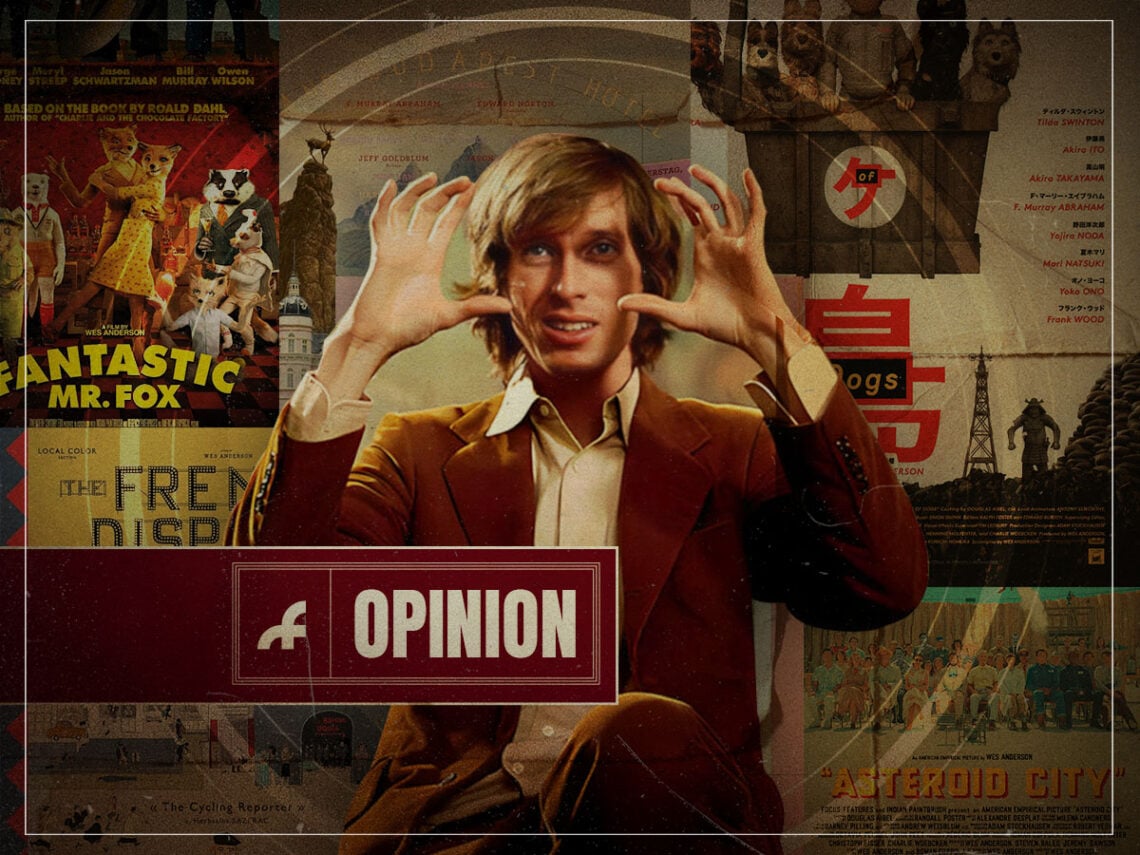
Hear Me Out: Nobody understands Wes Anderson

In the run-up to the 2023 film Asteroid City, I was fortunate enough to rewatch every single one of Wes Anderson’s films at a local independent theatre.
While Oppenheimer and Barbie were ostensibly the films of the summer, Asteroid City was a quiet success overshadowed by the massive cultural impact of ‘Barbenheimer’. A big part of the hype for Wes Anderson’s return to the big screen came from an unexpected place: TikTok. ‘Recreating’ Anderson’s style has been a trend for years – even SNL got in on it.
Really, there’s no harm in it at all – especially if it gets people to go out and see his movies. The unfortunate truth was that once it became so trendy, it started to become formulaic – and suddenly didn’t reflect Wes Anderson’s style beyond the vague essentials. Symmetry, bright colours, a dollhouse aesthetic. This was innocuous enough until artificial intelligence got involved.
Overnight, these garish renditions of popular films in ‘Wes Anderson’s style’ started popping up all over YouTube and social media. Ugly disembodied heads bobbing around oversaturated frames in garish outfits. To AI “content creators”, Anderson’s style seemed particularly suited to their brand of videography – one that you could easily pare down to its bare essentials. Slap together a symmetrical frame on Midjourney and let creepy animation software do the rest.
The lack of motion shouldn’t matter after all – if you watch the first minute of The Grand Budapest Hotel trailer, the camera doesn’t move at all. I first heard about these videos at a screening of The Royal Tenenbaums, and I was utterly dismayed to see how they’d massacred my boy. Over the next few months, hundreds more of these videos spat out into cyberspace. All the while, I was sitting wide-eyed in the theatre, astonished by Anderson’s control of the camera, his certain brand of sentimentality, and his excellent use of movement and blocking. I came to a realisation: I’m not sure anybody actually understands Wes Anderson.

I mean, this is a filmmaker with a deeply personal and idiosyncratic style – why are we constantly trying to flatten that technique? Anderson’s style is not just marked by stillness or symmetry – it is marked by very deliberate movement, a clear control of the editing, and the use of sincerity that absolutely punches an audience member in the gut. His films aren’t just deadpan – they’re often very funny and very emotive.
He also constantly tries to layer on new stylistic elements with each film. Moonrise Kingdom, which might be his most unique effort, looks and plays like a live-action Peanuts cartoon with a dog named Snoopy. The compositions are not notable for their symmetry but for their use of negative space. The precocious kids, like Charlie Brown, Peppermint Patty, Linus and Lucy, are almost always pictured as tiny within the frame, usually within the bottom third.
The French Dispatch also felt like a giant leap, with excellent use of intercutting, animation, mixed media, and an expert mixture of realism and surrealism. The short films Anderson worked on for the Henry Sugar collection are his most experimental yet, playing with close-ups, neon light, and direct address. The screen is more like a stage than a dollhouse.
While films like The Grand Budapest Hotel or Fantastic Mr Fox certainly do embody a dollhouse style, this choice serves a meaning that goes beyond mere ‘aesthetic’.
There is a reason Anderson’s style draws so much attention to itself: his films are all about performance. They centre around characters who are stifled by the world around them. Anderson himself is uniquely attuned to this idea of performance – that “all the world’s a stage”. He grew up never really feeling that he belonged. “At that age, I don’t think I allowed myself to feel, or to acknowledge, how much I felt like I didn’t fit in,” he laments. “I think I had probably too much embarrassment about not fitting in to even let it be known to myself that this was the case.” You can see this emotive core in many of his characters.

Take the Tenenbaums, for example, who grow up in an emotionally distant family where, from a young age, expectations are loaded upon them that require an ability not to feel emotions. As a result, these characters face difficulty with emotional regulation, and the film demonstrates a constant shift between passivity and extremity. Some of the greatest moments here – like Baumer’s meltdown and the disastrous events of Etheline’s wedding – completely break from the ‘stilted’ dialogue, the locked-down camera, and the symmetry. The hallmarks of what ‘makes’ a Wes Anderson film. These are punctuating moments of chaos, of sincerity, of darkness and crushing sadness. All of Anderson’s films portray characters caught in between the expectations of society and their essential selves – what Mazlow calls the transcendent self, independent of the culture.
The dioramas that frequent Anderson’s frames often represent the different trappings of class, gender, race, etc. Most recently, Poison uses its presentation to delve into racism as an institution. One that lurks beneath the veneer of civility, a racism still present in certain pockets of British and Western culture. The film paints how people come to view their interactions after experiencing institutionalised racism – like waiting for a bomb to go off. Waiting for a snake to bite.
Asteroid City feels like Anderson telling us to stop sending him Wes Anderson memes. It’s a statement of intent, taking these directorial features to their extreme, highlighting the artificiality in a Brechtian fashion. The actors are actors playing actors playing characters acting. The play-within-the-film was shot essentially all on location with natural lighting, but is made to look and feel like a set.
The framing device is an episode of Playhouse 90 that often interrupts the flow of the narrative with characters walking in and out of scenes, between the ‘real’ and ‘unreal’ worlds. It plays, sometimes, more like an episode of The Twilight Zone. The lines between fiction and reality are constantly broken. “You can’t wake up if you don’t fall asleep.” Before you stop performing, yield to the performance and the elements that surround you. Accept the absurdity of it all before you question it. Don’t worry if you’re doing it right. Just tell the story. It’s a singularly emotive piece. I took my sister to see the film – her first time seeing a Wes Anderson movie. It is also the only time I have seen a movie make her cry.
It seems apparent to me that in attempting to recreate Anderson’s style, we miss the forest for the trees. We can’t actually appreciate what makes his work so special – the fact that it isn’t all just about how they look. It’s how they make us feel. When we see a robot try to recreate Owen Wilson saying “wow” as Darth Vader, we might laugh or we might sigh. When Nico starts playing and Richie Tenenbaum sees Margot for the first time in ten years, all the air leaves the room.
I’ll leave you with this: The most successful parody of Wes Anderson’s work, directed by Wes Anderson himself.
