


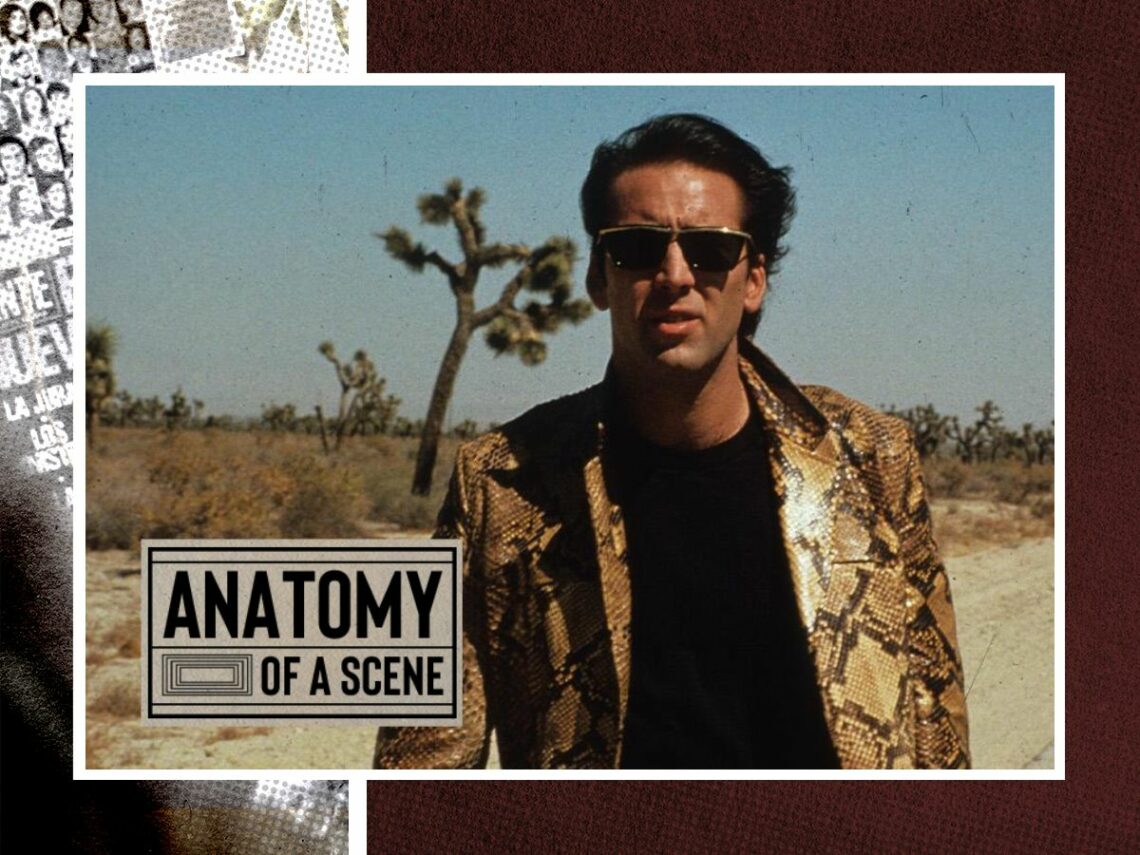
Anatomy of a Scene: Nicolas Cage turns into Elvis Presley for ‘Wild at Heart’

In 1989, David Lynch took a break from filming Twin Peaks to work on a new feature film, a project which ultimately became 1990’s Wild At Heart. Based on Barry Gifford’s novel of the same name, which Lynch got hold of before its completion, the film follows lovers Lula and Sailor as they run from gangsters hired by Lula’s overbearing mother to kill Sailor. Lynch’s road movie is both violent and campy, and his larger-than-life characters make the film an entirely entertaining experience.
In many ways, Wild at Heart is a bold entry into Lynch’s catalogue. The director moves between scenes that are highly erotic and downright silly, crafting a surreal microcosm where absolutely anything could happen. He described the story in the book Lynch on Lynch as “a really modern romance in a violent world—a picture about finding love in Hell.” With that, Lynch pulled inspiration from The Wizard of Oz, recalling: “It was an awful tough world, and there was something about Sailor being a rebel. But a rebel with a dream of the Wizard of Oz is kinda like a beautiful thing.”
The film has many standout moments, such as Diane Ladd’s Marietta Fortune smearing lipstick over her entire face or the couple discovering a gruesome car crash. Yet, one of the highlights of the whole film is Sailor’s performance at a Powermad gig, which feels like something straight out of a fever dream, more so than anything else in the movie, if that’s even possible. So far, the film has established that Sailor has just been released from prison after killing a man in self-defence. Yet, the man he killed was hired by Lula’s mother, who disapproves of the pair’s relationship. After Lula picks Sailor up from jail, his snakeskin jacket in hand, they head to a hotel before attending a Powermad performance.
A shot of Lula’s legs dancing on the bed cuts swiftly to an image of the pair dancing to the speed metal band. In arguably one of the most bizarre concert scenes in movie history, we see attendees rolling across the floor, Sailor executing some interesting karate chops, and Lula thrusting the air on her knees. Then we see the pair getting rather close, and it appears that Lula finds the whole experience very erotic. Lights strobe as gig-goers thrash their bodies around, with Lula and Sailor firmly planted in the middle of the action. The sequence is comical yet pivotal, and it reaffirms how well-suited the couple are, both throwing themselves into the music unashamedly.
However, when a man gets handsy with Lula, Sailor stops the music with one outstretched arm, the band’s performance cutting like he’s switched off a recording. He drops his cigarette to the floor, and a close-up shot shows it sizzling on the ground. The man tells Sailor that he looks like “a clown in that stupid jacket”, to which he replies with genuine seriousness: “This is a snakeskin jacket. For me, it’s a symbol of my individuality and my belief in personal freedom”. With one swift punch, Sailor knocks the man to the ground, his hand landing on his cigarette, before demanding he apologises to Lula.
Then, in an even stranger turn of events, the band throw Sailor a microphone, and he bursts into song, singing a rendition of Elvis Presley’s ‘Love Me’. Lula is more than flattered, and the female crowd members fawn and scream over Sailor as if the real king of rock and roll were in front of them. Following the sequence, we see the pair make love in their hotel room.
So, what did it all mean? Many of Lynch’s films are concerned with the destruction of the American Dream, uncovering the murky violence that lurks underneath the everyday. In Wild at Heart, Lynch depicts the struggle of a couple attempting to find happiness together, despite the many violent obstacles put in their way. The director spotlights love as a powerful and enduring force, recognising its existence in the darkest of situations. In this scene, Sailor and Lula’s love is the driving force of the narrative, and it spurs Cage’s character to act both violently and hopelessly cheesily. It encapsulates the bizarre experience of the film as a whole, reflecting the simultaneous existence of love and violence in the world, one of the overarching themes Lynch employs.
The scene demonstrates Sailor’s personality, highlighting his bizarre nature and his ability to move from aggressor to elegant crooner in a matter of moments. Yet, it also reflects his Wizard of Oz dreams. At the heart of his rebellious nature, he is a lovesick fool (as the song lyrics suggest) who wants nothing more than to be with Lula.
