


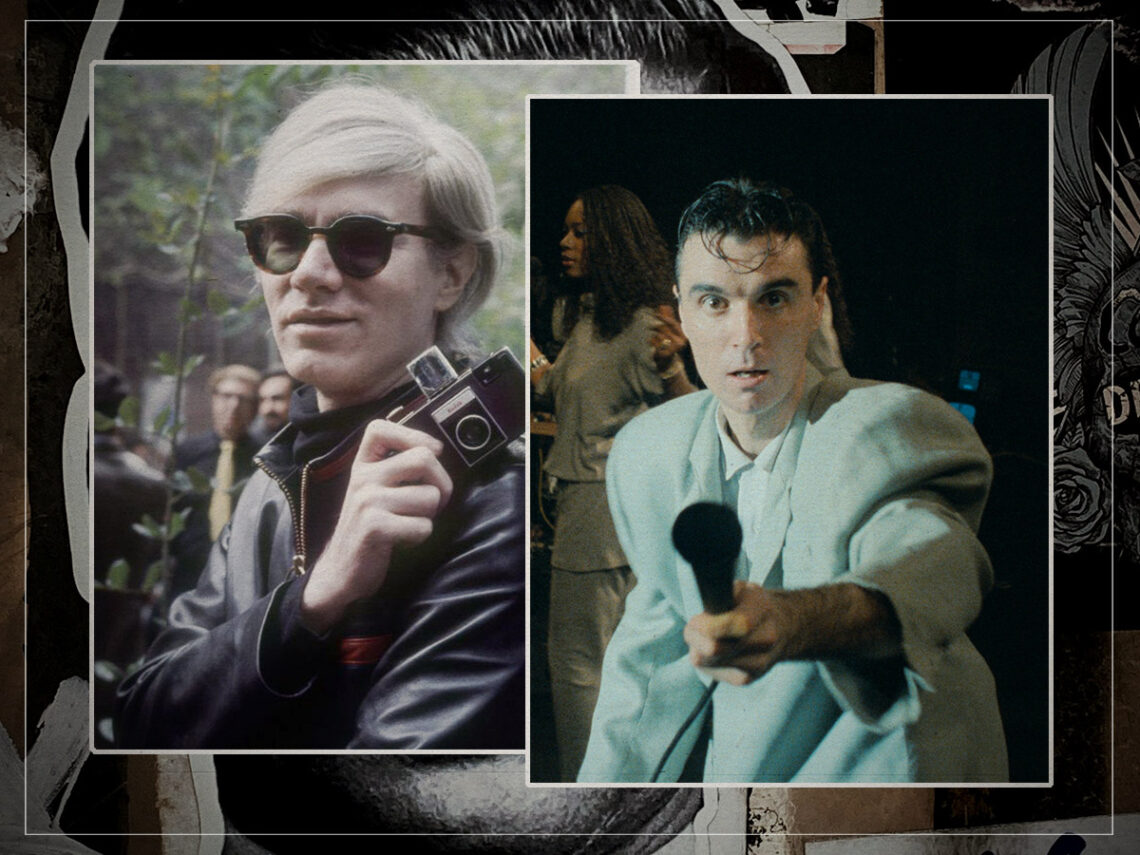
A New York connection: Andy Warhol and the Talking Heads

“Heaven is a place, a place where nothing, nothing ever happens,” David Byrne once sang. Meanwhile, on another side of the same city, Andy Warhol said, “I don’t believe in it because you’re not around to know that it’s happened.” The same ambivalence, the same nonchalance, the same bitterly dry wit. There have always been elements of the Talking Heads leader and the pop art icon that feel one and the same.
Any impression of Warhol is always full of Warholisms. He is a man often caricatured with his brawling “oh wow” or his facade of hazy disconnect. He liked to pretend that everything was exactly how you saw it: no deeper meaning, no bigger picture. Anyone who has spent any time considering the truth of the matter knows it’s false. As an artist, Warhol was a man with real insight, things to say and comments to make about the world and culture, but in public, the persona he adopted was the antithesis of that.
The same could be said for Byrne. Just as there are Warholisms, there are undeniable Byrneisms in his lyrics. Humour plays an important role but always in the same sort of super-dry form. There is silliness to be found, but all of it comes with more to it, even if Byrne, as was with Warhol, will deny it or play the typical role of the artist and explain it.
Byrne, too, had a love for playing up a persona. While it’s generally accepted that a band, especially a 1970s and ‘80s punk-adjacent band, would just get up on stage and play their instruments for a show, following the typical actions of the typical rockstar, Byrne denied that with Stop Making Sense, choosing to adopt an awkward character as well. “It’s me as a character—or me as myself—being anxious and isolated in the beginning, and then gradually finding himself with this little supportive community,” he explained as he began on stage solo and slowly the band built around him. But even still, at the climax of the show, there is an oddness and an awkwardness to it as he flails around in his huge suit.
Both men embody that kind of hypnotic strangeness. Neither are what anyone would consider a relaxing presence, yet people wanted to be around. In the 1970s and early ‘80s especially, they both stood out as that unique social character that’s hard to explain, but you know when you meet one—they’re the type of people you would forever be confused by but endlessly curious about to find out more.

Maybe that’s why Warhol had such a kinship with Talking Heads. Typically, the artist liked his rockstars to be glamorous and suave, like Mick Jagger or Debbie Harry, or rough around the edges, like Lou Reed. Music was always a vital part of his artistic world, embedding himself as a central figure in the New York Scene, but by the time Talking Heads were emerging, Warhol had retreated from those kinds of crowds. After being shot, he was only really found in more elite circles with top-tier celebrities. He was rarely found amongst the rabble anymore, like in the riff-raff of the CBGB, but one night, he made an exception.
Through a mutual connection that wrote for his magazine, Interview, Warhol was invited to one of Talking Heads’ first-ever gigs. Instantly, he was a fan, sharing that praise in the most Warhol way possible as he reportedly said, “Oh, they’re so cute. Do you think they’d like to have lunch at the Factory tomorrow and do an interview?” Obviously, the band knew who he was. He was the most famous artist in their city, but mostly, this was a band of art school kids. As Chris Franz wrote in his memoir, “At RISD (Rhode Island School of Design), we regarded him as a hero, and we still did.”
“Only just out of art school, and here we were having lunch at the Factory with Andy Warhol,” Franz remembered it like a fever dream, but their admiration was shared. It’s a beautiful anecdote about just how much of a music lover Warhol was. “Andy would even do a radio commercial for us, saying ‘Buy the new Talking Heads record and tell them Warhol sent you,’” Franz said as the artist applied his sell-sell-sell attitude to his new favourite band’s career.
Despite being shy and scared at this time in his life, Warhol would be found there often, lingering at the back of their gigs. Franz writes about it with total love, stating, “He was the most famous and quite possibly the greatest artist of our time, yet he always treated us like we were way more important than he was,” though adding, “he sometimes mistakenly referred to us as the Talking Horses.”
As for Byrne, with his infamous Byrneisms and exactly the same intense nonchalance as the artist himself, he said of the connection merely, “What a mind-fuck!”
