


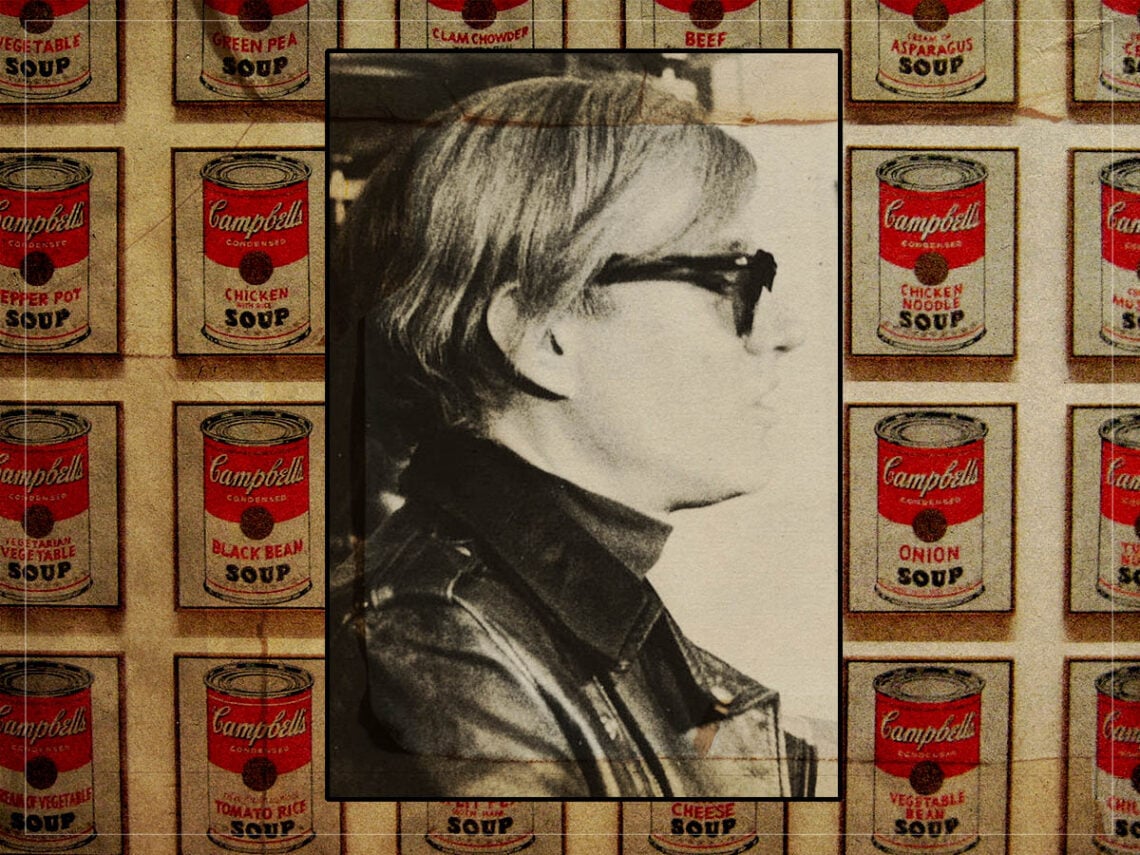
What did cans of soup mean to Andy Warhol?

There’s one statement that haunts boundary-pushing art like an echo in a chapel. You know it, I know it, and if you’re anything like me, hearing it shaves a few years off your life span: “My kid could do that!” It’s tempting to dismiss the person saying it as an ignorant contrarian, eager to appear above whatever’s in front of them. Yet, the phenomenon persists. It’s not even a modern complaint—one of the most infamous targets of this derision was none other than Andy Warhol himself, whose work frequently faced accusations of being “not art.”
With Warhol, though, the sly old provocateur that he was, that was a conversation he was absolutely trying to provoke within his audience and beyond. By the time he was the most famous American artist in the world, he was asking his audience to define for themselves the difference between art and product, if there was one at all.
This was a question he wasn’t alone in asking. The pop art movement began in the early 1950s with the formation of The Independent Group in London in 1952. This was a coalition of artists like Eduardo Paolozzi and William Turnbull, along with writers and critics like Toni Di Renzio and Reyner Banham, all dedicated to examining the art that could be found in so-called “disposable” or “found” objects. Things like advertising, comic strips and the like.
Roy Lichtenstein had already found success with his comic panel inspired works of the early ’60s, but Warhol was particularly placed to have a more intimate relationship with the idea of pop art than anyone else. See, most leading lights of the pop art scene were high artists and academics who’d explored the realms of pop culture for inspiration.
Warhol, on the other hand, lived it. He cut his teeth as an illustrator for everyone from Glamour Magazine and Tiffanys to RCA Records and Simon and Schuster, creating adverts and covers for records and books. This practise he kept alive well into his career as an artist, but unlike others, who would have kept his commercial and artistic work separate, Warhol didn’t see the need to separate.
After all, by his own admission, he was a man of simple pleasures. When gallery owner and friend of Warhol Muriel Lalow asked Andy what he loved most, he replied, “Money”. He loved movie stars and Coca-Cola, and pretty much every single day of his life, he would have Campbell’s soup for lunch.
If art is an expression of what comes from within, why couldn’t those everyday comforts that everyone loves be a part of that? After all, according to Warhol, products were the great equalizer. In his book The Philosophy of Andy Warhol, he wrote, “America started the tradition where the richest consumers buy essentially the same things as the poorest… All the Cokes are the same and all the Cokes are good.”
It was this attitude he was paying tribute to when, in 1962, he unveiled one of the most famous pieces of American art of all time. 32 canvases, each depicting a can of Campbell’s Tomato soup. All of them the same. All of them good. Of course, a lot of folk were scandalised, but that’s going to happen whenever something boundary-pushing is made. Whether that creation is boundary-pushing and intensely technical or something as every day as a can of soup. Everything has beauty to it, and it’s up to us to find it.
