


Are the needle drops in ‘Queer’ the perfect homage to William S Burroughs?

When the credits roll at the end of Queer, Luca Guadagnino’s cinematic adaptation of William S Burroughs’ novel, there’s plenty to unpack.
Audiences familiar with Burroughs’ work will expect nothing less—after all, simplicity was never the goal for one of the leading figures of the Beat Generation. Burroughs’ writing, and that of his peers, thrives on complexity: layered with meaning yet often nonsensical. Guadagnino captures this beautifully in the film’s imagery and its deliberate, open-ended ambiguities. However, it’s the soundtrack that feels like the ultimate homage to Burroughs, perfectly encapsulating his chaotic, avant-garde spirit.
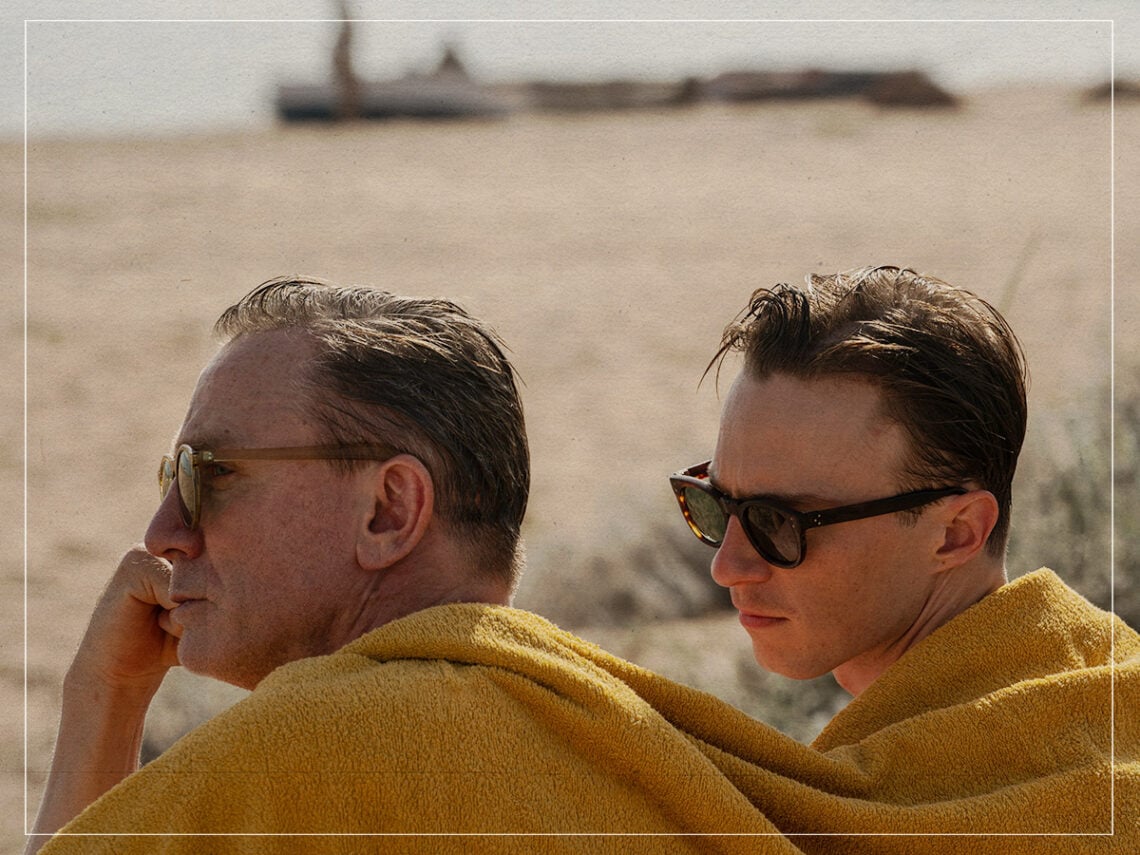
From start to finish, Queer makes bold choices with its needle drops. The first one comes instantly as Sinead O’Connor’s cover of Nirvana’s ‘All Apologies’ plays over the opening sequence, with the lyrics “What else could I say? / Everyone is gay / What else could I write? / I don’t have the right / What else should I be? / All apologies,” seeming to act like an overture and an overview of what’s to follow, which is Burroughs’ tale of Lee, a gay man played by Daniel Craig, who is at once both bold and insecure, unapologetic yet troubled, living freely yet shackled by his half-in-half-out love for Eugene Allerton, played by Drew Starkey. Before even a single actor hits the screen, this song choice is not only deeply mood-setting but is the first clear nod to Burroughs beyond the obvious fact that it’s his text about to be played out.
Kurt Cobain loved Burroughs, so much so that the grunge musician would send letters or tapes of him reading his idol’s stories over music. In 1993, the pair finally met, and Burroughs started loving Cobain back when they collaborated on a project. When Cobain died a year later, the Beat writer was reportedly devastated as Thurston Moore recalled, “He had this look in his eye like: ‘Why would anybody take their own life?’ He couldn’t make sense of it. Why would you do that? Why would you disturb your energy and your cosmic soul like that? You don’t do that. You protect it. You have to fight for it.”
So, when the needle drops on Nirvana again later in the film, for both ‘Come As You Are’ and ‘Marigold’, it’s a homage to the writer’s relationships and his impact on music makers.
As the 1990s grunge tune ‘Come As You Are’ plays out against the tropical setting of Mexico City in the 1950s, it’s an odd combination. There’s a moment where the audience almost jumps, confused as to how the soundtrack matches up with the moment. Another key moment of this is during the Prince needle drops, as the strange choice of the Piano and A Microphone 1983 spontaneous demo version of ‘17 Days’ feels messy and unkempt against the sleek film, or later when ‘Musicology’ feels weirdly slick and modern during a moment of nuance and complexity in the relationship between Lee and Eugene. As the movie jumps between modern songs with more topical Spanish tracks in keeping with the setting, or even between recognisable songs from known artists and the score made for the film, it’s somewhat jarring, but that’s the point.
Burroughs is most famous for pioneering the cut-up method. When he wrote, he would write odd pieces and shove them together, creating a project out of bits that really had no connection. Guadagnino honours that cinematically with disconnected sequences, especially in the final moments, as viewers seem to be pushed through a series of unrelated dreams. But really, Queer honours it best in the music, as the soundtrack feels cut up in that way that Burroughs loved.
Beyond being a writer, Burroughs was a man who loved music and had a major impact on music. Artists like David Bowie, Patti Smith, Sonic Youth and even The Beatles were greatly influenced by the writer, and he, in turn, supported the music community with his encouragement. No doubt, if he was alive to have a say, Burroughs would have certainly implored the film’s use of odd musical selections as if flipping through his jukebox and plucking tracks out with the day spontaneous approach as he handled his writing.
While Nine Inch Nails’ Trent Reznor and his collaborator Atticus Ross created an incredible and moving score for the movie, music supervisor Robin Urdang and Guadagnino’s own clear care for the legacy of Burroughs deserve a shout for pulling this off. Attempting to tackle a text from a notoriously difficult writer is a feat in itself, but in their musical choices, it’s clear that they approached it with the boldness that the writer would apply and would be proud of.
