


10 sumptuous movie scenes inspired by paintings

Art and film have had a complex and fruitful collaboration from the off. Filmmakers have often taken inspiration from art, letting the work of great artists inspire and guide everything from their colour palette to the structure of their shots. As you would expect, there’s no shortage of examples of directors conjuring up the paintings of Botticelli, Leonardo Da Vinci or Vincent van Gogh. Here, we’ve bought you ten stunning examples.
In the early days of cinema, there was a sense that the medium should be distinct from all other art forms. It was a mode of artistic creation based on placing abstract images in a particular order to evoke a specific emotional response. Silent film directors didn’t want to rely on title cards; they wanted to tell stories using images alone.
As such, paintings became an important reference point for many directors, and there are countless examples of directors using them as inspiration and actively recreating them. In a way, it makes sense. The director and the painter might work with different tools, but they are working towards the same result: to guide their audience into a world within the four walls of a frame.
10 movie scenes inspired by works of art:
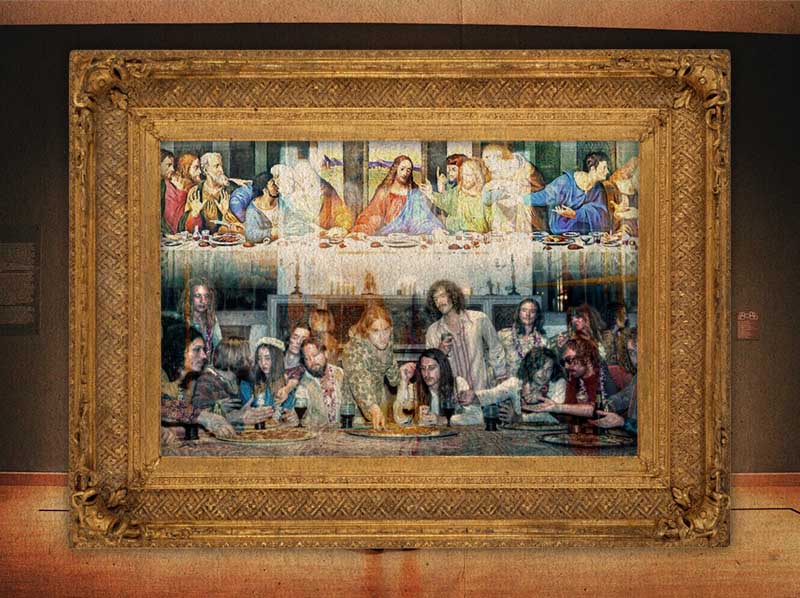
Inherent Vice: The Last Supper
Leonardo Da Vinci’s The Last Supper depicts a scene from the Gospel of John, Chapter 13, verse 21, when Jesus declares that one of his twelve disciples will betray him. Where previous Last Supper scenes identified Judas by depicting him as the only Apostle without a halo, Da Vinci’s oil fresco is different – instead portraying the traitor with his head turned towards the shadows.
In the Inherent Vice scene, Paul Thomas Anderson recreates Da Vinci’s religious masterpiece where a group of hippies gather around a table to dine on pizza. A photographer shuffles in to take their portrait, capturing them at the precise moment they are organised according to the blocking of The Last Supper. It might be stuffed crust, but they’re breaking bread nonetheless.

The Exorcist: The Empire of Lights
Produced by one of the most important and enduring artists of the surrealist movement, The Empire Of Lights series saw René Magritte continue his exploration of mind-bending oxymorons by depicting houses which seem to exist in a space between day and night. In one painting in particular, the daylight in the upper part of the canvas juxtaposes the night in the bottom half, creating a dizzying sense of dislocation.
The Exorcist director William Friedkin recreated Magritte’s work for the scene where the priest approaches the house of the possessed girl. Both in the director’s use of light and the overall composition of the shot, the scene is incredibly evocative of The Empire of Light cycle- perfectly capturing the disharmonious spiritual aura that surrounds the home.

Dreams: Wheat Field With Crows
Surely one of Vincent van Gogh’s most famous paintings, Wheat Fields With Crows, is often described as the very last the artist completed before committing suicide. Truth be told, he completed several other works after this one. Nevertheless, the artist does seem to have perceived melancholy in everything he put to the canvas during this period. This work, with its dark sky filled with winged omens, is a good example.
Akira Kurosawa recreates this painting in one of the beautiful vignettes in Dreams, perhaps the most personal and endearing of all the director’s films. The 1990 picture was apparently based on real dreams the director experienced, which he plucked from his slumber and turned into eight episodic and startlingly transcendent stories.

The Adventures Of Baron Munchausen: The Birth Of Venus
Made for the powerful Medici family, Sandro Botticelli’s The Birth of Venus is one of the most iconic depictions of the Roman goddess of love. Venus – or Aphrodite in the Ancient Greek tradition – was born from the foam of the sea and was the most beautiful of all the Gods. And of all the depictions of her in sculpture and painting, Botticelli’s is widely regarded as the most magnificent.
As the very epitome of feminine beauty, it’s no surprise that Botticelli’s Venus has seen a fair amount of screen time. In Terry Gilliam’s fantasy adventure film The Adventures of Baron Munchausen, for example, she is given new life by Uma Thurman, who emerges from a giant clam dressed in, well, not very much at all.

Lust For Life: Le Café De Nuit
Another van Gogh now. Completed in 1888, Le Café De Nuit was executed on a hefty industrial primed canvas. It depicts the interior of a quiet cafe after nightfall. Five customers sit at tables along the red walls to the left and right, while a waiter in a pale coat brings the viewer’s gaze towards the billiard table at the centre of the room.
The striking artwork is recreated down to the colours of the walls in the 1956 van Gogh biopic Lust For Life, which starred Kirk Douglas as the troubled artist. Decades later, directors Dorota Kobiela and Hugh Welchman would take things one step further to tell the story of van Gogh’s life by animating thousands upon thousands of post-impressionist oil paintings.

Pan’s Labyrinth: Saturn Devouring His Son
There aren’t many paintings quite as disturbing as Francisco Goya’s Saturn Devouring His Son. Even if you know nothing about art, you’ll recognise this deeply unnerving portrait of the Ancient God tearing the limbs from one of his offspring – his eyes wide with ecstasy. Most worrying all, of course, is that this particular work wasn’t made to be sold. It was painted on the walls of Goya’s house, La Quinta del Sordo, for no other reason (we can assume) than to give life to something borrowed deep in his psyche.
Guillermo del Toro took inspiration from the 1819-1823 paintings when making his dark fantasy Pan’s Labyrinth – using the figure of the cannibalistic Titian as the model for The Pale Man, the eyeless, child-eating creature that guards the feast Ofelia so foolishly feeds on while searching for Pan’s key.

Melancholia: Ophelia
Finished in 1851, John Everett Millais’ Ophelia, as the name suggests, depicts the scene from Shakespeare’s Hamlet in which Ophelia drowns herself out of grief for her murdered father. Ophelia was a favourite character among the Pre-Raphaelite painters, as was model Elizabeth Siddal. The latter was required to pose for Millais in a bath of lamp-heated water for four months. Following one tough sitting, the lamps went out, leading Siddal to catch a severe cold. As you can imagine, it wasn’t long before her doctor threatened Millais with legal action.
The image used to promote Lars von Trier’s Melancholia, the third film in his ‘Depression Trilogy’, features Kirstin Dunst’s character dressed in matrimonial attire, clutching a bunch of flowers and meaning back into a river, clearly referencing Millais’ depiction of Siddal as the famously melancholy princess.

Gladiator: Pollice Verso
The Pollice Verso, or Turned Thumb, by Jean-Léon Gérôme, captures the moment a victorious gladiator looks to the Roman emperor to decide his opponent’s fate. With its use of vivid reds and pearlescent golds, you can almost hear the crowd calling out for blood.
The painting was apparently the inspiration behind Ridley Scott’s 2000 historical drama Gladiator, which includes a direct homage to Pollice Verso in the scene where Emperor Commodus points his thumb towards the sand, sealing the fate of the armoured warrior Maximus’ has pinned to the Colosseum floor.
As producer Douglas Wick recalled in the 2000s, “We brought Ridley a painting from the late 1800s of the Roman Colosseum. It was beautifully shaded, and because it was sort of in the blush of the British Empire, it was slightly idealised. Ridley looked at the painting and said, ‘I’ll do the movie. Wherever the script is, we’ll get it right. I’m doing this movie'”.

Metropolis: The Tower of Babel
Interestingly, the Colosseum was itself partly responsible for this next painting: Pieter Bruegel’s (Great) Tower Of Babel. The artist crafted the 1560 work when he was 35 years old, travelling to Rome to take inspiration from the ancient structure’s impressive architecture to craft an imagined version of the Biblical Tower of Babel while still under construction.
Babylon is the original city of sin. Fritz Lang clearly knew this – using Bruegel’s depiction of the city’s soaring library to inspire the urban architecture of Metropolis. The German expressionist masterpiece focuses on a bitter class struggle in a society in which people have been divided into two categories: the thinkers, who live in the city’s skyscrapers, and the workers who spend their entire lives underground. Lang reimagined Bruegel’s version of the resplendent tower during the animated scenes of the Metropolis skyline.

Shutter Island: The Kiss
If you’ve ever stepped foot inside an art student’s bedroom, you will have undoubtedly laid eyed on Gustav Klimt’s obnoxiously famous The Kiss. Though to be symbolic of Klimt’s own romantic relationship with Emilie Flöge, the artwork captures two lovers kissing and blending together in a shimmer of geometric colour.
In his psychological thriller Shutter Island, Martin Scorsese recreated the (1907-1908) artwork, which stars Leonardo DiCaprio as a US Marshall charged with investigating an insane asylum on an isolated island. During one scene, DiCaprio and his wife, played by Michelle Williams, hold the exact same pose as the two lovers in The Kiss – William’s costume bearing the same green and yellow flecks that characterise the original painting.

