


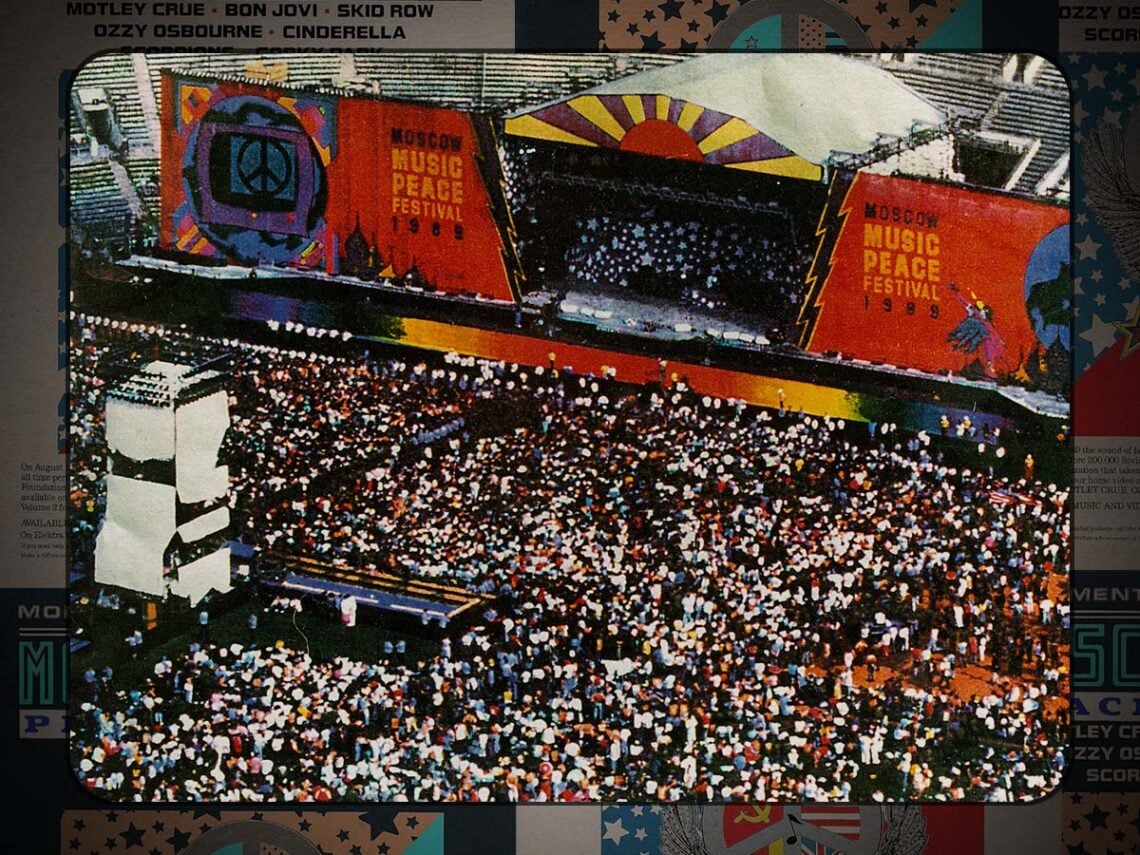
Moscow Peace Festival: The madness of the ‘Russian Woodstock’

Jon Bon Jovi called it “the highest high we’ve ever experienced”, but the two-day event known as the Moscow Music Peace Festival was also very much a ramshackle party held at the crumbling demise of an empire.
On August 12th and 13th, 1989, an estimated 100,000 people crammed into the Luzhniki football stadium (then known as Central Lenin Stadium) to watch an interesting ensemble of the best that Western hard rock and hair metal had to offer.
Ozzy Osbourne, Bon Jovi, Mötley Crüe, Scorpions, Skid Row, and Cinderella were all on the card, with a sprinkling of Soviet rock bands included as a sort of devil-horned olive branch. The event was co-organised by Bon Jovi’s manager Doc McGhee and the Russian musician and activist Stas Namin, whose band Gorky Park also performed.
The idea of the Moscow Music Peace Festival, as the name would suggest, was to bring the old 1969 Woodstock vibe to the USSR, just without any of the hippies and a significantly less welcoming view on drug use. In fact, the event was officially sponsored by the Make A Difference Foundation, a non-profit anti-drug charity that McGhee had started in 1988. Don’t get the wrong idea, though. McGhee wasn’t a square. He’d only launched “Make a Difference” as part of a plea bargain after his own felony drug arrest, when he was accused of importing 20 tons of marijuana into a port in North Carolina.
It’s unclear if McGhee actually expected Ozzy Osbourne or the rest of his headliners to go on stage and tell a giant crowd of hyped up Russians not to smoke reefer, but from most accounts, no such educational messages were included. Instead, McGhee and his team had bigger fish to fry. Specifically, they were in way over their heads when it came to putting on a massive rock festival in a country at the height of perestroika and on the brink of total transformation.
The Berlin Wall was just weeks from coming down, and the USSR itself would cease to exist within two years. As such, cash support for the event within Moscow was minimal, and even with Bon Jovi and Mötley Crüe agreeing to play for free, the challenges of getting the Peace Festival off the ground were endless.
“There were tremendous cost overruns because there was nothing available in Moscow to do anything with,” McGhee’s lawyer Joe Cheshire later told the Associated Press. “There was no electricity to run the stadium. There was no plywood to build the stage. It all had to be brought in.”
The rock stars themselves still needed to be coddled with quality food, private transport, and ego stroking, as well, especially as tensions were building between the various bands over who deserved the bigger billing and more desirable stage times. Jon Bon Jovi was one of the more magnanimous ones, supposedly offering up his headline slot to Ozzy. When it came to his personal accommodations for the weekend, though, Jon was less pleased.
“The Ukraina is, for Russia, a four-star hotel,” Bon Jovi told reporters during the festival. “In America, it would be a no-star motel. . . . I’m one of the lucky ones. My room has hot water, a shower curtain, and only a handful of friendly cockroaches.”
Despite the rough conditions, though, the concert itself definitely achieved something, as Bon Jovi later acknowledged. The event not only gave rock fans in the USSR a chance to see some of the biggest acts in the world, but it was also broadcast internationally on Pay-Per-View, potentially changing some minds about Russian culture as the Cold War neared a temporary conclusion.
A song directly inspired by the Moscow Music Peace Festival, the Scorpions’ ‘Wind of Change’, would later become a phenomenon in Europe during and after the collapse of the USSR, selling upwards of 14 million copies.
