


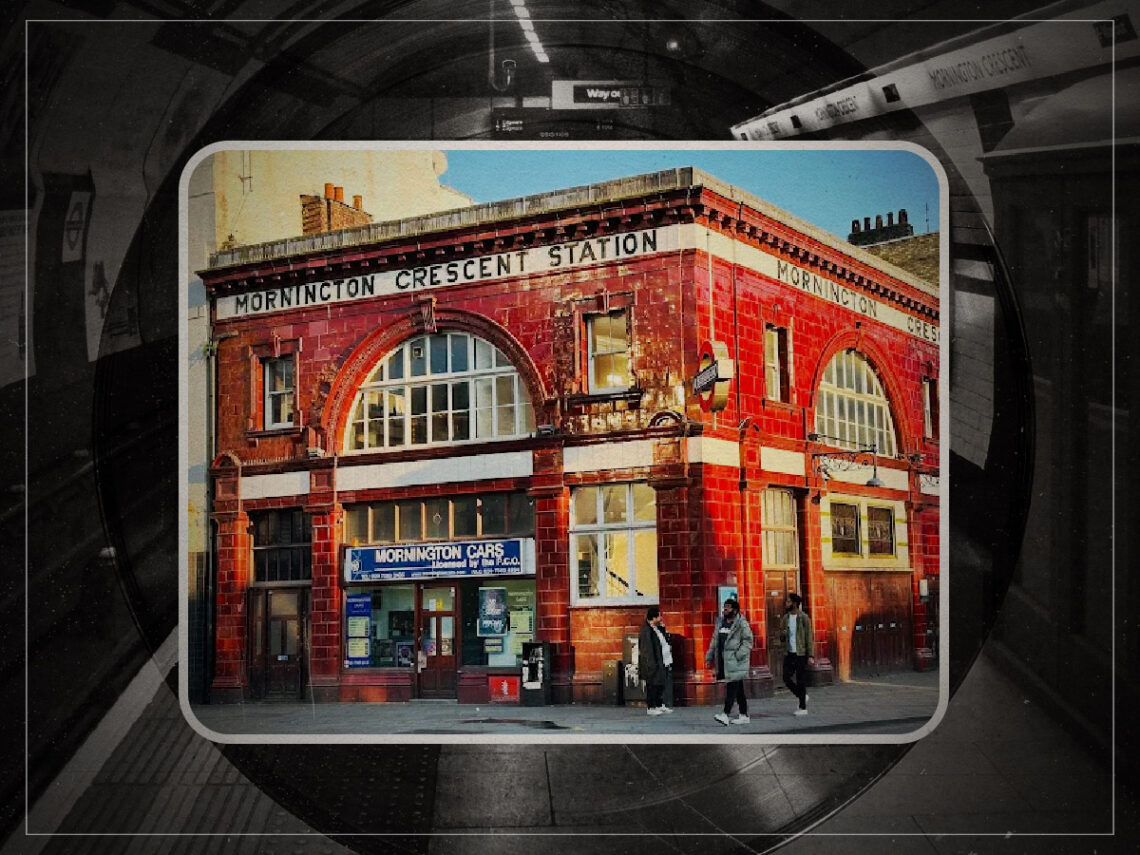
‘Mornington Crescent’: the London Tube stop with a rich musical history

Once you get past the eardrum-piercing noise, the horrible smell that seems to stick to you throughout the day, and the oppressive misery of everybody on board, the London Underground is a pretty fascinating subway system to travel on. Not only does it provide connections across the entirety of England’s capital – provided you don’t want to go south of the river – but it is also awash with history.
In addition to the rich tapestry of London’s social, political, and economic history that can be told through the tales of the Underground, the network also boasts a particularly good soundtrack. Whether it’s Paul Weller’s harrowing tale of late-night assault on The Jam’s ‘Down In The Tube Station at Midnight’ or the infectious rhythm of Ebony Bones’ underrated ‘Story of Stockwell’, one Tube station in particular, though, boasts a much bigger musical impact than any other.
Situated between Euston and Camden Town on the Northern line, Mornington Crescent has been serving the commuters of Somers Town for well over a century, having first opened back in 1907, and despite not being the busiest station on that particular line, the Zone Two stop has certainly left its mark on the cultural landscape of London and beyond.
Having served the commuters of Somers Town for well over a century, Mornington Crescent has been a fixture of the Underground network since back in 1907, and during its lifetime, the Zone Two stop has left a colossal mark on the cultural landscape of both London and beyond.
Not only has the station been a cornerstone of BBC Radio Four’s long-running programme I’m Sorry I Haven’t a Clue since back in the 1970s, but it has also experienced a continued presence within the music realm. For starters, music hall legend William Hargreaves namedropped Mornington Crescent in the lyrics of his 1922 song ‘The Night I Appeared as Macbeth’.
While not an overly notable song, particularly for those not interested in the ageing sounds of music hall, Mornington Crescent’s influence has stretched all the way to the far more modern realm of indie music. In fact, underrated Britpop-era outfit My Life Story released an entire album named Mornington Crescent back in 1995, thanks largely to its proximity to Camden Town, the arguable epicentre of Britpop’s emergence.
Perhaps most notably, though, the Tube station lent itself to a 2006 classic by Glaswegian indie icons Belle and Sebastian, for their 2006 record The Life Pursuit. A coming-of-age tale centred around the Northern line, ‘Mornington Crescent’ is one of the band’s most notably London-centric recordings and, as Stuart Murdoch once reflected, “That was a real effort to write a London song.”
Explaining the inspiration of the song, and why he chose to focus on Mornington Crescent rather than – for instance – Glasgow’s underappreciated subway system, Murdoch explained, “Back when we were in London for a long while, Mornington Crescent station was shut, and it seemed to be this lonely little place, it was like a ghost station.”
Continuing, “I guess I gave it a personality and decided to write a song to the station and tell all my London stories.”
It was back in 1992 that the station shut its doors, with the apparent motivation being to replace the lifts inside the station. In the end, though, the project lasted for many more years than anybody anticipated. It wasn’t until 1998, in fact, that the station was reopened, by which time Stuart Murdoch and Belle and Sebastian had already found the inspiration for the song that would reaffirm the Underground station’s musical credentials.
So, while it might not be the most frequented station on the Tube network, Mornington Crescent has certainly left its imprint on the cultural landscape of the nation, arguably much more so than some of its more popular neighbours.
