


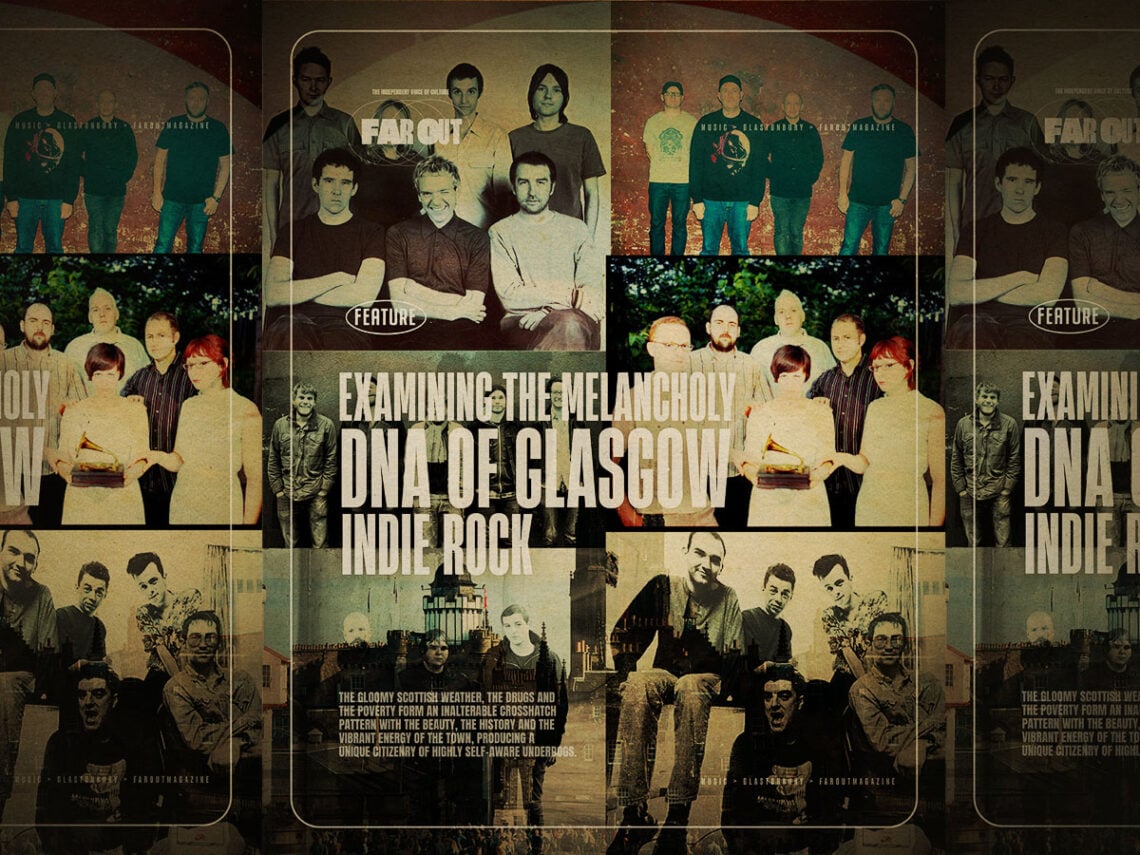
Examining the melancholy DNA of Glasgow indie rock

“We’re not ones to shout about ourselves,” the late Frightened Rabbit singer Scott Hutchinson once told me in a 2011 interview. He wasn’t just referring to his band, which was embarking on a high-profile American tour at the time, but the entirety of the Glasgow indie music scene of which they were a part.
“It’s a very self-deprecating place,” he added, “And I think that often comes across in the music; songwriters like Aidan Moffat and Stuart Murdoch. As a place for initial, individual creativity, it’s fantastic. But I could also see a lot of people wanting to move on from it later.”
And therein lies the rub. Glasgow, along with being one of the great music cities in the world, is also partially cursed by the same magic that inspires so many of its artists. The gloomy Scottish weather, the drugs and the poverty form an inalterable crosshatch pattern with the beauty, the history and the vibrant energy of the town, producing a unique citizenry of highly self-aware underdogs. It’s like the Hotel California in reverse: you can leave whenever you like, and many musicians do, but you can never really check out. It always pops up again and again in your work.
“It’s just part of our DNA,” Belle & Sebastian guitarist Stevie Jackson explained to me in 2012, adding that, while his feelings on being Scottish, British, or European can change from week to week, “The one thing where I do have a really strong sense of regional identity or sense of self is as a Glaswegian. I just have this very intense love of the city… If you have a romanticised view of Glasgow, and you come here, I don’t think you’d be disappointed. It’s a very magical place.”
Tracyanne Campbell, lead singer of the veteran Glasgow indie-pop band Camera Obscura, captured the feeling of that romantic side of the city in her song ‘Knee Deep at the National Pop League’, inspired by attending one of Glasgow’s wintertime indie-pop discos in the early 2000s. She also wrote a song, however, called ‘Let’s Get Out of This Country’, which includes the lines: “What does the city have to offer me? / Everyone else thinks it’s the bee’s knees”.
“Yeah, I do think I understand what the appeal is,” Campbell told me in 2009, “But it’s very hard to have the same perception as an outsider, because I’m amongst it, you know? We’re part of it. Glasgow is a great city. Don’t get me wrong. It’s a wonderful city. There have been times in my life where I haven’t been able to appreciate it, but I think that’s natural for somebody who gets bored and feels a little stuck… The grass is always greener, you know?”

“Psychologically, it’s a working-class area,” Stevie Jackson noted, trying to hone in on what makes the Glasgow mindset identifiable, “and music has always been an escape here. Obviously, there is a sort of great pop tradition here, but a lot of our contemporaries—bands that Belle & Sebastian came up with—were groups like Mogwai and Arab Strap, who were nothing like us at all, aside from some core sensibilities, certainly. So, it’s quite diverse, as well.”
Stuart Braithwaite, one of the founding members of post-rock outfit Mogwai, wasn’t inclined to dig too deep into the causes of the Glasgow effect: ”Scottish people don’t talk about emotions,” he had already explained to me in this 2008 discussion. Still, his mood undoubtedly began to perk up as he reflected on the benefits of being a band in the city.
“Glasgow’s good because there’s a lot of places for bands to play—a lot of smaller venues,” Braithwaite relayed, “Like, there’s a place called the 13th Note [it has since closed], where we first started playing, along with bands like Delgados and Belle & Sebastian. There’s a place called Mono, which is sort of a vegan café and a venue, and good bands play there, and another one called Stereo. And, of course, there’s the Barrowland Ballroom, which is amazing.” [All apologies to additional unmentioned icons like King Tut’s Wah Wah Hut and Nice N Sleazy].
Fran Healy, frontman of Travis, had similar sentiments. “If you’re in a band, it’s a great place to be,” he told me in 2009, noting, “There’s lots of places to rehearse and lots of opportunities for gigs. It’s not scrutinised as much as London if you’re a young band. So, the type of music that comes out of Glasgow will only reach London after maybe a year or so of rehearsals and getting it together. Whereas in London, you do your first gig and you get five A&R men at your gig passing on you. And then you’re that band everyone passed on. You weren’t even given a chance. So you’ll always get better bands coming out of Glasgow.”
Healy did eventually move to London himself, admitting that, at some point, he just got fed up with Scotland, as seems a rite of passage for even the proudest Scots.
“There’s an old Billy Connolly routine,” Trashcan Sinatras’ frontman Frank Reader passed on to me in 2011, “where he talks about how—when you’re growing up in Glasgow—men are always singing these melancholy songs about not being in Glasgow while they’re all still in Glasgow. I think it just travels with you, you know? Maybe it’s a sense of drama that we have. I do know that I’ve always felt there was a certain country music influence in Glasgow. I knew a lot of people whose parents loved the kind of country music that was maybe kind of less popular or passé at the time, Frankie Lee and George Jones, etc. The heartbreaking, heavy-drinking kind of country music. So I think there’s something to be said for an inherent melancholy in there. It probably never really leaves you, no matter where you end up living.”
“Yeah, probably in a subconscious way, it’s there,” added James Graham of The Twilight Sad, speaking in 2010. “I think if we came from a different place, we would sound completely different. It’s not something where we play on the fact that we’re Scottish or a band from Glasgow. It’s just a fact that we are—there’s nothing we can do about it… The good music that comes out of here is usually pretty dark. That’s probably because all there is to do is write music, and drink, and talk rubbish. But I would never want to write music anywhere else.”
