


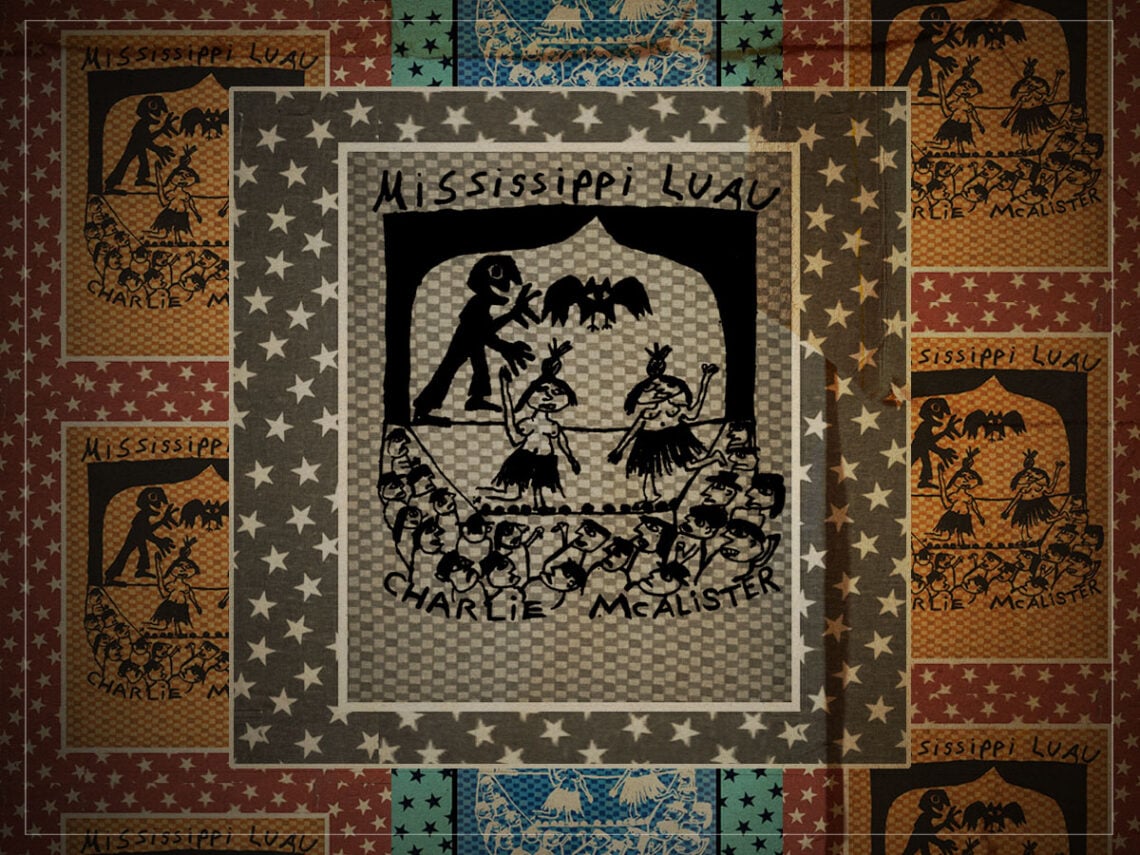
‘Mississippi Luau’: a voyage into the beautiful mind of Charlie McAlister

When artists from one discipline try their hand at another from outside of their remit, the results can often be a catastrophic representation of why we shouldn’t give stars the impression that they’re capable of anything they put their hand to. So often, when someone’s CV reads “actor and musician”, you get a sudden overwhelming feeling that one of those needs to be taken with a slight pinch of salt and that their acting chops might be carrying them into a musical career as nothing more than a vanity project.
However, the closer you get to the fringes of the art world, the less it matters that people are dipping their toes into multiple mediums. You’ll often find that their creations are done with a sense of authenticity and love of the craft rather than born from a desire to remain the centre of attention. As fun as it might be to poke fun at the musical ineptitude of egotistical Hollywood stars, it’s far more satisfying to listen to something that possesses a freewheeling spirit and an unwavering sense of creative spark.
Art shouldn’t have to be polished or refined for it to be enjoyed, nor does it really need to be competent, but it needs to come from a place of honesty. The works of South Carolina multidisciplinary artist Charlie McAlister were never exceptional for their technical mastery, whether with brush, camera or guitar, but they’re gorgeous representations of an endlessly curious and creative mind. While he was prolific as an illustrator, collage artist, sculptor, filmmaker and many other things, one of his most defining works that truly allows you to immerse yourself in the abstract creativity of McAlister is Mississippi Luau.
Released in 1997, Mississippi Luau is a lo-fi folk record of questionable proficiency, with all of its elements slapped on top of each other in a seemingly haphazard way. While this sound collage approach was something that McAlister was known for, the ways in which atonal acoustic guitars clash with the scratchiness of his Carolinian drawl, looped lap steels and scrap percussion sound as though it would be a toe-curlingly difficult listen to drag yourself through.
However, there’s a simplistic and naive beauty to what McAlister delivers on this loosely conceptual record, and the mixing of the folk music of the South and Polynesian culture and history feel so deliberately juxtaposed that their misalignments begin to find harmony in one another. The clattering of the instruments isn’t far beyond the ability that a preschooler might exhibit, but the curiosity to see if he could marry the two cultures together, all tied together by his humorous yet surreal lyricism, is a stroke of wild inspiration.
Seemingly exploring themes of Indigenous culture and the threat of capitalism and colonisation to its existence, McAlister presents a satirical and childlike imagining of what it would be like to merge the world that surrounded him in his hometown of Charleston with the Pacific Islands. The characters he portrays provide conflicting perspectives on how things might turn out, with the Southerners imagining a harmonious and paradisal party where cultures are exchanged and the islanders rejecting outside interference.
The album’s centrepiece, ‘Darla Come Down From Jackson’, is a surreal retelling of the creationist story of Adam and Eve, and the layers of Hawaiian guitars with sleepy swamp blues give it an almost fantastical edge. That is, in fact, the best way of summing up Mississippi Luau as a whole – the work of a daydreamer. Everything that McAlister puts into the album feels like it was done with an exceeding amount of glee, reverie and good humour. It’s ramshackle in an endearing way, and even if the execution is missing, the raw creative spirit is coursing through every moment.
