



Mimi Fariña: The reluctant folk icon

Mimi Fariña is remembered in the cultural consciousness for her evocative guitar stylings on her albums recorded with her husband, Richard, her restorative work with her non-profit, Bread and Roses, and, perhaps most often, for being the younger sister of Joan Baez, notably, standing apart in her talents, even in the wake of the cult-followed contemporaries she shared, becoming a folk icon in her own right.
Mimi was born Margarita Mimi Baez Fariña on April 30th, 1945, the youngest of the three Baez daughters, after Pauline and Joan. From a young age, where Pauline preferred to play on her own, Joan and the four years younger Mimi, were inseparable, even when they would argue, as sisters do, over their looks and talents. “I think Mimi was just as jealous of Joan…[because] Joan was so talented,” their mother, and also Joan, once said, quoted in David Hajdu’s Positively 4th Street, “They were both talented, but…I just know they loved each other so much, I thought sometimes they’d kill each other.”
All of the Baez girls showed an interest in music early on, with Mimi, particularly, undergoing years’ worth of violin lessons: “I did very well, but I was really more interested in singing,” she admitted, “But that was more of Joanie’s thing”. There was a shift for the sisters in the spring of 1954, when their aunt took them to Palo Alto High School to attend a concert in the school’s gym, featuring none other than Pete Seeger, who had been blacklisted two years earlier for his presumed association with communism.
The concert struck young Mimi and Joan; Seeger later recalled Joan telling him that it was that performance that made her realise that she, too, could be a singer. Mimi, conversely, later claimed not to remember the concert at all, but by her aunt’s account, she had also declared that she wanted to become a singer. “Mimi was not exactly a big out-there, out-in-front girl like Joan,” her aunt explained, “But she really loved music… And I thought, ‘Now, how different can two girls be and want to do the same thing?’”
“I was good at the violin, and I was a good dancer, and I knew it,” Mimi later reflected, “Which was such a relief from feeling incompetent”.
“When I danced or played music, I could be who I really was”.
Mimi Fariña
Mimi often quite literally followed in her sister’s footsteps to the point where, when the Baez family moved from San Francisco to Boston in 1958 (where their father assumed a faculty position at MIT), she, at 13 years old, would accompany Joan at the various coffeehouses and clubs she performed at within Boston and Cambridge’s music scene. As her older sister honed her talents in the city’s folk circles, Mimi was doing the same, finding solace away from the mundanity of schoolwork in her guitar and confining herself to her bedroom.
“I was trying to learn guitar without leaving my room,” she once said, as she took up lessons to perfect her classically-trained approach, occasionally performing with Joan around Harvard Square and being recognised for her distinct soprano.


“I know precisely the moment when I got drawn into wanting to play folk music,” she remembered in the Cambridge folk music history book Baby, Let Me Follow You Down, “I was 13. I got a call from Joanie, who was at Harvard Square. I was at home, and she said, ‘Get on a bus and get down here. There’s a group here I know you’ll enjoy’. It was the Charles River Valley Boys at Lowell House in one of their first times playing.”
At 16, she moved to Paris with her parents, leaving Joan in the States to work on her music, while Pauline had married artist Brice Marden, and during this time, she completed high school through correspondence courses as she explored Paris and larger Europe. She starred in a film, studied dance and toured with a ballet troupe in Germany, all within her first year. The next year, she would meet Richard Fariña, a writer and poet, and her future husband.

At eight years Mimi’s senior, Richard was married to another folk singer, Carolyn Hester, but would soon be divorced. They met at a picnic where, upon getting drunk for the first time, Mimi made quite the first impression: “[Richard] was telling stories and embellishing and carrying on and getting us all laughing,” she recounted, “At one point, I laughed so hard that I threw up my sandwich in his face… He just wiped it off his face, laughed really hard and then went on with his story.”
A year after meeting, they were secretly married in Paris, moving back to California, near Joan’s home in Carmel Valley, where they received the Baez family’s blessing and married a second time. Richard worked on his upcoming novel during the day, while at night, the couple began writing music together, with Mimi playing the guitar and Richard playing the dulcimer. Together, their sound was rooted in folk, but traversed other melodies that gave the folk tradition a sort of eclecticism. The couple simply began jamming together and, in place of a recorded debut, they made a live one at the Big Sur Folk Festival in 1964. With only three songs to their setlist, they caught the attention of the audience and record companies, and they eventually signed to Vanguard (with whom Richard and Joan already had publishing contracts).
Mimi and Richard released two albums in 1965, Celebrations for a Grey Day and Reflections in a Crystal Wind; the first saw them return to the Cambridge/Boston music scene, where they performed in the folk houses that Mimi once did with Joan, and became local staples. They celebrated their debut at the Newport Folk Festival, coincidentally in the year that Bob Dylan went electric, performing just hours before him to a standing ovation. “I looked out, and the audience started dancing in the pouring rain,” Mimi recalled of her view at the festival.
“Everybody was getting soaked, and people were laughing and dancing to the music.”
Mimi was undeniably brilliant on the guitar, both technically sound and experimental in scope, and while Richard wrote the majority of the lyrics for their songs, it was Mimi who enhanced their melodies most, providing beautiful tunes alongside her husband’s dulcimer that grounded them both. Reflections in a Crystal Wind emphasised this, and the release of the album saw the duo appear on Pete Seeger’s Rainbow Quest television series, in a sweet full-circle moment for Mimi.
Tragically, the promise of the duo’s music and their marriage would be cut short. Richard’s novel, Been Down So Long It Looks Like Up To Me, had been recently published in April 1966, and on the 30th, Mimi’s 21st birthday, the couple attended a party at a bookshop in its honour. Later that night, at a surprise party for her, Richard left on his motorcycle with a friend and was in a fatal accident, passing at just 29 years old.
Mimi was left to suddenly follow in the footsteps not just of her older sister, Joan, but her husband’s, too, as he became a cult-like icon of the era. She began to search for an identity of her own, and that June, she moved to San Francisco, where she continued dancing and making music, performing at festivals and in clubs across the Bay Area, alongside everyone from the Grateful Dead and Jefferson Airplane to Judy Collins and Arlo Guthrie. She tried her hand at comedy, too, joining The Committee, an improvisational comedy troupe in San Francisco, partly in remembrance of Richard. “Dick loved The Committee, and I think I was testing being him, as if I had gained some of his energy when he died,” she later admitted, “I just thought, ‘This is what I’m supposed to be doing now’.”
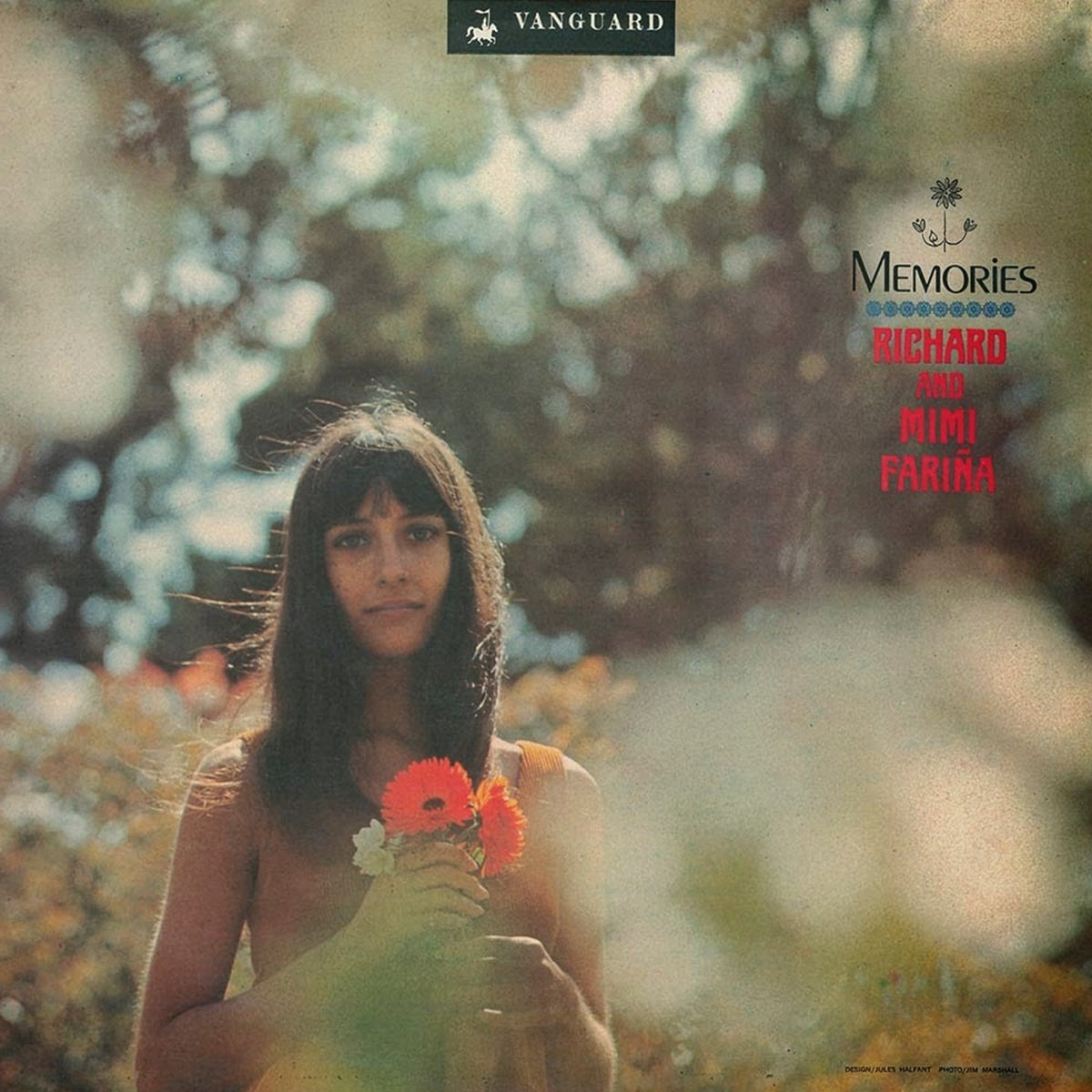
Vanguard released a compilation album, Memories, in 1968, in place of Mimi’s planned solo album, a collection of unreleased songs of hers and Richard’s, as well as duets with Joan and two solo songs. The album’s cover shows Mimi in a field, holding red flowers with a serene yet sad look on her face. It is a photo that she reportedly resented, as time passed, referring to it as “the sad-eyed widow bit”.
She was eventually remarried to Milan Melvin, a producer and radio announcer, in the fall of 1968. Joan wrote her 1969 tune ‘Sweet Sir Galahad’ about their marriage, inspired by the image of Mimi in her wedding dress, and it would become one of her most well-known songs. The marriage only lasted until 1971, but in that time and its aftermath, Mimi regained her confidence as a musician and performer, touring and singing with Joan or the folk singer-songwriter Tom Jans. As a duo with Jans, she recorded their sole album, Take Heart, in 1971, before they went their separate ways the following year. She then recorded a ‘lost’ solo album, which essentially disappeared when she did not want to comply with the rigid nature of the music industry.
“I was looked on as a product,” Mimi later reflected, “I told him that I’d love to hear myself on the radio, but it’s not the aim of my life. I don’t think they wanted me. They wanted something they could package”. A couple of the songs intended for this album found their home on Joan’s 1973 album, Where Are You Now, My Son?, ‘Mary Call’ and ‘Best of Friends’, both of which the sisters recorded together.
Through the ebbs and flows of the music industry, Mimi did eventually find her true calling. On Thanksgiving Day in 1972, she and Joan attended a performance by BB King at Sing Sing Prison in New York, where she saw firsthand the therapeutic effect that the music had on the inmates. She gave her own performance at a hospital after, and it was these two instances that compelled her to found Bread and Roses, her Bay Area-based non-profit organisation that aimed to provide free music to hospitals, prisons, shelters and other institutions. By the next decade, the non-profit spread its message beyond the Bay Area, hosting benefit festivals and hundreds of free concerts annually, with similar organisations emerging as a result.
Bread and Roses became the mission of the rest of Mimi’s life, though she did continue to sing and record music, releasing an album, the aptly-titled Solo, in 1985. “The lure of the stage remains compelling,” she explained of the album’s release, in her Bread and Roses newsletter, “For me, it’s not the glamour of show biz so much as a marvellous means with which to communicate. A song can relate emotions which reach the poet in all of us, and can tap a common ground we often forget to tread. It’s those feelings that inspire me to write and sing.”
Sadly, Mimi would be diagnosed with neuroendocrine cancer in late 1999, which she fought until July 2001, passing away at just 56. “Mimi filled empty souls with hope and song”, Joan shared in a statement after her sister’s passing, “She held the aged and forgotten in her light. She reminded prisoners that they were human beings with names and not just numbers.”
