


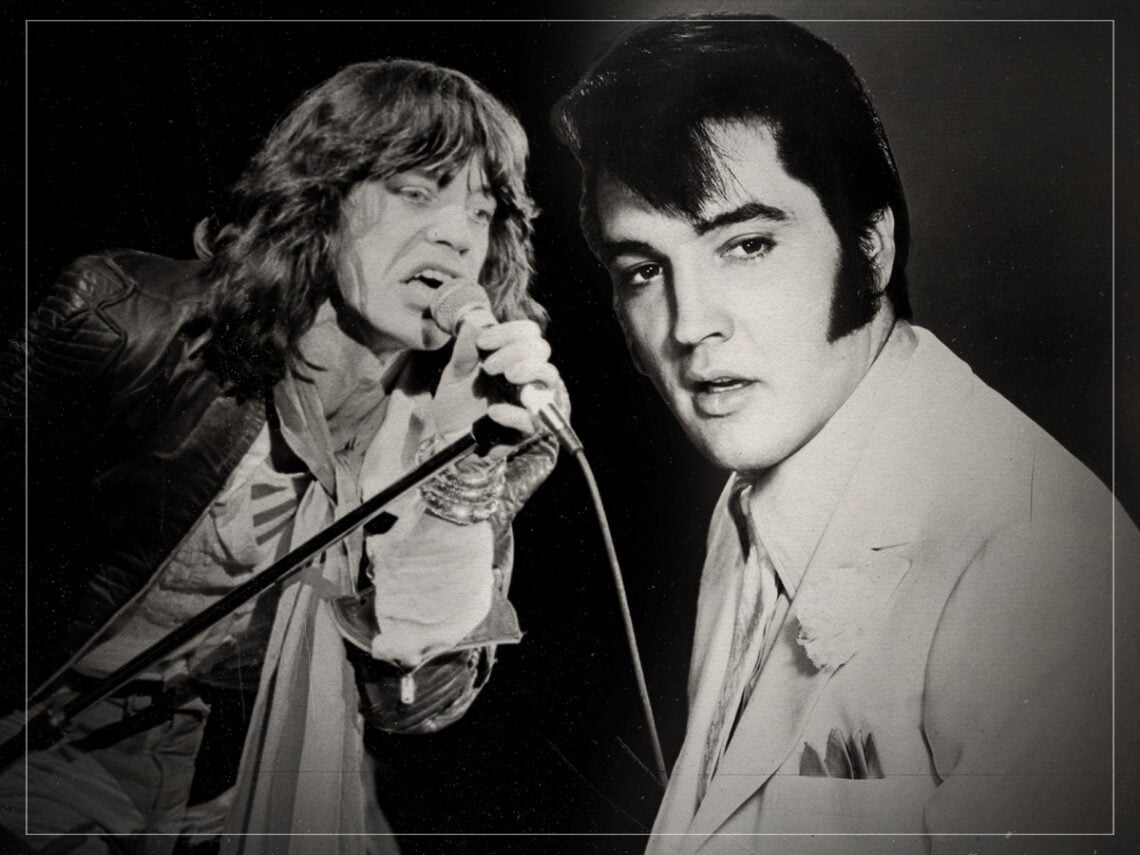
Mick Jagger’s biggest problem with Elvis Presley: “Always a question of money”

When Mick Jagger started taking the stage with The Rolling Stones, he had a catalogue of musicians to build his style from.
Because Jagger wasn’t exactly blessed with the natural vocal or songwriting talent as some of his 1960s contemporaries – namely The Beatles – he sharply realised that his stardom relied on charisma. A charisma that was already baked into his personality, and so, just needed to be extracted into his performative approach.
That’s where the string of inspirations came in handy. Little Richard and James Brown showed him the way, proving that the lyric sheet could be emboldened with an animated performance style. The vibrance bled into The Rolling Stones’ discography of self-written music, and eventually, Jagger became one of the most captivating performers in world music.
But even though Jagger made it incessantly clear that it was Richard and Brown who formed the two pillars of his influence, the world was desperate to link him with Elvis Presley. Presley was, of course, one of the pioneering performers of the 1950s, and like Jagger, helped commercialise the blues-rock sounds that had traditionally been mastered by the black-American community.
So naturally, Jagger and Presley were pitted as kindred artistic spirits, each with a set of wobbling knees to boot. But Jagger wasn’t happy with that. Despite selling out records and stadiums himself, Jagger saw Presley as something of a commercial sell-out, giving himself away to Colonel Tom Parker’s lucrative regime of film soundtracks and Las Vegas residencies.
Jagger saw that as a mark of what not to do, and even pitied Presley, who was seemingly trapped in a world of his own solodom and had no band to help him break out of that imprisonment.
“Presley hasn’t got anyone to tell him what to do, and really that’s what he needs more than anything else,” Jagger said. “His trouble is that it was always a question of making money. So Elvis is still fantastically successful. Why? Because he makes money, and he made his comeback because of Tom Jones or whatever. Anyway, that’s what I’ve been told.”

It’s hard to pin the blame on Presley himself, however. As much as we like to believe that he was a self-made icon, whose style was built on the back of his own autonomy, the reality was anything but. It’s hard to agree with Jagger in saying that Presley himself was concerned about the money as much as his manager, Colonel Tom Parker.
Having spotted him at an early age and seen the financial opportunity, Parker essentially had him locked into a tightly woven contract for his whole career. It meant he never left America to perform and was subjected to starring in a string of Hollywood films, which allowed him to pen the soundtrack and ultimately double his earnings.
Inside Presley was the heart of a curious and innovative artist, eventually stamped out by the bureaucratic approach of Parker himself. One thing Jagger was right about was the change that could have beckoned, should Elvis have found himself in a band.
