


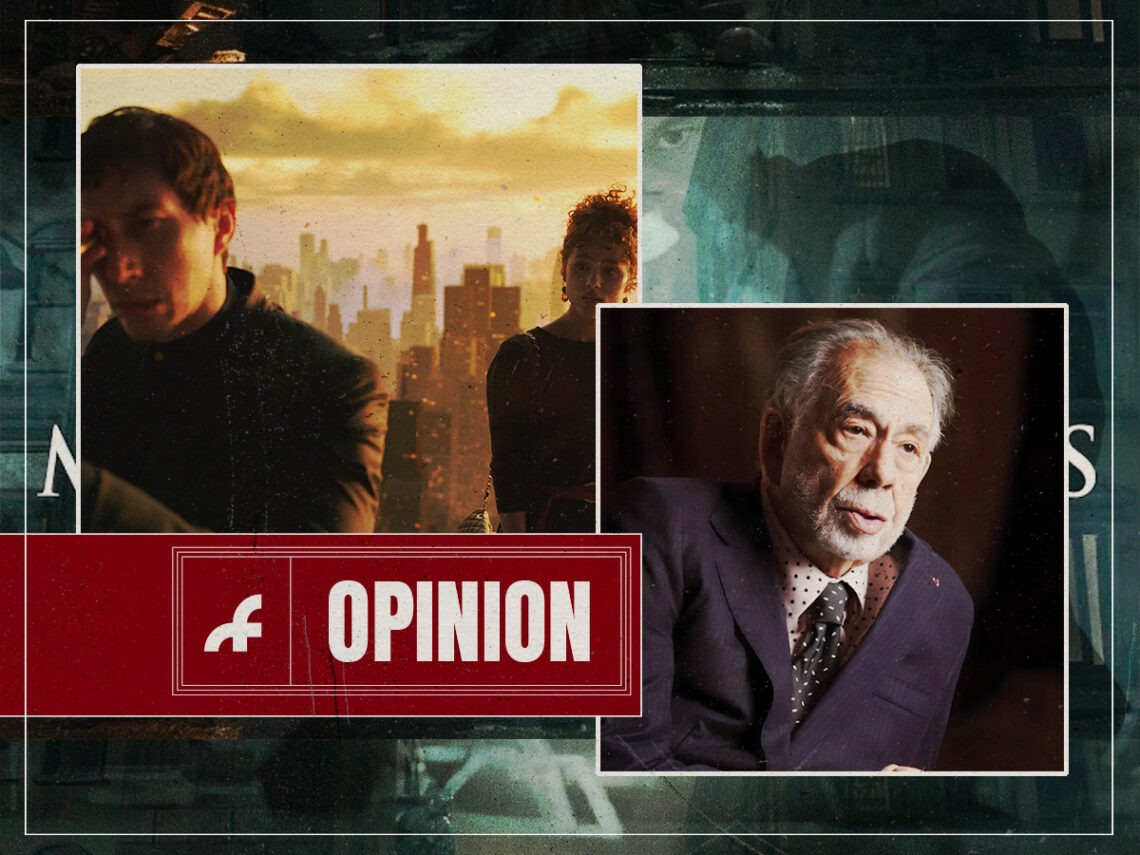
Hear Me Out: ‘Megalopolis’ being anything other than wildly divisive would be a disappointment

It sounds counterintuitive to what cinema is supposed to be about, but the best possible outcome from Francis Ford Coppola’s Megalopolis is that of lines being drawn in the sand between those who think it’s the legendary filmmaker’s latest masterpiece, and the others who claim it’s one of the worst movies ever made.
With five Academy Awards under his belt and his status as the director responsible for at least three of the greatest films ever made in The Godfather, The Godfather Part II, and Apocalypse Now, Coppola’s place in the annals of film history has been set in stone since the 1970s. While it would have been a nice professional pat on the pack for Megalopolis to be unanimously received as such, that doesn’t do true justice to its existence.
After all, it’s the first feature in 13 years from a maverick auteur who already declared bankruptcy multiple times due to their repeated insistence they funnel millions of their own dollars into their passion projects regardless of what the critics and the ticket-buying public think. The added benefit of his sweeping sci-fi drama, having spent 40 years in development, is that it was an idea Coppola always had but was never able to let go of.
He sold off a huge part of his wine empire to foot the $120million bill from straight out of his own pocket, which is completely and utterly insane. The man is into his 80s and could have quite happily enjoyed a quiet, lucrative, and stress-free life away from the cutthroat world of Hollywood. Instead, he decided to mount one last great fuck you to the establishment by investing nine figures into a bewildering three-hour epic that wasn’t even guaranteed to secure a distribution deal to play in cinemas.
Incorporating intentionally anachronistic production techniques, lavish sets, ornate costumes, and a fourth-wall-breaking moment that begs the question of how it’ll factor into theatrical screenings of the film, Coppola could not have cared less about the optics of Megalopolis when he decided that because he had the money and passion to make it happen, he was going to make it anyway. It’s a bonkers undertaking at every single level, and it wouldn’t be so entrancing were it not proving to be so polarising.
If it had been universally embraced as a masterful work of cinema from the second the credits rolled on its premiere, then Coppola would have been vindicated and justified in the mammoth, decades-spanning enterprise that is Megalopolis. Admittedly, some of the reactions have toed that line, but just as many have been wondering why the hell he persevered for so long with a self-indulgent and pretentious exercise that displays how anyone can realise their own vanity on-screen if they’re wealthy enough.
Had Megalopolis been showered in nothing but the utmost admiration, then it might have a better chance of doing a decent turn at the box office. Not that Coppola cares because there’s almost no chance it’ll be anything other than a huge flop. He made it his way, which was all he ever wanted, and it’s a great deal better off as a contentious head-scratcher than one last prestigious hurrah from one of the best to ever do it.
The sheer breadth of the responses has turned it into one of those movies that every cinephile needs to see so that they can make their own minds up, which has inadvertently turned the filmmaker’s latest triumph/folly/delete where applicable into one of the summer’s hottest cinematic talking points.
