


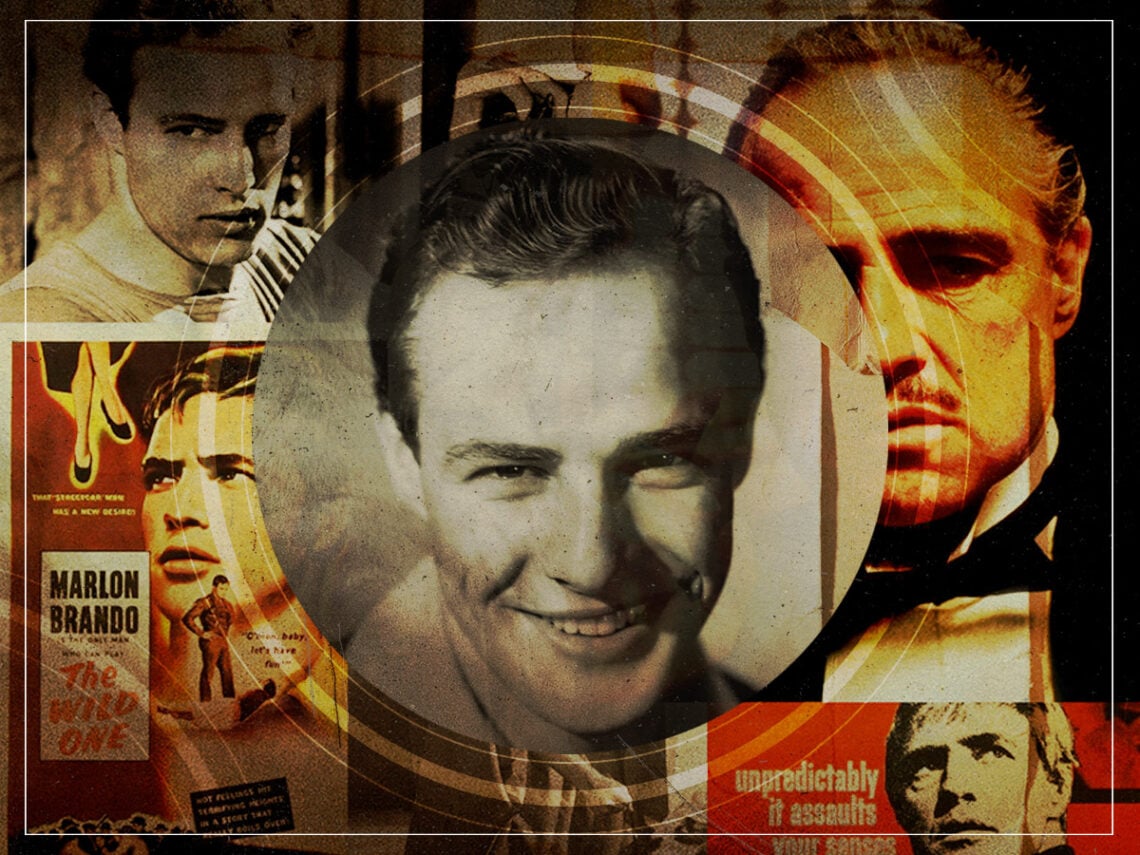
100 years of Marlon Brando: the icon who revolutionised, ruined, and reviled acting

The easiest way to gauge anybody’s legacy and influence on their chosen profession is to look at how it existed before and after them. When it comes to acting, there’s not a shred of doubt in a single mind that Marlon Brando is unquestionably one of the most influential thespians to have ever graced the silver screen, and he might just be the most important in history.
There’s acting before Brando, and there’s acting after Brando. It’s that simple, with a clear distinction being drawn between the way performers conducted themselves on-screen before he first rose to prominence in the 1950s and the adoption of his signature techniques, naturalistic tendencies, and effortless gravitas as the norm that’s been prevalent ever since.
Of course, there’s only ever going to be one Brando, and the list of legends, icons, and heavyweight talents he’s directly inspired adds another layer to his legendary status. Robert De Niro, Al Pacino, Gene Hackman, Dustin Hoffman, and Jack Nicholson can all comfortably be listed among the all-time greats in their own right. Still, it goes without saying they were clearly more indebted to Brando’s revolutionary approach than the classic silver screen stars of the Golden Age like Cary Grant, James Stewart, and Clark Gable.
A staunch proponent of the method style, Hollywood acting in the pre-Brando era was broader, showier, and theatrical. Once A Streetcar Named Desire and On the Waterfront were released to shoot him into the stratosphere and win him an Academy Award for ‘Best Actor’ in the latter’s case, everybody with their eyes on an acting career wanted to be like him. It was out with the old and in with the new and never again has acting seen such a sweeping shift in sentiment as it did in the wake of Brando’s transformative, trailblazing, and game-changing work.
The downside is that it made method the go-to way of working for every single aspiring star who wanted to emulate Brando, of which there were many. Fast forward seven decades and the debate over its merits continues to rage, with opponents remaining adamant that it’s a gimmick used by certain names for no other reason than to feed their ego, allow them to wax lyrical about ‘the craft’, and generate easy buzz for a marketing campaign.

Of course, that isn’t entirely true of them all, especially when so many of the best actors of the modern age are famed for their method approach. Still, Brando instigated such a landscape-altering shift in the art form that its lasting effects haven’t been entirely positive. Kirk Douglas was a star cut from a more classical mould, lived to the ripe old age of 103, and saw his son follow more in his own footsteps than Brando’s, so he was well-qualified to pass judgment on The Godfather icon’s lasting impact.
He didn’t shower it in praise, either, explaining to Dick Cavett that Brando’s titanic reputation and status as the spark that changed acting forever was a detriment. “He has ruined more actors because people try and imitate that style, but they can’t,” he suggested. “He also opened the door to a lot of bad acting because you’ve got those actors that go, ‘Well, why should I go from here to there? I don’t feel like it doesn’t motivate me’… No, I think Marlon introduced more bad actors because they tried to imitate that which was very unique and original to him.”
Regardless of whether or not the generation-spanning shadow Brando cast over acting yielded more positive or negative outcomes, one thing which cannot be argued is that he fell out of love with it eventually. After winning his second Oscar for The Godfather, he embarked on the next stage of his career, which would ultimately serve as his extended final act: that of an unprepared, uninterested, and unmotivated troublemaker.
Brando refused to learn his lines for a brief and very lucrative cameo in Richard Donner’s Superman, showed up drastically out-of-shape and listless for Coppola’s Apocalypse Now, and performed scenes in his underwear on a whim and refused to be directed by Frank Oz in The Score. He not only made ridiculous demands during the production of cursed failure The Island of Dr. Moreau but also mounted a rejected request to be removed from the credits of Christopher Columbus: The Discovery despite being paid $5million for the role. All of this doesn’t even include the repeated announcements of his retirement and subsequent backtrackings that characterised him as a difficult customer.
Still, people were willing to bend over backwards to hire him specifically because of who he was, even though he’d spent the better part of two decades making it abundantly clear that his heart wasn’t really in it anymore. From being one of the most intensely dedicated and fiercely committed actors in the industry, Brando ended up coasting by on his name and reputation to the point it was much more of a surprise if he didn’t cause any behind-the-scenes chaos.
Brando revolutionised and reinvented acting when he exploded onto the scene, created an endless debate over whether irrevocably and inadvertently reshaping it in his own image was a good or a bad thing, and then became openly disdainful of being asked to do even the basics like learning lines, all while repeatedly wreaking havoc on a number of productions. It’s a complex, complicated legacy just like that of the man himself, but one thing that’s inarguably true is that there’ll never be another like him ever again.
