


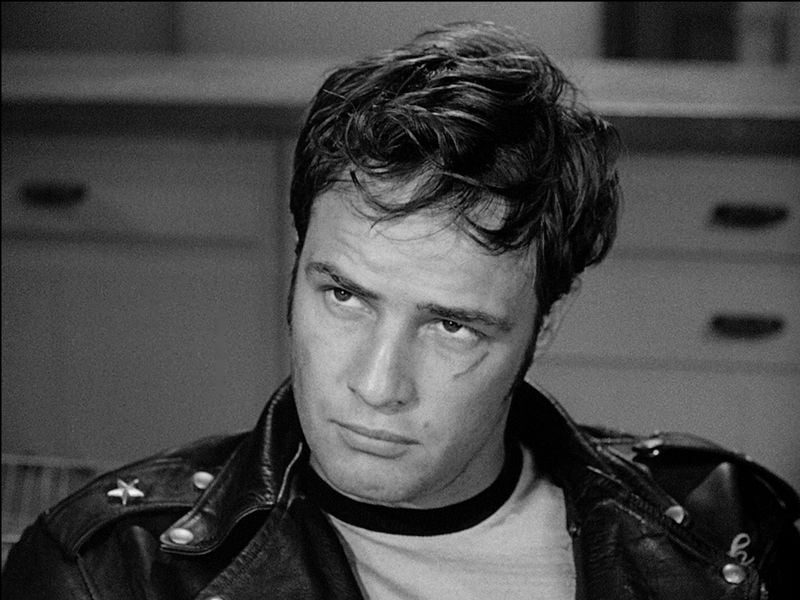
How Marlon Brando changed Hollywood acting forever

Marlon Brando is quite possibly the most celebrated male actor in Hollywood history – and for good reason. Born to a calcium carbonate salesman in Omaha, Nebraska, Brando left his disproving father and scolding teachers behind in 1943 and started a new life for himself in New York, where he enrolled in Erwin Piscator’s Dramatic Workshop at the New School. His mentor was Stella Adler, a member of the famous Yiddish Theatre acting family, who was responsible for introducing the young actor to the New York stage and teaching him the “emotional memory” technique espoused by Russian theatre director and practitioner Konstantin Stanislavski.
Brando’s use of method acting practices such as the Stanislavski technique may well have inspired the intensity behind his performances in movies such as A Streetcar Named Desire and On The Waterfront, changing Hollywood acting forever. His early roles stood in stark contrast to the stagey, occasionally bloated performances of Golden Age actors like Cary Grant and Lawrence Olivier.
Adler held the utmost reverence for scripts. Unlike her partner, Lee Strasberg, Adler believed that actors should find truth in the script itself rather than forming direct connections between their life and that of the character. She taught Brando to familiarise himself with the circumstances surrounding each scene and to study anything that might help him understand the motivations of his characters. This, Adler believed, would allow for an authentic sense of emotion. Emotion was, after all, the be-all and end-all for Adler, who argued that the actor’s role was to use emotion to command the attention of the audience as much as possible.
Brando certainly commanded attention. Sure, there were attention-grabbing performances in the days before Brando, but method techniques allowed for more nuanced, realistic performances, perhaps because actors like Brando were no longer acting for themselves but for the script. The emotional depth of his performances inspired countless actors in the subsequent decades, including Edward Norton, who also studied method acting before embarking on a successful Hollywood career.
Discussing the effect of Brando on Hollywood, Norton said: “Brando had such an enormous influence on the psychology of men in America. If you look at the “great” generation of American actors like Dustin Hoffman, Robert DeNiro, Robert Duvall, Gene Hackman, Al Pacino, Morgan Freeman, Meryl Streep, that’s all the post-Brando generation. All of them wanted to become actors because of Marlon Brando. He so rewrote the idea of what it was, what it could be. It was like what Bob Dylan did in the culture. It just rewrote the game.”
He continued: “There are these people who come, and they have a kind of permanent before and after in a certain kind of field. He [Brando] changed the idea of the type of person male actors wanted to be. They to be visceral, not polished; they wanted to be masculine; they wanted to be masculine; they wanted to be intense. When you look back on Jimmy Stweart, Cary Grant, like that is not what movie stars were aspiring to.”
