


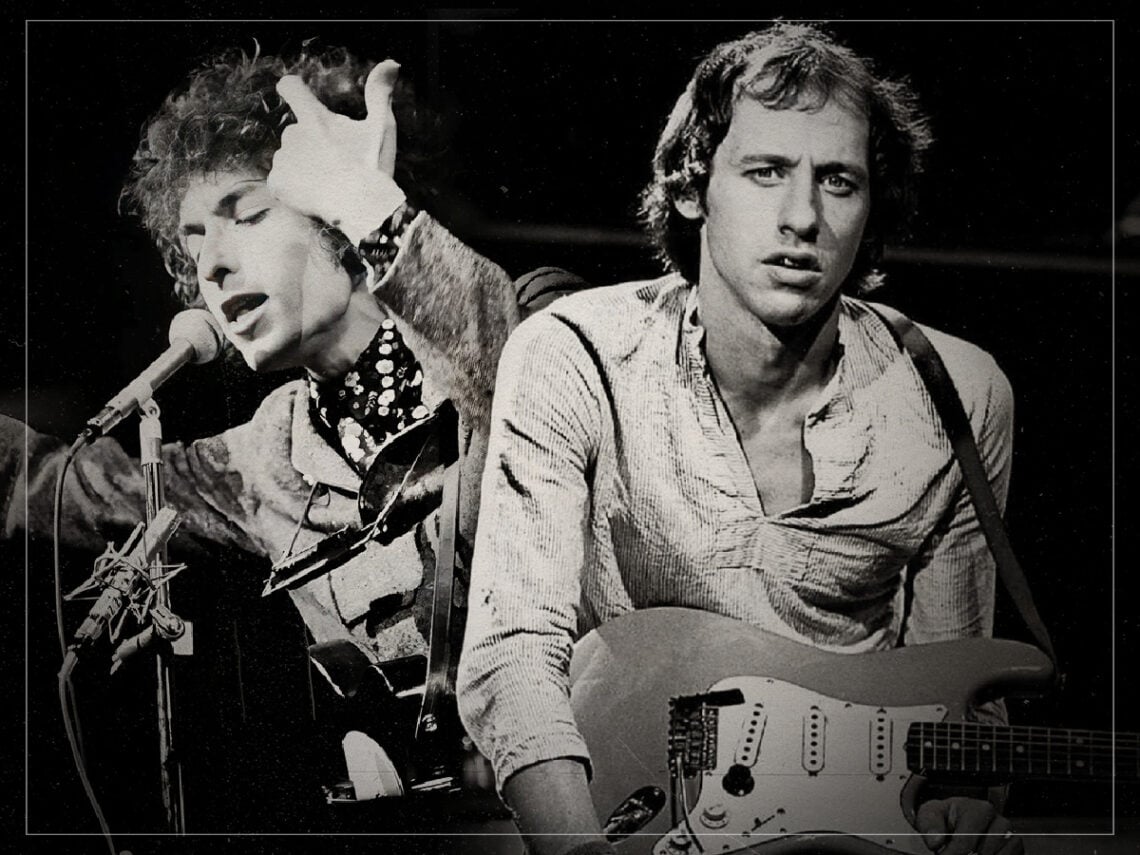
“I’m bored with this”: Mark Knopfler’s difficult collaboration with Bob Dylan

When Cate Blanchett took on the character of Bob Dylan in Todd Haynes’ I’m Not There, she put a sock down her pants in order to feel more masculine.
This isn’t a point about gender essentialism; rather, Blanchett played a pretty dickish version of the legendary star, one who was flipping off the mainstream media in his move to the electric guitar. This is a point about Dylan having big dick energy, which, in turn, made him into a big dick to be around.
You’ll find anecdotes of Dylan sprinkled all over the internet, from the rich and the famous who loved the ‘Subterranean Homesick Blues’ singer to the candid and soul-crushed who couldn’t stand him – Mark Knopfler, the lead guitarist and frontman of the rock band Dire Straits, might’ve expected to fall into the former category, but his experience with Dylan pushed him closer to the latter.
The pair had worked together once in 1979, when Knopfler played guitar on Dylan’s faith-centred album, Slow Train Coming, after Dylan saw him in concert and was impressed with the showmanship on display, and upon their second collaboration, it was Knopfler’s production skills that Dylan was interested in, he offered the Scottish musician the chance to work on his 1983 album, Infidels, in New York City. This isn’t the kind of offer you turn down.
However, far from the relative ease of their earlier partnership, producing an entire project was a bigger beast entirely. Knopfler has been candid about the fact that Dylan was one of his childhood heroes, but he quickly lost that doe-eyed adoration in the process of sharing a sweaty studio with the sour-mouthed star.
Wanting his best troops ready for battle, Knopfler brought in keyboardist Alan Clark and engineer Neil Dorfsman, who had worked on Dire Straits’ 1982 album, Love Over Gold. Thankfully for us, it was Dorfsman who would shine a light on the head-butting that went on as the two musical geniuses attempted to find the project’s through-path.
“I don’t want to use the wrong word, here, but Bob was also a little bit of an agent provocateur, or he even had a little saboteur in him,” Dorfsman told Uncut sheepishly.
“If things were going maybe too well, in somebody else’s definition, he would consciously make an effort to make that stop.”
Dorfsman painted one specific picture of a particular session, where Dylan was despondent over a half-eaten sandwich, something itching below his skin. He was a star, and he could do anything, so why shouldn’t he attempt to include the tinfoil wrapper from his lunch in the album? Petulantly, Dylan began flexing the tinfoil into the microphone, like the simulacrum of an accordion creating fierce feedback.
”It was just his way of saying, ‘I’m bored with this, I don’t want to do this particular song anymore,’” the engineer recalled. Dealing with the antics of a grown man-child, Knopfler began to realise the challenge was bigger than he’d come to expect. However, much the gentleman, he’s remained extremely complimentary of their time together in the studio, admitting only it was “strange at times with Bob” but he learnt to be “sensitive and flexible, and it’s fun”.
Sure, we (won’t) take your word for it, pal.

Never Miss A Tale
The Far Out Bob Dylan Newsletter
All the latest stories about Bob Dylan from the independent voice of culture.
Straight to your inbox.