


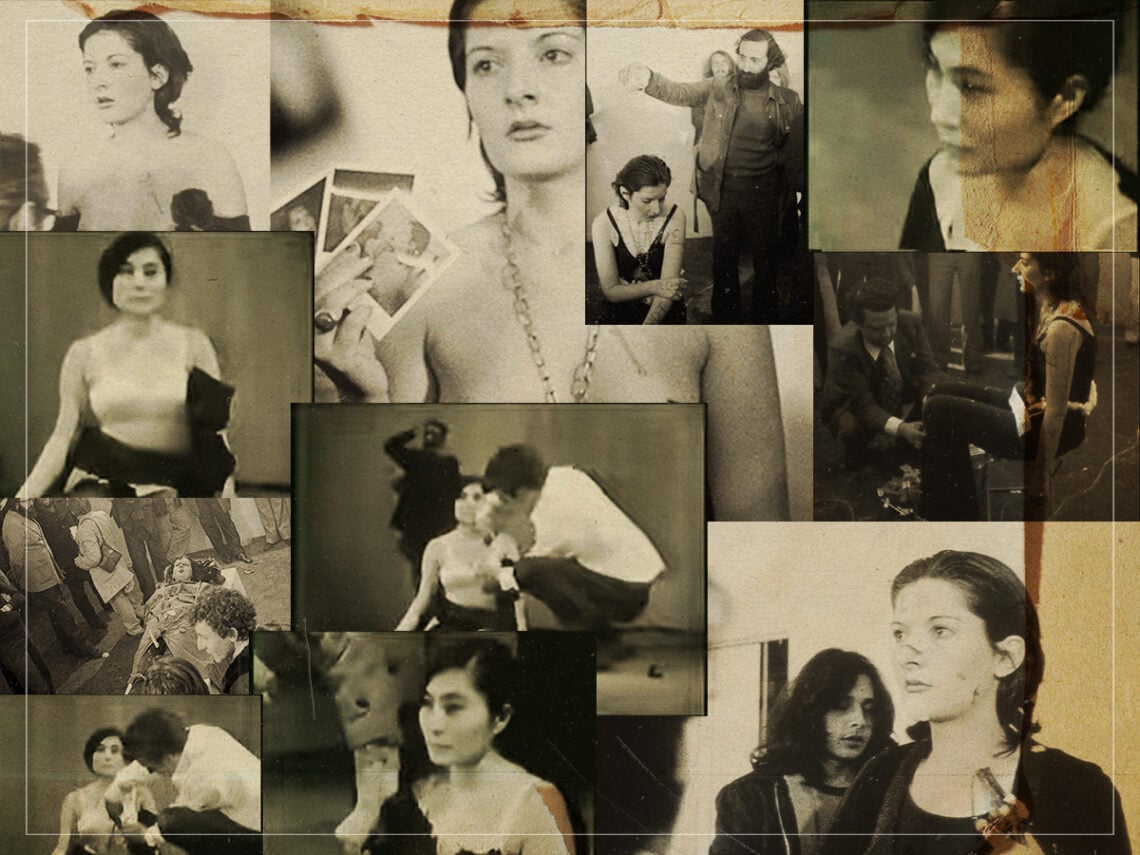
Marina Abramović’s ‘Rhythm 0’ and Yoko Ono’s ‘Cut Piece’: art from the confrontation of violence

What would man do if they went unchecked? Or, maybe, more honestly and specifically, what would men do if they were unchecked? In a room with free rein, a woman in the centre unable to move or speak or mete out any consequences, what would happen? Marina Abramović found out and never recovered.
In 1974, the performance artist did a piece that she never truly came back from. Rhythm 0 was an experiment in trust, in a way, but also a piece that confronted people’s desire to break it. Abramović stood in a room in a gallery in Naples. In front of her on a table, there was a selection of props: a rose, a feather, a gun and a bullet, scissors, wine, grapes, nails, perfume, a scalpel and more. Some could inflict pleasure, some could inflict pain; the choice would be up to her audience.
Everything was up to her audience, or her participants. She simply stood there and let anyone do anything. She wrote her intentions as instructions, stating:
“There are 72 objects on the table that one can use on me as desired.
Performance.
I am the object…
During this period I take full responsibility.
Duration: 6 hours (8 pm – 2 am)”
At first, people were gentle, offering her the food and tickling her. Then it began to escalate as the people started kissing and touching her. By the third hour, her clothes were cut off.
This is where the line of reference is drawn to another starkly confronting piece. In 1964, ten years prior, Yoko Ono sat in Yamaichi Concert Hall in Kyoto, Japan, doing her first performance of Cut Piece. The image is similar: a woman still, the participants moving, and the invitation for the audience to behave as they would if there were no consequences. Ono only had one prop, a pair of scissors and people were invited to come up and cut a portion of her clothing off to keep. The initial intention was inspired by Buddhism and the idea that giving in this way was a removal of the ego. But as the performance went on, it became less about that.
A 1965 performance of the piece at Carnegie Hall followed the same horrific pattern as Abramović’s experience. At first, people are quiet and respectful, snipping off small, inconsequential pieces of her clothing. But as time goes on and male participants begin cutting more and more, Ono becomes visibly nervous. It ends with one man leering and laughing as he cuts her entire top off. He jokes, “This might take a while” as he snips at her clothes. The rule is to cut one piece to take it. Not only does he push the limits of this by taking her entire remaining top, but he can’t resist causing further destruction by cutting her two bra straps, forcing her to move and hold her breasts to remain covered.
That’s the moment things change. The purpose of the art or how it’s perceived switches in that moment because the man breaks the rule. He’s no longer following the instructions. Even as he arrogantly cuts at her top, he’s still within Ono’s boundaries and maintaining, to a degree, her intention. When he simply cuts her bra and takes nothing, he breaks it. That’s the point where one critic remarked that it now feels “more like a rape than an art performance”.
Not to pit two harrowing experiences against one another, but Abramović’s ended worse than that. Three hours into Rhythm 0, she was naked. Four hours in, someone cut her neck with the scalpel and drank her blood. As the hours went on, she was assaulted, injured, and violated. She wept but still didn’t move, dedicated to the performance. Things ended with one man loading the gun and pointing it at her head; finally, the rest of the participants decided things had gone too far, and a fight broke out to stop any further escalation.
After the sixth hour, when the performance ended, Abramović merely took a step towards the participants who had spent the last hours essentially torturing her. Everyone ran away.
The two performers see their performances differently. For Ono, Cut Piece is still about giving and ego, while others see it as a feminist artwork highlighting the way women’s bodies are treated. For Abramović, though, Rhythm 0 was genuinely harrowing in a way she is still grappling with.
“What I learned was that […] if you leave it up to the audience, they can kill you,” she said after the fact. Even in a 2010 interview, she said, “I still have the scars of the cuts,” adding, “After the performance, I have one streak of white hair on my head. I cannot get rid of the feeling of fear for a long time.” She’s remarked before that she felt like, for years after, her subsequent work was in constant response to the trauma Rhythm 0 caused her.
What’s the point? Both artists chose to do these things. They chose to stay still and take it and simply see what happened—but that’s the point. In both performances, Ono and Abramović confronted the desire, the urge or excitement to violate women’s bodies. By promising a lack of consequence with their stillness, both confronted how quickly an audience, and a male audience, will land on violence and violation, creating two harrowingly confrontational pieces.
