


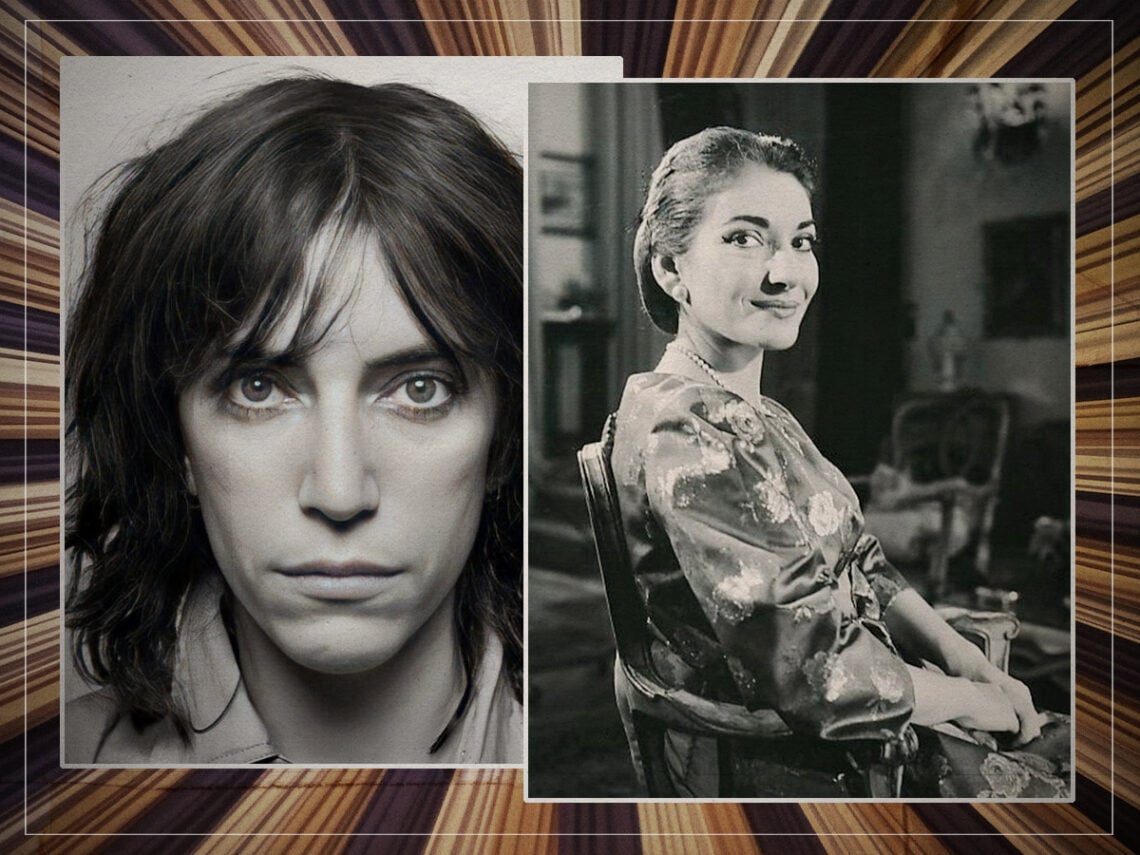
Maria Callas: the legendary soprano who inspired Patti Smith

When thinking of Patti Smith, a beautiful singing voice isn’t the first thing that comes to mind. As the poet laureate of punk, her legacy is defined by a raw, power-driven growl that delivers literary verses with unrestrained intensity. So, when she named Maria Callas—renowned for her operatic brilliance—as one of her biggest inspirations, it was a surprising revelation that even her most devoted fans likely wouldn’t have anticipated.
Obviously, across Smith’s discography, there are moments of power and emotion and goose-bump-inducing vocal performances. ‘Easter’ is tender and hypnotic. ‘Because The Night’ sees her go all out for a pure rock anthem, allowing her voice to soar to stadium-filling sizes. On rougher tracks like ‘Gloria’ or ‘Dancing Barefoot’, she lets her vocals be gruff and growling on the sleazy rock tracks. More of a performance poet than your typical rock star, Smith’s approach to her vocals all feels like part of her storytelling as she delivers the song with whatever style or emotion she thinks it needs, allowing her voice to be another instrument or another vehicle for the tale she’s telling.
In that way, the connection between herself and the famed opera singer Maria Callas makes sense, no matter how unlikely the link is. Born in New York City to a Greek family, Callas made her name for herself as a soprano, building a legacy as one of the most renowned and influential opera singers in history due to her stunning voice and incredible range. But most of all, Callas is praised for her drama. She didn’t just sing songs beautifully, but she truly performed them, allowing her voice to fully embody whatever emotion the song called for.
“From her I learned how to develop a narrative within a song, to tap into the emotional content,” Smith told New York Magazine. When discussing her biggest influences, Callas’ name comes up alongside a more expected class, including Bob Dylan, Neil Young, and even directors like Jean-Luc Godard. But while she admits Callas is an unexpected inspiration, it’s one that actually makes much more sense than the surface might suggest.
Punk and opera singers don’t get any more different. Though existing on two totally opposing ends of the cultural spectrum, both rebelled against expectation. Both defied their small-town origins as Smith ran away from her job at a factory for a bolder life in New York, and Callas refused to be held back by wartime poverty or her strict family as she pushed for a career in the arts.
Both, too, faced tragedy and trauma. For Smith, her life has been marked by a series of devastating losses, including her husband, her brother and several important friends. For Callas, it was affairs, betrayals by her peers and an enduring discomfort with the trappings of the success she’d worked for.
“She paid a tremendously difficult and expensive price for this career,” Callas’ close friend John Ardoin once said of the singer, but yet, she kept making art, just as Smith did in the wake of grief.
So while Smith’s voice sounds absolutely nothing like Callas, her music is in no way comparable and the two women couldn’t be more different in terms of style, Smith sees a kind of kinship between them, or at least a shining light of inspiration that ties her to the opera singer.
“She’s a great teacher, even if one doesn’t have the range, the voice,” she said, counting herself as a student.
