


Head in the clouds, feet in the sea: Makarska through the eyes of local artists

Vedran is tracing his country’s border. Being pinched between Slovenia, Hungary and Bosnia, Croatia starts off bulbous and then tapers to a point as it reaches the Adriatic. “When the Holy Roman Empire was new,” he tells me, pointing to a busy strip of the map, “They decided to put the East-West border right here, setting off 1000 years of political history.”
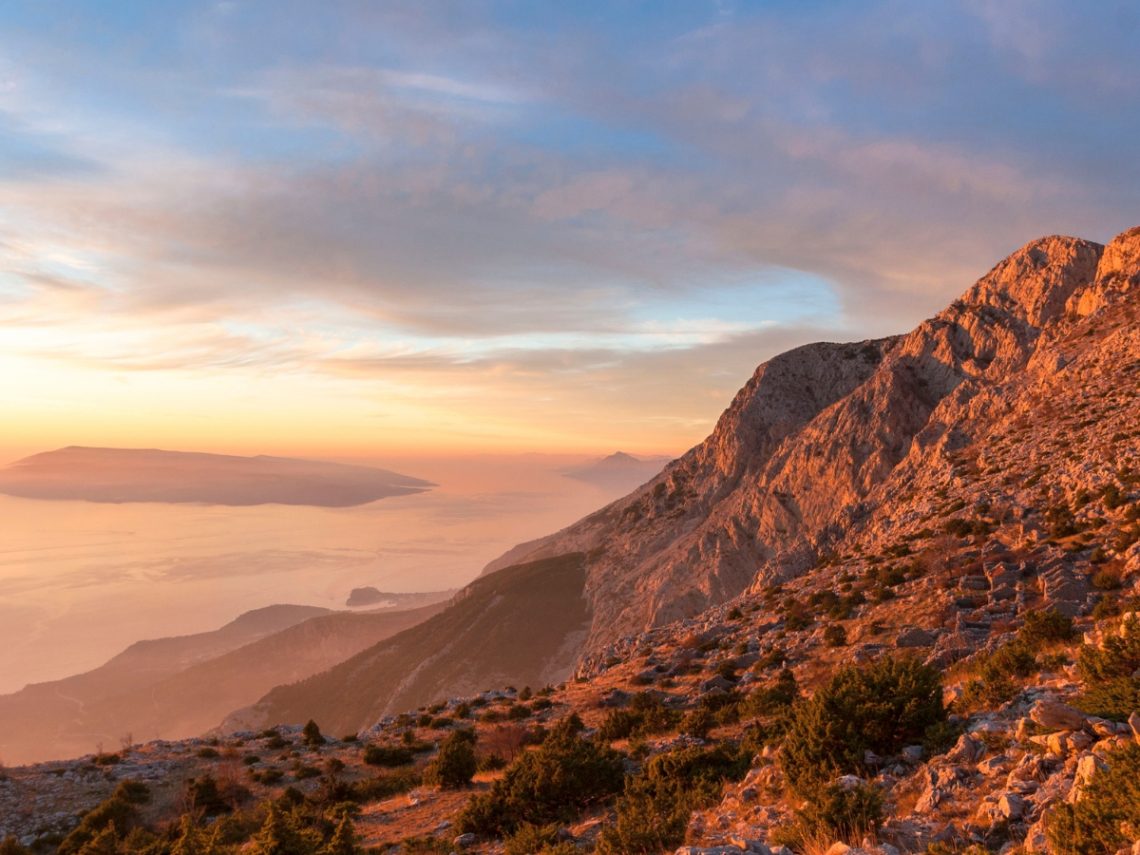
He looks out towards Biokovo, a limestone cloud looming above the town. “We sit on a border too, but ours is more natural. You have the mountains,” he says, drawing an invisible line with one hand. “And then there’s the sea. In between, that’s Makarska.”
Vedran, my guide, has lived here his whole life. And although he admits to preferring the nightlife in nearby Zagreb, it strikes me that he’d do anything for this town, much of which is startlingly new. After the Second World War, Makarska was a ruin. Allied bombers used it as a dumping ground, blasting great swathes of the nearby Baroque town into pale dust. When the smoke finally settled in 1945, brigades of young Makarskans set about rebuilding it. “They were proud,” Vedran says.”They wanted to be the first to build this new road or that new bridge.”
What bombs had done, earthquakes had been doing for centuries. This area of Dalmatia sits along two tectonic plates, hence why the Biokovo mountains spring up out of nowhere. There was a time when these mountains were speckled with small limestone villages. But after the war, lured by the prospect of the sweet life, the villagers, many of whom had fought as Partisans, began trickling down towards the sea. Today, the mountains are empty of human habitation while the coast is full to the brim.
Krešimir Žanetić, photographer
Krešimir, a local wildlife photographer and environmental activist, remembers growing up in Makarska in the 1960s. Like so many Makarskans, he was shaped by the presence of Biokovo. “This is a unique landscape. These mountains, this coast, these islands: back when I was younger – 25 years ago or so – it was very different. I had a strong connection with nature from the beginning because my parents were hikers, and that’s how I got interested in the mountains and nature photography. He turns and gives an embarrassed smile: “That and BBC nature documentaries.”
Krešimir is taking me to one of his favourite spots in Makarska: a forested peninsula heavy with the scent of pine. In the dying light, a statue of St Peter stands with his back to the ocean, a key held firmly in one hand.” We used to be a small city,” he says, suddenly nostalgic. “We had these long beaches. When I was younger, my grandmother lived in this yellow house. All my childhood took place in that house and on that beach. After that, it was big hotels. Now we don’t live on the beach, and houses like my grandmothers have disappeared. “
Krešimir started working as a professional photographer in 1997. He spent ten years as a photojournalist before going freelance in the mid-’00s. “When I started working as a commercial photographer, I had this strong urge to conserve the nature around Makarska,” he says, “To use art as a way of preserving things. I spent four years collecting garbage from beaches. Here in Croatia, if you see garbage, you can’t collect it because you don’t have permission from the government. They allowed me to do it because I drew attention to the problem. I made a sculpture: I put all the rubbish in one spot, and everyone saw it. It was a totem. Then Covid came along and ruined my concept. Ecological problems are only problems when people don’t have war or pandemics to distract them.”
At the top of St Peter’s Island sits a brick church surrounded by gnarled olive trees and shattered stone. Here, Krešimir shows me some of his recent work. His photos capture the dizzying abundance of life in Biokovo.
Mouflon locking horns, bees gathering nectar from heavy-headed flowers, trees weeping with sap: all are captured at their most dynamic, as though Krešimir walked into the landscape at the exact moment it exploded into being. “I use old techniques,” he says. “No hides or long lenses – it’s just me and my camera.” He points to a triptych of a baby Mouflon jumping on its hind legs. “I was just walking, and I came across him like this – he was very young.” With the goat springing himself into a frenzy, Kresimir pulled out his camera to capture it mid-Bacchanalia. “I went back the next week,” he adds, “He’d been shot – by hunters.”


Vice Glibota, Sculpter
After leaving his hometown to study at the Academy of Art in Bosnia, local sculptor Vice Gilbota decided to return and settle down. “The main thing that brought me back was my family,” he says. “I also had the opportunity to fix up my permanent art studio in Makarska. I find the area inspiring.” Vice is bubbly and full of optimism. He and his wife have just had their first child, a daughter, and I can’t help but wonder if it’s her future he’s thinking of when he talks of dystopias. Images of apocalypse define Vice’s most recent series: a collection of gaunt, industrial sculptures that he describes as “relics of something that has not yet happened but could happen.”
There is violence here. Vice’s pieces are angular, post-industrial and frequently Frankensteinesque. Whereas Kresimir’s photographs attempt to preserve Makarska’s natural splendour, Vice’s sculptures remind us of the brutality we inflict on our environments. Some look like 3D blueprints of cities from which nature has long since receded; others are imagined artefacts local fishermen might find tangled in their nets. “I’ve been trying to show people that Dystopia isn’t a binary thing; it’s more like a greyscale. So the right question would be: where are we on that greyscale? We are definitely living in some dystopia, but we don’t know where we are yet. I’m trying to make people think about it.”
We decide to grab a drink at one of the many bars along the harbour, where I ask if there’s a place local artists like to hang out. “Not really,” he laughs. “We tend to keep ourselves to ourselves. But Betty is great – that’s in the old town.” I’m still curious about why Vice decided to return to Makarska, given that he was surrounded by fellow artists in Bosnia. Like Kresimir, he seems to have felt the pull of the landscape: “Even when I was a little boy, I used to climb the mountains,” he says. “I always found their secrecy and grandeur so inspiring. A simple texture or a source of light between cracks in the rock continues to serve as a catalyst to create. It’s strange how a small, seemingly unimportant natural texture to someone else can spark such creativity in me. It could be a texture or a shape. My work tends to be tessellated, like fractals, so I find lots of inspiration from the rocky places at the shorelines, which are really tessellated – full of small pieces gathered together.”
For Vice, the shoreline is a wealth of inspiration. Makarska is one of the oldest towns on the Croatian Adriatic, and it’s believed that humans have been settling here since 6000 BC. It’s been occupied by the Romans, the Venetians, The Ottomans and the Austrians, all of whom left their mark. The water swirls with stories, connecting Makarskans to their long past and complex future. Vice’s work, it seems to me, is a product of both.


With Split to the West, Dubrovnik to the East, Biokovo to the north and the pale blue Adriatic to the south, Makarska is perfectly situated if you’re looking to explore all that Dalmatia has to offer. If you want to learn more about this unique landscape, read about our trip to the Biokovo mountains here. You can also find accommodation recommendations here.
