


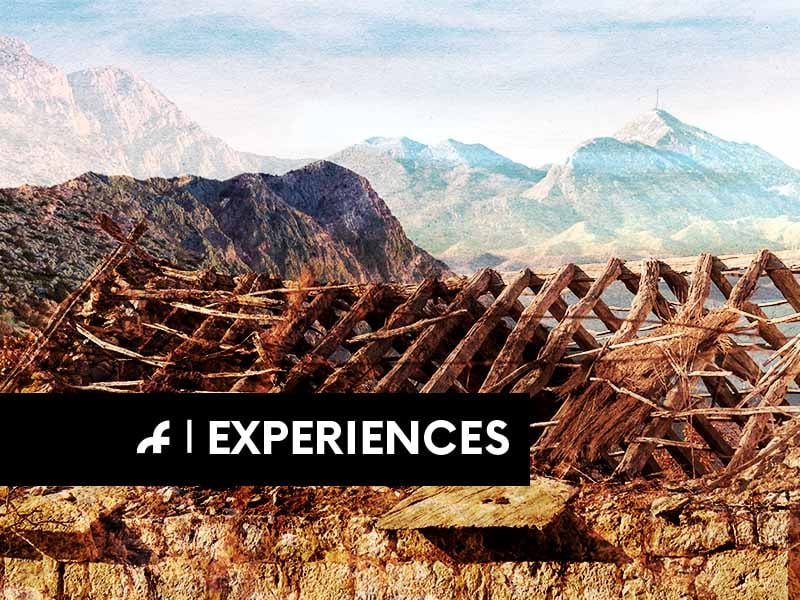
Far Out Experiences: A trip into the Biokovo mountains

I heard Biokovo before I saw it. I was on my way to Makarska, a jewel of a town on the pale banks of the Adriatic. The wind, the name of which I learned only when it was rushing all around me, had nearly caused my plane to crash, and now it was throwing itself against the car. “Bura,” the driver said, casting a knowing look towards the mountain’s hulking silhouette. Bu-Rah. I rolled the word around my mouth like a pebble.
By morning, things had calmed down, the previous night’s squall replaced by the resonant chime of church bells. I followed the sound to the central square, where I had organised to meet Tonci, a Makarska’s mountain rescue service volunteer. A slow sermon flowed from a loudhailer hanging from one of the church windows. Around the corner, a cafe was playing Billy Joel’s ‘Uptown Girl.’ “Makarska is a small town,” Tonci observed proudly as we made our way to the national park. ‘Thin’ might have been a more suitable word. Nestled on an aquiline stretch of coastline between Split and Dubrovnik, Makarska is pinched between two immovable geographical features: the mountains and the sea. On one side of Biokovo, you have a continental climate; on the other, you have the Mediterranean. “This is why we have Bura,” Tonci explained, speaking the wind’s name with all the necessary reverence. “It rushes down the mountains, and then, bam, it hits the sea”.
Tonci, like so many people in Makarska, grew up under the shadow of Biokovo. The town itself is located in the fertile strip of land where the limestone peaks end and the coast begins. Once we’d passed beyond the outskirts, he drew my attention to a patch of regimented trees heavy with darkening fruit. “My olives,” he said. “Not many, but enough. This year’s harvest has been very good. Very good indeed”. “How do you pick them?” I asked, expecting him to name a piece of agricultural machinery. “We shake,” he said, a broad smile crumpling his cheek into folds. At some point during our conversation, the landscape must have metamorphosised. Gone were the olive groves and vineyards – replaced by an area of sparse scrubland, which, come spring, is filled with the vibrant hue of Blue Lasinja and Campanula. Tonci stopped near a herd of wild horses and watched them silently. In the distance, someone was trying to scare a mare away by clapping and stomping his feet. “This one is injured,” he said, lowering his tone and pointing to a horse with the most gigantic arse. Something had pulled a square lump of flesh from its leg. “Maybe a small bear,” he added. “Or a wolf”.
Wolves are a permanent, spectral presence on Biokovo. Of course, the biggest killers aren’t the wolves but the mountain itself. Being limestone, it is riddled with sinkholes and caves, many of which were discovered entirely by accident. In the winter, the landscape becomes wreathed in snow, and avalanches are common. Many experienced walkers go missing. Some are never found, or, at least, not until the snow has thawed. Countless people in Makarska know someone who has died. Tonci’s own brother was out walking with one of their friends when an avalanche swallowed them up. The brother survived, but his friend was found with not a single bone in his body left unbroken. As the wind picked up, I began to wonder if that early tragedy had anything to do with Tonci’s 30-year stint with the mountain rescue service. As we hiked up towards a guest house on the summit, he recalled venturing into an electrical storm to rescue an ex-army hiker. “It was like a movie,” he began. “The lightning was all around us. And then we found him. Everything was broken – apart from his spine.” The conditions were too severe for the rescue helicopter to land, so Tonci and his team carried the man back down the mountain on a stretcher. “He kept on asking me if he was going to die,” he continued. “I just kept on saying ‘no, no.'”
At the summit, we met the man looking after the guest house. His face was gnarled like a mulberry trunk, his beard filled with flecks of white. We sat and drank Tonci’s homemade walnut brandy. The pair talked in Croatian for a while, after which Tonci turned to me and said: “He’s anxious about wood.” After swallowing another thimbleful of brandy, the housekeeper explained that he planned to stay in the house over winter. “He’ll need to drag the wood up the mountain before then,” Tonci added. That lonely man was a reminder of a pre-war way of life.
Before tourism lured people towards the coast in the ’60s, these mountains were filled with farming communities which survived by growing vegetables and rearing sheep for wool and meat. The mountains retain their memory. As we walked, I noticed neat squares of limestone brick where tiny villages had once stood and where Tonci’s grandmother may have once lived. I ask him if he remembers anything about her time in the mountains: “Life was hard. Life was very hard.” Indeed it was. During the war, Biokovo hosted rival bands of partisans and fascists. Tonci’s grandma – a partisan – smuggled explosives. She stuck to paths only she knew, but one day she was circled by a group of enemy soldiers. They found the explosives, and one of them raised a pistol to her head. “He was about to pull the trigger, too,” Tonci told me. Then, out of the blue, an officer arrived. “It was someone she knew. He was a friend. He told her: ‘You’re stupid, stop this now’. She was lucky.”
Tonci himself is no stranger to mountain warfare. During the Croatian War Of Independence in the 1990s, he fought in the mountains above Dubrovnik. Like his grandmother, he was one of the lucky ones: “I died, almost,” he told me. “But I was lucky because a lot of gunners were around me but never near me. They wanted to shoot me a lot of times, with sniper and grenades, but I was always lucky to stay alive. I remember I was like Rambo. Lots of weapons, bullets, shotguns – big shotguns – knives, bombs. I was 27. It was horrible, horrible. It was dying every day.”
We peered over a precipice, below which undulating, forest-clad hills stretched all the way to Bosnia and beyond. “I hope there will be no more fighting ever,” he said after a short pause. The weather was turning. Tonci decided it was time to go, so we went home. “The weather changes like that,” he said, clicking his fingers. The sound bounced off the pockmarked rock. And so we began our slow descent.


