


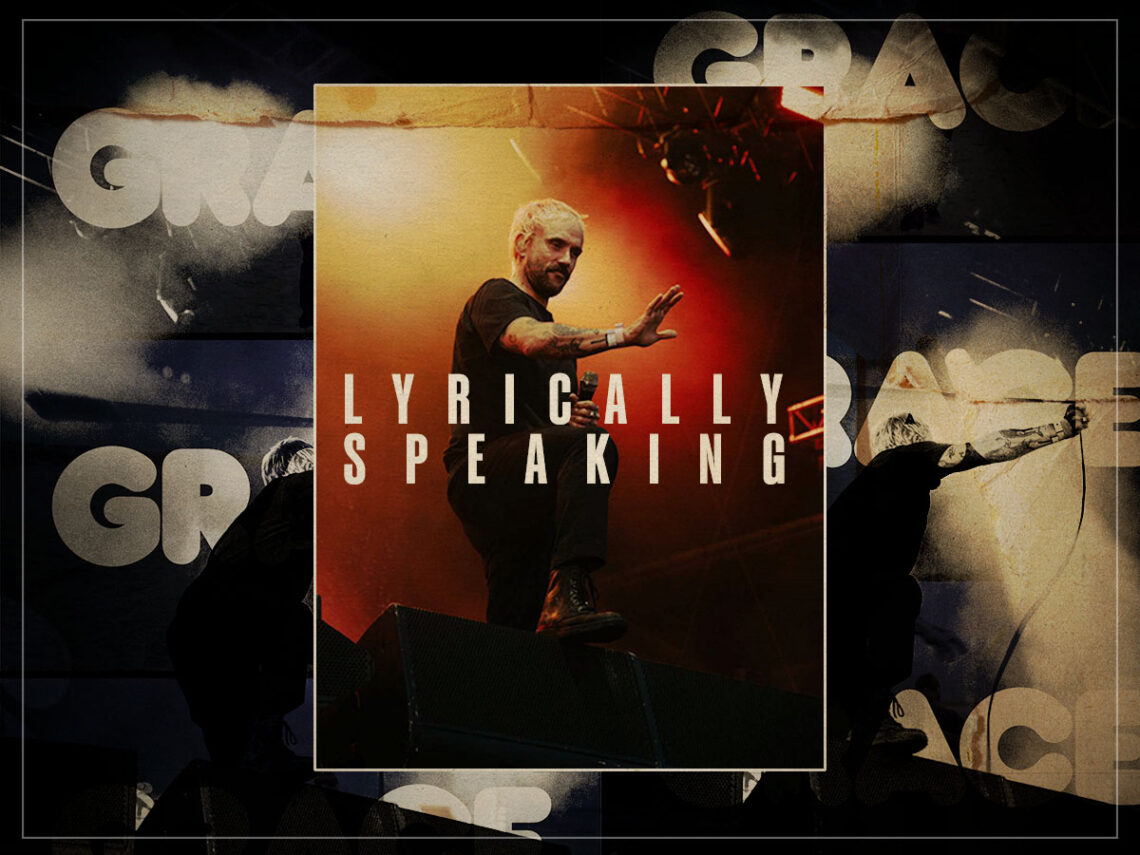
Lyrically Speaking: How Idles frontman Joe Talbot turned the gaze inwards on ‘Grace’

It’s customary for band members to introduce each other to the audience during every show to receive individual cheers. Over the top of a drum roll, the lead vocalist provides a verbal tour of every instrumentalist, with some sort of endearing adjective to precede it. However, as Idles guitarist Mark Bowen took the microphone to introduce vocalist Joe Talbot during their show last summer, he spared us the predictable “most-talented” or “my best friend” affirmations and instead labelled him “the barking dog of Newport”.
When said with the warmth Bowen delivered, you can’t help but agree with it being the most accurate portrayal of Talbot’s ability as a frontman. Ever since the Idles’ debut record, Brutalism, Talbot has established himself as a powerful and important social commentator, with the ability to be scathing and witty in equal measure.
Throughout the records that followed, Joy As An Act Of Resistance and Ultra Mono, Talbot became somewhat of a verbal assault gun. Be it towards hyper-vanity and Love Island culture on ‘Never Fight A Man With A Perm’ or small-town alt-right vigilantism in ‘Model Village’, the band’s growing artistic voice gave a platform to a lifetime of observational dwellings from the periphery.
As the band’s profile rose, so did Talbot’s criticism. In recent records, we’ve seen an artist grappling with the pressures of a growing profile and how to use his power of influence wisely. On the Idles’ latest record, Tangk, a renewed Talbot has inverted his observational gaze and is seeking to understand how love centres our behaviour, both good and bad.
It’s a vulnerability exposed at its finest on the record’s seventh track ‘Grace’. In a press release for the 2024 album, Talbot said, “I needed love. So I made it”—a motif that culminates on this track with Talbot repeating the line “No god, no king / I said love is the thing”. Talbot has always had a keen eye on Britain’s politicism and, perhaps, more importantly, on its class structure and has often sought to expose its evils. On ‘Grace’, he is more at ease with a reality he feels somewhat powerless to change and instead simply refers his listeners to the one constant that remains in the absence of any societal meaning: love.
But how did Talbot reach a point where his hands are above his head, and he’s ready to relinquish control? In the opening verse, he sings: “Give me grace, make me pure / When they’re knocking at my door / Make me safe, away from harm / Hold me in my brother’s arms / Make me pure” with an uncharacteristically tender vocal take.
What seemingly reads as a prayer sets the tone for Talbot to reject religious norms in the later reprise of “no god, no king” while simultaneously giving up the personal struggle he has bestowed on himself to be an orator for societal change. Thus, he allows his suffering to join that of the collective he has created with Idles.
The growing sense of recognition that comes with being the frontman of one of the country’s finest bands is not a healthy ingredient to add to existing struggles of substance abuse. Thus, in that opening verse, it’s abundantly clear that for the first time, Talbot is asking for something back from the people he’s artistically given so much to.
“A return to love is all I want for me and for all I see in front of me. My cycles of addiction and of loss are at a junction. I’m looking back, and I see why I was lost, and I just want to hold myself and emphasise the importance of the words, ‘Everything is going to be OK,’” he wrote in an essay for The Big Issue.
He continued, “This album is driven by gratitude and the power of being held and carried by the beautiful force of our audience, and more importantly, the energy force created by Idles’ and our people’s exchange.”
As the second verse unfolds, Talbot acknowledges the work he has done while allowing himself to relinquish the sole responsibility: “I will hear your burdened cries / I will give myself to you”.
On the surface, this record is a narrative departure from everything that preceded it, offering a more open-armed disposition from the Bristol band. But, it is, in fact, a stunning continuation. Idles have always been a band that encouraged a sense of community, and in their early works, they established that by creating the soundtrack to a cultural revolution. But now, on ‘Grace’, their fearless leader looks over at the congregation, asking them to extend their arms and accept him as one of their own. They no longer want to use their energy to fight; instead, they want to better place it in the creation of a new world centring love.
