


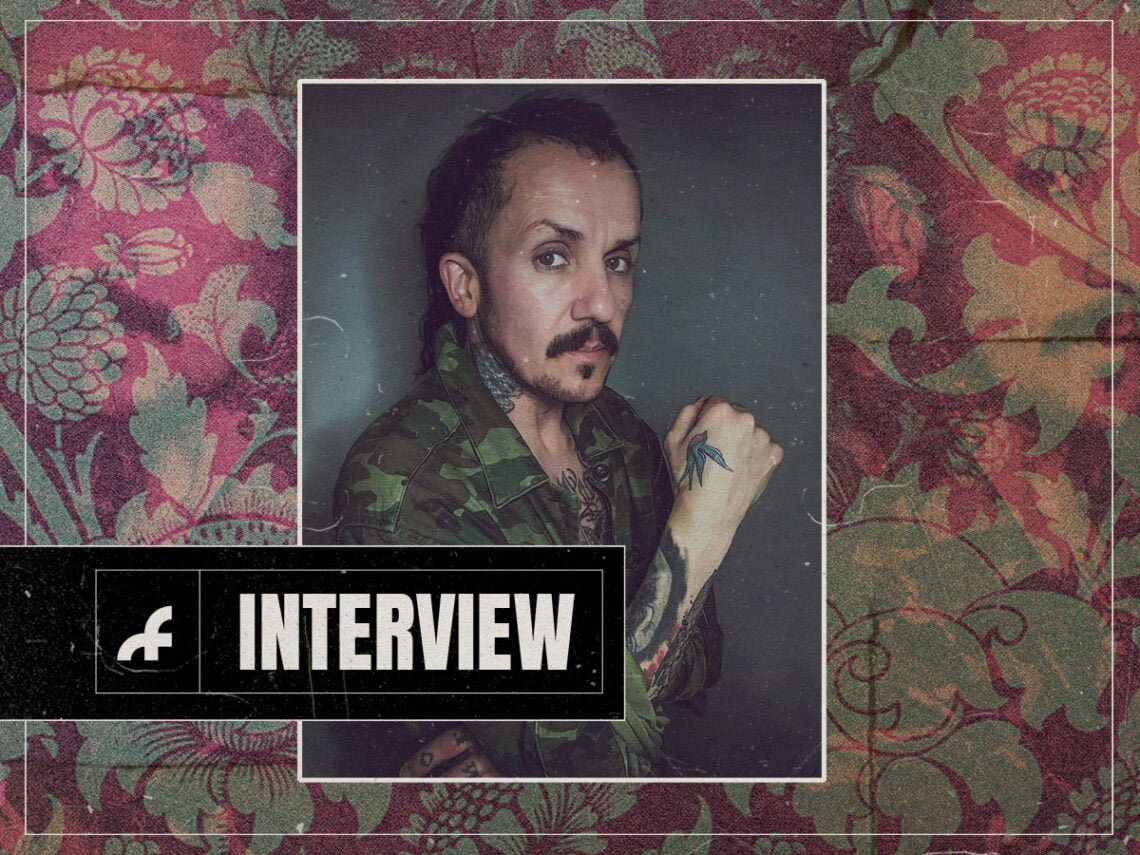
The inspiring story of Lucas Silveira: the first trans man to sign to a major label

When you meet a person for the first time, you can usually tell right away if they’re going to inspire you. Right off the bat, as soon as I met Lucas Silveira, his compliments about my Buffy jumper gave me all I needed to know. Of course, I knew beforehand this would be a conversation to remember. After all, this is an artist whose journey has delved into unimaginable depths, someone who has faced profound betrayals only to emerge on the other side, shining brightly like a beacon of hope and wisdom. In the music world, Silveira is perhaps best known as the lead vocalist and guitarist of rock band The Cliks.
For the most part, Silveira has lived in Toronto, where the themes of identity, love, and resilience present in his music are beautifully mirrored in the surroundings. Of course, in the beginning, it wasn’t that straightforward, especially considering the fact that Silveira’s identity was different from what it is now.
The Cliks emerged onto the music scene in the early 2000s, initially garnering attention for their energetic performances and unique blend of alternative rock, punk, and pop sounds. The early years of The Cliks saw them performing extensively in Toronto’s vibrant music scene, gaining a loyal local following. Their music resonated with audiences, who were drawn to the band’s raw energy and Silveira’s powerful vocals.
Their debut album, Snakehouse, propelled The Cliks into the spotlight and earned them a dedicated fan base beyond the sparkling realm of Toronto. For Silveira, however, music was always a sanctuary that sat much closer to home. “I always escaped into music,” he tells me. “I think music was not only something that felt very connected to me and myself as an artist, but also, it gave me this whole world of privacy that I needed at the time to feel safe. I grew up with music of the time, and my dad, of course, was a Beatles fan. And so I became a Beatles fan. And I remember at the age of four or five just listening to the Beatles and going into these imaginary worlds.”
Like many of us, discovering our escape is often how we uncover our true selves, as untouched and genuine as we could possibly be. For Silveira, it was no different. “In those worlds, I would always be a boy,” he says. “And I remember that being part of my story right from the get-go. I didn’t have friends when I was a kid, and if I did, I always played by myself. And my presentation was male. I was being a boy.”
For some reason, this reminds me of one of the lyrics to ‘Not Your Boy’ as Silveira, with vocals as sultry and heartbreaking as ever, sings: “Everything’s profound / When you are on a cloud / Riddled by this crowd / That just can’t feel me / When the darkness disappears / The only thing inside that can see / Is in the lie that tells me / I’ve been dreaming / Am I dreaming?”
Despite the achievements of The Cliks’ albums and the organic evolution of their sound with each release, Silveira’s journey speaks volumes about the shortcomings of early 2000s music culture in embracing its most intriguing and diverse people. Asking yourself, “Am I dreaming?” often brings sheer joy and disbelief, yet for Silveira, it seems like the lack of support at the time felt closer to that of a nightmare.
“When I was 18, I came out as a lesbian. And that was a very different time,” Silveira explains. “I figured this is the closest I can be to who I think I am. At the time, there was no reference point for being transgender, especially if you were female-to-male. I had never in my life encountered or heard of anybody who was transgender like me. I didn’t think that people like me existed. So, for 13 years, I identified as cisgender. When I was 32, that’s when I came out as a trans man, and after that, the Toronto queer scene started blowing up in a way where trans folks were now becoming more open.”

Finding your way through the maze of identity is challenging enough, but doing it in the public eye adds another level of complexity. This was particularly true for Silveira, who already had a well-established audience with fixed ideas about who he was at the time. “When I started transitioning physically, I lost a very diehard and loyal audience of mainly cis-gendered females, and it was this double impact that it had on me, which was, ‘Oh, I knew that nobody was seeing me as being a real man. Because even though I was identifying as Lucas, and as he/him, my presentation to them was still seen as being a cis-gendered female.'”
Continuing, Silveira adds: “I even had lesbians call me ‘she’, and I’d be like, ‘it’s actually ‘he”. So, it was really not ever taken seriously. So, what ended up happening was not only the fallout of me, but it was the understanding that I’d never been very validated in that aspect. It was the loss of my family. And it was pretty heartbreaking.”
However, despite finding facets of supporters in certain places, even the most seemingly accepting parts of the music industry didn’t feel very safe. “I went from being out very privately to all of a sudden being a signed band and being on tours with Cyndi Lauper, The B-52’s, and Joan Jett, and people were talking about my trans-ness and asking me all these questions, and I was just getting to know myself.”
“That didn’t go so well with a lot of trans folks,” he continues. “At the time, there was no non-binary movement, so what ended up happening was I also got flack from the trans community for not being a real man. And I wasn’t a real trans person because if I was, I would have chosen hormones and my presentation and my transition physically over my music career.”
Besides many encounters with bigoted people going out of their way to accuse artists like Silveira of “riding the coattails” of their – probably insubstantial – achievements, things did eventually get better, even if it’s clear that we still have a long way to go before every trans person feels safe and accepted. One thing that is particularly enchanting about Silveira is that his trans-ness isn’t necessarily a separate identity. His humanity and authenticity are what make his experiences and songwriting real.
Moreover, Silveira also enlightens me to a new perspective about the unrest that exists surrounding the queer community as given to him by his girlfriend; “hurt people hurt people,” he says, and it makes sense. The LGBTQ+ community suffers from constant ostracisation, devaluation, trauma, and so on, and so when people within the community or outside of it belittle or lash out at others, it’s because their strongly held perception of something has been threatened.
“Sometimes when people identify with something artistically, and find a connection to their identity, they feel that that thing that they were connecting to, and was keeping them afloat, changes,” Silveira explains. “It’s almost like they lose their buoyancy. And I think what ends up happening is they feel hurt themselves because they feel a sense of, ‘but you’re all I had, and now you’ve changed’. I think the LGBTQ+ community feel such a sense of disempowerment at times that it’s almost like they grasp at these things.”
As we discuss the influx of big names disappointing the community, from Kiss to Alice Cooper, Silveira makes his position clear; it sucks, but if you focus on yourself, trust yourself, and believe in what you have to offer, that’s what matters. “I have had like this total 360,” he shares, “When it comes to what it means to be a musician and what it means to be a singer-songwriter, and it’s actually the healthiest relationship I think I’ve ever had with being an artist.”
He continues, “If you want to do music in a healthy way, you need to be able to not allow your ego to say, ‘if you have a job outside of the music industry, that means you’re not taking it seriously.’ That is not a reality that musicians can have. And so because of that, I have allowed myself to create from a very genuine space and a place where I feel super authentic with what I’m creating, where I’m not putting this kind of pressure on myself to create a ‘successful’ album.”
As our conversation winds down, it dawns on me that I’m likely catching Silveira at one of the most enchanting junctures of his life. While The Cliks may have had their moment in the spotlight some 15 years ago, the idea of heightened fame pales in comparison to the ongoing impact individuals like Silveira have on countless lives every day.
My suspicion is confirmed when he begins telling me about a project he’s about to embark on at the Toronto Public Library called ‘Transcendence and Sound’. This will be an opportunity for Silveira to showcase his insights and expertise in the music industry, covering everything from songwriting, performance, and copyrights to recording demos. He’ll be providing guidance on navigating the music industry as a trans man, with a particular focus on the experiences of trans men and non-binary people on testosterone, including how to manage vocal changes.
It’s an empowering thing to listen to, and it’s exciting to learn about the opportunities and resources trans and non-binary are beginning to have access to, especially for those who may experience significant parts of their transition in the limelight or with a local following. Even as Silveira calls himself “Papa Bear”, I feel like this may be somewhat of a reductive term. Try trailblazer, perhaps. I, for one, will be blown away by this musician’s extraordinary talent and resilience for a long, long time.
