


How did Alice Cooper, a true pioneer of breaking gender stereotypes, come to oppose trans rights?

Boasting an all-white ensemble, as he might be of one of rock music’s purest contributions, a youthful Alice Cooper in his 20s contemplates whether he is himself – Vincent Damon Furnier – or whether he’s his stage persona at that particular moment in time. “If you think ‘Alice Cooper’,” he muses, “you would expect to see a blonde folk singer, and what they see is me”.
When dreaming up the perfect moniker, Cooper and his friends chose ‘Alice Cooper’ because the mere mention of the name sounded wholesome and the complete opposite of hardcore metal. They specifically chose a name that sounded more sensible and effeminate in an attempt to humorously contrast what they were all about. And what they were all about, according to Cooper in 1974, was “reflecting America’s attitude right now”.
Of course, this was a time when ‘Alice Cooper’ conceptualised a group rather than a single person, and Cooper’s individualised moniker was reserved for the stage because being him in everyday life was “too dangerous”. During this time, and all throughout his life, Cooper claimed to be strictly non-political. He went out of his way to make sure people knew that. “I don’t take anything seriously,” he admitted, “because I don’t believe in being preached to.” Cooper, whose name later became fundamentally his own, often faced questions about his theatricality, along with its place in metal. If it wasn’t a statement – because Cooper strictly didn’t believe in representing political messages – then what was it?
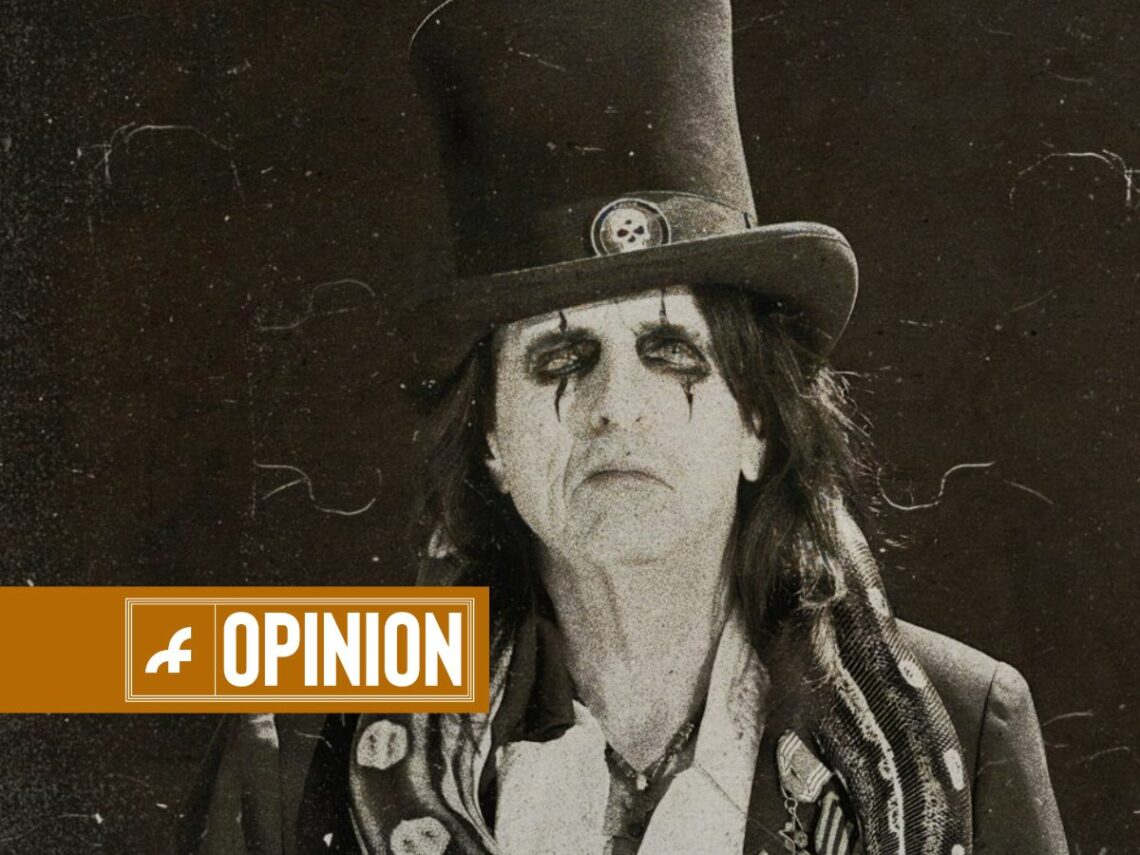
According to Cooper, incorporating hard rock with theatricality and extravagance helped them to stand out. In fact, looking the part was what Cooper once called “the icing on the cake”, and his approach with “chopping up the doll” propelled shock rock to the mainstream, a genre characterised by extreme pyrotechnics to heighten a performance’s sense of horror. Cooper’s appearance also played a big part in this imagery, with the use of purposefully overdone eyeliner and other dramatic makeup techniques. Coupled with his long, black hair, Cooper became the ultimate shock rock visual.
Cooper’s influence in those early days of experimenting with physical appearance and public persona is no secret. In his book Alice Cooper, Golf Monster, Cooper explained that his look was partially taken from films, with figures like Bette Davis forging a strong imprint in his mind. When he saw the film What Ever Happened to Baby Jane?, starring Davis, his calling became clear: “In the movie,” he said, “Bette wears disgusting caked makeup smeared on her face and underneath her eyes, with deep, dark, black eyeliner”.
Another film that inspired the ‘Alice Cooper’ aesthetic was 1968’s Barbarella. “When I saw Anita Pallenberg playing the Great Tyrant in that movie,” he recalled, “wearing long black leather gloves with switchblades coming out of them, I thought, ‘That’s what Alice should look like’”. Cooper borrowing fragments of looks from iconic women in film formed the basis of what would become his legacy: he was a rock star, but he also subverted expectations and traditional gender conventions. Even better, he didn’t care what others thought.
At the same time, as an art student, Cooper greatly admired great works from the likes of Salvador Dalí, whose entire portfolio centres around defying convention and celebrating the beauty of surrealist notions. Cooper’s world, therefore, was built around going against the grain. Cooper and the group transformed the lasting impact of glam rock and translated it into metal, using their androgyny for pure entertainment and to create an impressive spectacle rather than being forthcoming with any particular type of political statement.
Therefore, Cooper had done well to craft himself as someone who’s as progressive as he was inclusive, providing a safe space for people to express themselves. In 1971, Cooper’s group orchestrated an elaborate stage performance that incorporated simulated fights and gothic scenes of torment inflicted upon Cooper. The performance culminated with a meticulously choreographed enactment of an electric chair execution, and the band donned dazzling, sequin-adorned costumes reflecting the flamboyant aesthetic of glam rock. In this phase, Cooper’s on-stage persona evolved into a villainous figure and a potential menace to contemporary society. By 1975, Cooper was now a solo act, one whose glow still very much attracted faces from all walks of life.
Cut to 2023, after a five-decade-long reign with unifying a diverse range of audiences from around the globe, Cooper’s seemingly strong, welcoming personality was shattered. In an interview with Stereogum, Cooper divulged his opinions on the transgender community, calling it a “fad” before diving into a long list of reasons why he thinks the entire movement is “laughable”.
In the interview, Cooper said: “You’re still trying to find your identity, and yet here’s this thing going on, saying, ‘Yeah, but you can be anything you want. You can be a cat if you want to be. I mean, if you identify as a tree… And I’m going, ‘Come on! What are we in, a Kurt Vonnegut novel?’ It’s so absurd that it’s gone now to the point of absurdity.”
He continued: “Let somebody at least become sexually aware of who they are before they start thinking about if they’re a boy or a girl. A lot of times, I look at it this way, the logical way: If you have these genitals, you’re a boy. If you have those genitals, you’re a girl.”
Rock and roll culture aside, Cooper’s views could stem from a more insidious root – a lack of education. Ignorance yields some of the most detrimental opinions, particularly within the queer community, often around the differences between biological sex and gender identity. Cooper comes from a generation that looks at the world in its binaries, one that isn’t yet privy to the mosaic of identities that a person can adhere to. By claiming that people need to first become sexually aware of themselves, Cooper’s position becomes clear: his care-free rock and roll attitude works when pandering to early 1970s-esque rebellion from gender norms, but he neglects to realise that, in today’s world, there’s something much bigger at play.
Above all, Cooper’s views show that there exists a perpetual misunderstanding between self-expression and personal identity. Being transgender – or any other identity, for that matter – isn’t a fad, like putting on makeup and a costume in the 1980s. It’s not something that you ‘wear’ and take off as you please; it’s a part of who you are, even if who you are doesn’t conform to anything at all. The likelihood that Cooper is inherently transphobic is a little unlikely, at least you would sincerely hope, but his comments still provide a basis for severely hurtful notions pertaining to outdated attitudes.
A lack of education may excuse ignorance to a point, but once you go on record to express views that go against everything you’ve created as an artist and entertainer – it’s no wonder when fans become upset, confused, and unsure of their own place in the world.
