


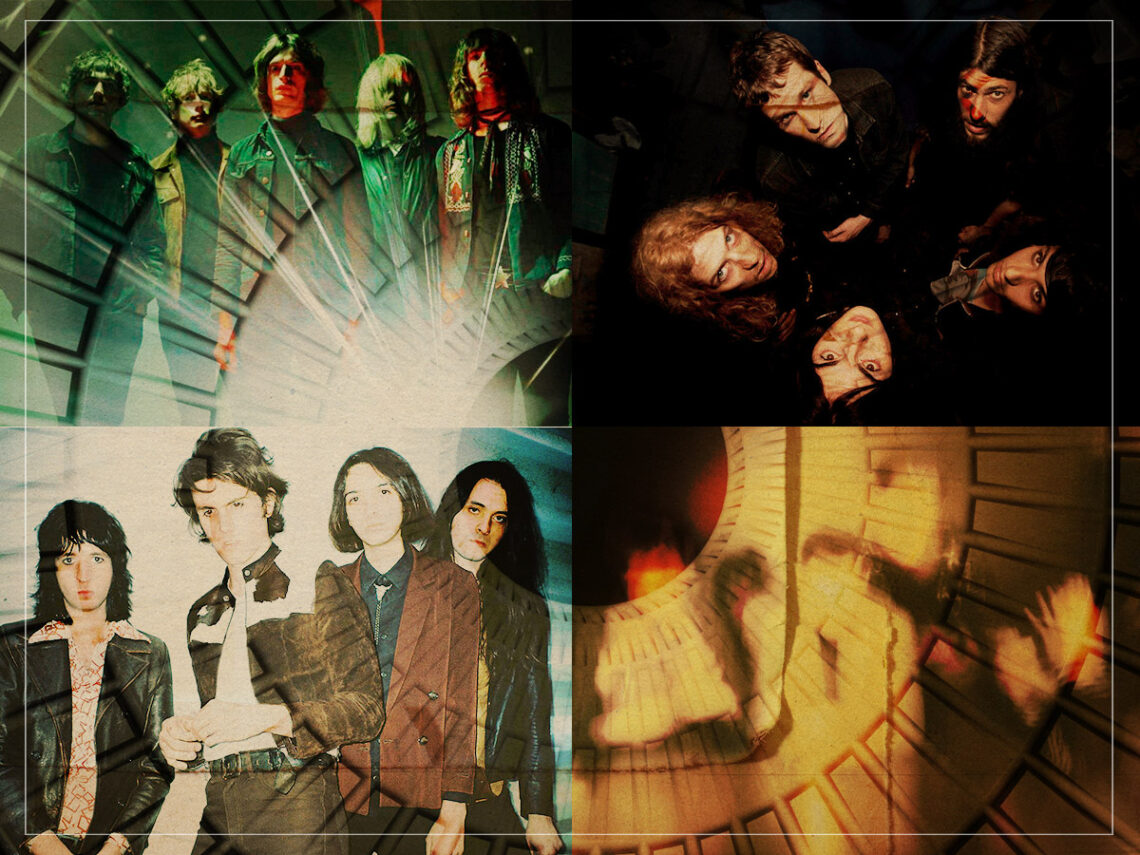
Remember the London krautrock phase that came and went?

The early 2010s were a great time for music. It felt like a regular occurrence that new artists were breaking out with refreshing sounds. Whether it be the likes of DIIV, Whirr, Nothing, Grimes, or post-punk revivalists like Savages and Eagulls, many formative artists burst onto the scene in rapid and singular succession. Like any era, though, it also had its transient parts, and one of them was the near-mystic London krautrock scene. It was talked up and forgotten in a flash.
But where did it come from, and where did it go?
The scene found its roots in the indie heyday of the previous decade and its fascination with the music of the 1970s. While it’s difficult to pinpoint exactly how or why this trend began, one could argue that The Horrors were at the forefront. Following the frenetic gothic garage punk of their 2007 debut, Strange House, the band made a few adjustments to their lineup and embraced a more pulsating, hypnotic sound. Drawing heavily from psychedelic, krautrock, and shoegaze influences, they saw guitar virtuoso Joshua Hayward gradually emerge as their creative spearhead.
The 2009 record Primary Colours was a glacial blend of various ’70s genres and, well, a lot of Joy Division. It set the scene for 2011’s masterpiece, Skying, one of the perfect drug albums, exposing the quintet and their influences to a new generation of listeners. Although The Horrors were on XL Recordings during this time – the pinnacle of their career, despite the underrated moments that would follow – their take on the sounds of the late ’60s and the ’70s would incidentally shift listener tastes for the handful of London-based groups, collectively dubbed ‘krautrock’ revivalists. The bands looked very similar to them, and their sounds bore several of the same hallmarks.
It’s no surprise that during this era, bands like Toy—formed from the remnants of the short-lived indie group Joe Lean and the Jing Jang Jong—Temples, Stealing Sheep, The Voyeurs, and Telegram began to dominate the music headlines. A growing fascination with The Velvet Underground, obscure ’60s psychedelia from bands like July and The Seeds, the grooves of Tom Verlaine’s Television, and krautrock pioneers such as Can and Neu! swept through the scene.
By 2011, east London and beyond saw a wave of John Cale lookalikes sporting black turtlenecks, skinny trousers, and polished Cuban heels or Chelsea boots. It felt like a surreal, real-life version of The Mighty Boosh, with The Horrors taking on the role of The Black Tubes.
Sp, who were London’s krautrock revival bands?
While the aforementioned groups had different sonics, Toy, The Voyeurs and Telegram were most alike in their krautrock styles and aesthetics. With Toy and The Voyeurs also signed to Heavenly Recordings, from the outside looking in, it appeared that the scene had a firm basis from which to leap. The former became the most prominent due to successes in the live setting with support slots for The Horrors, and their early singles ‘Motoring’ and ‘Left Myself Behind’ were celebrated across the board.
Something was bubbling under the cultural surface, and it seemed that this part of the 1970s was to have a complete contemporary resurgence. Venues like The Shacklewell Arms, The Old Blue Last, and others in the capital played essential roles as the spiritual homes of these bands. They provided a bedrock for the scene and, because of it, came to wider prominence. Everything seemed well placed for a boom.
However, this cultural charge ultimately fell flat. While it’s often said that Toy never lived up to the hype—whatever that may mean—their songs undeniably hold up. They remain distinct from much of what was happening at the time, offering a unique sound despite their clear nods to their influences. So, what derailed the movement before it truly had a chance to take off?
Well, nobody really grasped the mantle of the critic’s darling. Toy’s 2012 self-titled debut was regarded as a flop by many. Much of it concerned the production, which fell flat in large parts and failed to capture the band’s scintillating live show and penchant for intensely narcotic grooves. Ironically, the majority of production was helmed by Dan Carey, the Speedy Wunderground boss who’s since risen as a key part of the so-called south London scene, with a post-punk production style raved about and widely heard.
Toy pushed on, though, and their second album, 2013’s Join the Dots, was also not as well received as they maybe would have hoped. Save for a few moments, fans feared the group were losing that original spark. Pointing to the contours of his own arc, Carey produced again, but the sound was much crisper this time out. It was as though the revival was already changing tactics in search of an equaliser.
As for The Voyeurs, while they were solid live performers with a few standout singles, their sound leaned heavily on the era they were indebted to. From Charlie Boyer’s vocals to the synth textures and overall aesthetic, the influences were often more apparent than the originality. Their debut album, Clarietta, co-produced by Edwyn Collins, failed to deliver on the hype. Rather than sparking a new genre or movement, it mostly served to direct listeners back to the past.
Meanwhile, the gaps between The Horrors’ albums grew. New start-ups that had followed in their wake failed to get signed. With a hint of commercial potential still lingering in alternative music, post-punk became the next trend worth backing. Quietly, undramatically, and without any public statements, krautrock bands were literally dropped, and a shoutier style more befitting for the trend of bastardising the bloody bourgeoisie emerged.
Suddenly, the headlines failed to match the reality. Toy’s story became one of “What if?”, with their 2019 album Happy in the Hollow arguably their best work, but largely overlooked as the cultural moment had passed. Meanwhile, The Voyeurs and Telegram, the latter perhaps arriving too late to the party, faded into obscurity as public interest shifted elsewhere. Unsurprisingly, both Toy and The Voyeurs were swiftly dropped from Heavenly Records, a move that felt like it happened in the blink of an eye.
Telegram’s drummer, Jordan Cook, has since joined The Horrors, who are preparing to release their sixth album, Night Life, in March 2025. As for Toy, frontman Tom Dougall is now part of the Berlin-based band Luft, which also features former Voyeurs guitarist Sam Davies. Clearly, the dream never truly died. Could there ever be a resurgence? Stranger things have certainly happened.
