


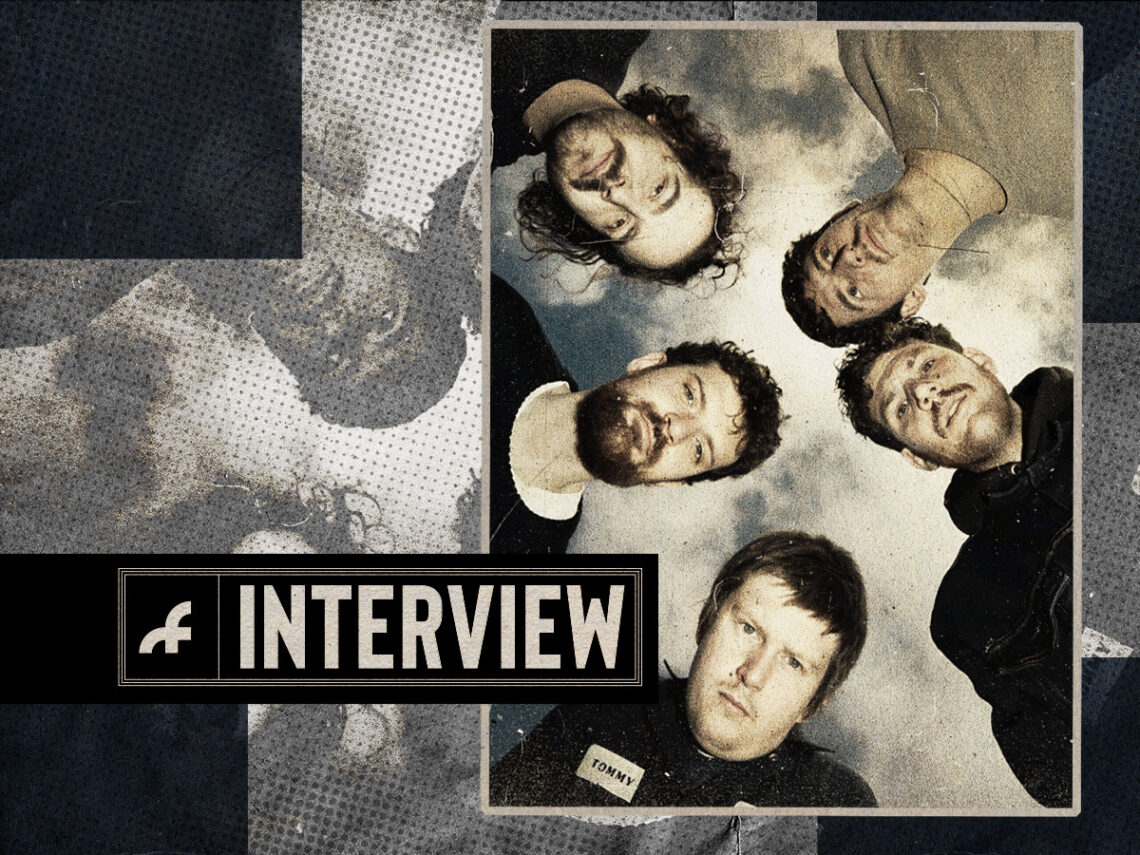
Moreish Idols discuss guitars, the future, and a little help from Speedy Wunderground’s Dan Carey

I rarely agree with the reviews when a band picks up a buzz. Yet, Moreish Idols deserve all the excitement enveloping them. The south London quintet are part of the second wave of the capital’s southern scene, signed to Dan Carey’s ubiquitous label Speedy Wunderground – a collection of artists at the forefront of new British popular music – and to me, they stand out above the rest. There’s authenticity and total harmony between the many elements of their sound, two things that don’t go amiss in contemporary times.
Very much in keeping with the spirit of Speedy Wunderground, the band provide a postmodern potpourri that cherrypicks from an eclectic palette of genres, with the current penchant for acid jazz mixed in for extra scent. The Falmouth exports are as dynamic as they come. On April 28th, they released their second EP, Lock Eyes and Collide, which rightly gathered music world plaudits and my own seal of approval.
Comprised of co-frontmen and guitarists Jude Lilley and Tom Wilson Kellet, bassist Caspar Swindells, saxophonist Dylan Humphreys and drummer Solomon Lamey, with their new EP, Moreish Idols have made good on the promise of their debut extended play, August 2022’s Float. Building on the foundations laid in their introductory body of work by refining their kaleidoscopic sound, which bounces from frenetic to heady in the blink of an eye, Lock Eyes and Collide is another indicator that the excitement is not unwarranted. It espouses clear vision and nouse, and the space for their next instalment is being guarded by watching eyes.
“It’s exactly what I was looking for,” Speedy Wunderground’s Carey explained of the moment he first laid eyes and ears on the band in the press material. A 20-minute live set sent to him after three lockdowns in the creative incubator was enough to grab his attention and bring Moreish Idols into the office for a chat. That was it. From that moment on, their sound was to be facilitated by the producer à la mode. A blistering collection of songs later, and the scene was set for the band to kick on. So far, it’s another three points on the board.
I’d been aware of Moreish Idols since the tail end of 2020. One rainy December evening, an eBay advert led me to east London to purchase a Fender Mustang from a bloke called Caspar, who told me he was in a band called Moreish Idols. “Sick,” I thought before looking them up on Facebook and giving them a like. Two years later, I was glad to see them crop up on the south London scene, and then sometime after, I was pleasantly surprised to receive their PR emails. By this point, I was already watching intently, Float had landed differently from most records released in the same vein, it had captured an audience, and I was one of them. When an opportunity arose for an interview the day after ‘Chum’ was released at the start of April, I jumped into action.
Peckham it was. I linked up with the pair of frontmen/guitarists, Lilley and Kellet, for a couple of beers and a chat about all things Moreish Idols. Incredibly amiable for people in a band of worth, practically as soon as I’d placed my pint of Peroni on the table, a girthy end-of-the-working-day cigarette was rolled, and off we went.
After briefly discussing the politics of press releases, the guitar tones on ‘Chum’ were dissected. After all, the effervescence of Kellet and Lilley’s dovetailing guitars is a highlight of Moreish Idols. Whether in their blistering moments or more deliberate ones, they sound cultivated, and they’re particularly rich on ‘Chum’. I sought to uncover their secret and identify the unique brown guitar Kellet uses in the video. I’d never seen anything quite like it. A quick Google also bore no results.
It looks like a dark brown Fender Mustang, but I couldn’t be sure. Firstly, I am informed that all the equipment in the video – set on an unhinged American-style chat show – was borrowed. All of it, that is, apart from Kellett’s guitar. That, he explains, is no Mustang at all but a converted Musicmaster: “It’s a Musicmaster that someone’s converted into two pickups, so it’s basically a Duo-Sonic. It’s fucking ridiculous, and I got it for like nothing. The best thing I’ve ever bought.”
Lilley adds, “It is the most unique guitar, even the lacquer job.” Furthermore, the instrument is not dark brown but “horrible toffee”, as Kellett defines it. Whoever handled its transformations might have done a relatively “crumby” job, its owner says, but he ultimately reasons that it is “sick”. Listening to the high-octane, krautrock-inspired section of ‘Chum’, it’s hard to argue with its cap-wearing wielder.
This was an appropriate point for some of the mystery evoked by the Speedy Wunderground name to be tapped into. In an extended moment for the guitar nerds, Kellet turned our attention to a sacrosanct 1960s Fender Mustang owned by Carey. He played it on some of the band’s new cuts, including ‘Nocturnal Creatures’, a song featuring some of their best tones, and another excellent riff.
“I thought mine was really good,” he resumed. “Dan’s favourite guitar is his ’60s Mustang…you know when you just love what you have. I played my guitar for the first EP, which is totally fine, no problems. But for Lock Eyes and Collide, I needed four separate guitars because of all the tuning differences and the capo and stuff. I had to tune everything separately. So I thought I may as well use Dan’s Mustang because he’s obsessed with it.”
If you asked the Speedy Wundeground boss what he’d save in a burning building, it would be that guitar. Ironically, Kellet continues, it has been in a house fire. “He claims it’s always warm when he picks it up,” and he’s not joking. “I played it and finally realised how much better than mine it was. I was playing something that was just louder than everything else. It was just so good. It’s just so fat. And that’s ‘Nocturnal Creatures’. I think that’s my best tone.” It’s hard to disagree with Kellet’s assertion. Whilst the guitars on their last EP sounded impressive, they have an extra bit of magic on Lock Eyes and Collide. Maybe the denizens of Denmark Street were right all along; perhaps Fender did make them better in the 1960s, after all.
So, now that vital matter was out of the way, where do Moreish Idols go from here? “We’re trying to write an album now,” Kellet starts before Lilley picks up, “To be honest, we’ve been doing that since before the second EP, and we just decided to do a second EP instead of going straight into an album, which I’m so fucking grateful for now.”
He continues: “We needed to buy more time for ourselves. The second EP taught us so much in terms of writing and quality. Like what you said about guitar tones, we spent so much time in the studio, really, really, getting into the finer details of things like guitar tones and space, tightening up the little bells and whistles. Things we could do in the moment so that it gives Dan as little to do as possible when it came to the recording.”
Despite all the time spent fine-tuning their operation, it’s still amazing how little the band know of actually recording the band, Kellet concedes, before citing south London peers KEG as a model that has conquered the nuances of the studio and live setting. “There’s no end to that side of things,” he says. Naturally, the more time you spend on it, the more it improves. “It can literally only get better,” he asserts. I wonder if that was a D:Ream reference.
“I have to say, we give ourselves so much to do as a five-piece,” Lilley affirms. “I think we’re finally starting to realise it’s a bit of our thing, which is why we’re now starting to rein it back in, in, let’s say, a verse of whatever, or try and do a song that’s just based on the drums because we now know our strength is when we’re all making the racket in that split moment. It’s now about building that context and making it neater. I would say, right?” looking across the table to Kellet, who nods in full agreement. There may be infinite ways of approaching creativity, but at this point, it’s a matter of keeping momentum for when the day of recording arrives. That’s the main aim.
There is nothing worse than being underprepared when recording. No matter how tough recording can be, the band still wants to have fun with it, which can only be achieved by going at it full-throttle and using every last second to their benefit. You get out what you put in, so for Moreish Idols, now is the time to prepare. This idea is heard clearly in their music, with the lines between respecting the craft and the desire to experiment straddled adroitly. These are positive lessons to be taken by other artists wanting to make such a blitzkrieg-like foray into the industry.

Although we’d touched on working with the Speedy Wunderground boss, I wondered how the quick transition went from being unsigned to working with the producer du jour. How did Carey help them refine their craft? “Fear,” Kellet says deadpan, before reaffirming that “not wanting to be not ready” played a significant role in them taking the step up. This new level was not reached conventionally, though. Had Carey made them more professional? “I think he tries to fuck the professionalism up,” Kellet expresses.
After listening to the original demo of ‘Nocturnal Creatures’, which Kellet adds was a more “gooey” piece than the final product, Carey told the band it needed to be “faster, heavier and weirder”. Unsurprisingly, he achieved this end by quickening the temp and adding a few tweaks, such as making Kellet’s riff more distorted and deeper in the mix. It sounds much, much better, he assures me.
A perfect man manager in many ways, with a holistic grasp on proceedings, Kellet finishes, “So, we just have to be plucked out of our own heads and put into his whole thing.” Is this a good condition? “Yeah,” the pair agree as one.
From Kellet describing the band’s indecisive tendencies to Lilley labelling the process “so creative”, judging by their engaged dialogue, which bounces from one thrilling point to another, it seems they’re in the right home. “It’s really funny,” Lilley explains. “It does sound like you’re building some sort of weird monster. I’ve said this before; in the relationship with Dan in the studio, there is rarely a no between him and us. It’s always yes – with any idea. We seem to be on the same page.”
“Everything we made were sketches” before the Speedy Wundeground convergence is how Lilley views it, with the band using each gig as the next cup final. That was the wrong way of doing it, Kellet appends. They changed tact, hunkered down in a friend’s Peckham studio and wrote Float. Emerging from their sessions, they were quietly confident that something would come out of their new-look operation. “If you feel good about the music you’re playing, it looks like that,” Kellet adds in an astute meditation. Many prominent names over the years have weaponised this thought.
But it was a very well-timed email that brought the two entities together. Kellet first met the producer when he called at his house to pick something up from his housemate. He used the opportunity to ask him if he had any recommendations for mastering a song he was hoping to release. He got what he was looking for and Carey’s email was in his hands. This was a fortuitous moment in the band’s career, even if they didn’t realise it at the time. They’d just filmed a live session, a somewhat comical affair that included a friend-cum-cameraman who couldn’t be edited out. Regardless, they sent the footage to “like 100 people” and added the Speedy Wunderground boss to the list. Remarkably, even though they thought nothing of adding him, Carey was the only one that replied. “It was fucking mad,” Lilley says.
When all said and done, the quintet aren’t getting ahead of themselves; there’s still much to be done. “The album’s gonna be tough,” Kellet adds. “It’s going to be fun as long as we have all bases covered.” Referring back to the time they have at present, he explains that if they use it wisely and explore enough ideas – more than “the minimal amount” – it will be “one of the sickest albums”. Logically building on what came before with each stage they reach, the band have more confidence than ever in their work. There’s no wonder, then, that Lock Eyes and Collide feels like a natural successor to Float. Moreish Idols are growing with their process. This state of play also makes the prospect of their next release, whether the album or another EP, undeniably fascinating.
A large part of the band’s triumph is unity; everyone has an equal stake in the process. It’s not about just Kellet or Lilley or the pair of them. They write together in the rehearsal room. Whilst individuals will bring ideas, “We absolutely make sure that everyone is accommodated, and everyone has as much creative influence on the track,” Lilley reveals. This was a refreshing point to hear; it’s not about ego. Everyone is devoted to the cause.
Each member writes their parts, too, Kellet says, before adding: “As long as that happens, we will have a Moreish Idols song”. The attempt at writing a piece with no chords at Swindells’ suggestion a few days prior was an example of this fluidity. “As long as things keep moving like this and don’t become too heavy, things should be alright,” Kellet optimistically adds, glancing to their future.
In the heady new tack ‘Green Light’, Kellet and Lilley sing about being stuck at a crossroads, waiting for the green light that will permit them to move on to the next chapter. With Lock Eyes and Collide, it’s arrived. The revs are building, and they’re pushing off, taking it up a gear.
