


“I been swimming ever since”: The overlooked life of blues legend, Blind Arvella Gray

Walking through the thriving cultural hub of Maxwell Street Market in Chicago, you could hardly hear yourself think over the noise of street vendors, haggling, and the amalgamation of countless buskers. In all the chaos, you could very easily have passed by one of the greatest blues musicians America has ever produced, without ever knowing it. Blind Arvella Gray is one of the few artists who can truly claim to have mastered the blues, yet during his twilight years in the 1970s, he could most often be found at Maxwell Street Market, strumming a guitar while unsuspecting hordes of people passed him by.
Gray epitomised the spirit of the blues more than most. Born into a poor family in Texas during the early 1900s, he quickly turned to music as a form of solace and escapism. The best way to sum up his early years came from Gray himself, speaking in John Jeremy’s revolutionary documentary Blues Like Showers of Rain.
He was one of three triplets, adding to the five other children his parents had at the time. They were so poor that, as Gray recalled, his father “called my mama–and he said, ‘Dora,’ say, ‘come in here and pick out the one you want,’ you see, ‘because I’m gonna drown the other two.’”
“I been swimming ever since,” the performer chuckled. The tragedy of that story made Gray a natural when it came to the blues, a timeless musical style that has so often turned tragedy into musical innovation. With roots going back centuries, to the days prior to emancipation in America, blues has offered an artistic outlet to countless generations of Black Americans, each imbuing seemingly simple compositions with the kind of emotional weight that could move even the most stony-faced of audiences.
There was no shortage of emotional material for Gray, either. Born and raised in the poor town of Somerville, Texas, in 1906, life had certainly dealt the young musician a difficult hand. After all, this was America under Jim Crow, during a time when Black people were treated as less than second-class citizens. It was also the era during the mid-to-late 1910s that saw a widespread resurgence in the Ku Klux Klan, spurred on by the release of The Birth of a Nation in 1915. To say life was tough for Gray, then, would be a gross understatement.
By the 1930s, he had been driven to crime as a means of making ends meet. However, when a bank job took a wrong turn, Gray was left blinded and without two of his fingers. Destitute, without a penny to his name, he travelled from Texas to Chicago, where he once again sought solace in his only constant friend, the blues.
By this time, blues music had become the definitive sound of Black America, reflecting the hardships, poverty, and discrimination faced by Black people on a daily basis. Figures like Robert Johnson, Blind Willie McTell, and Ma Rainey helped to carve out the sounds of modern blues music, speaking for widespread audiences of Black Americans in the process. In that same spirit, Gray began to perform in subway stations, transit depots, and, of course, the Maxwell Street Market.
Like many buskers down on their luck, Gray was largely ignored by the masses of people passing through the market or by those catching trains in and out of Chicago. For those willing to listen, however, he produced some of the hardest-hitting blues anthems ever heard. The blues is littered with groundbreaking, incredible artists who never got the recognition they so richly deserved, but it feels like a much more tragic occurrence in the case of Blind Arvella Gray.
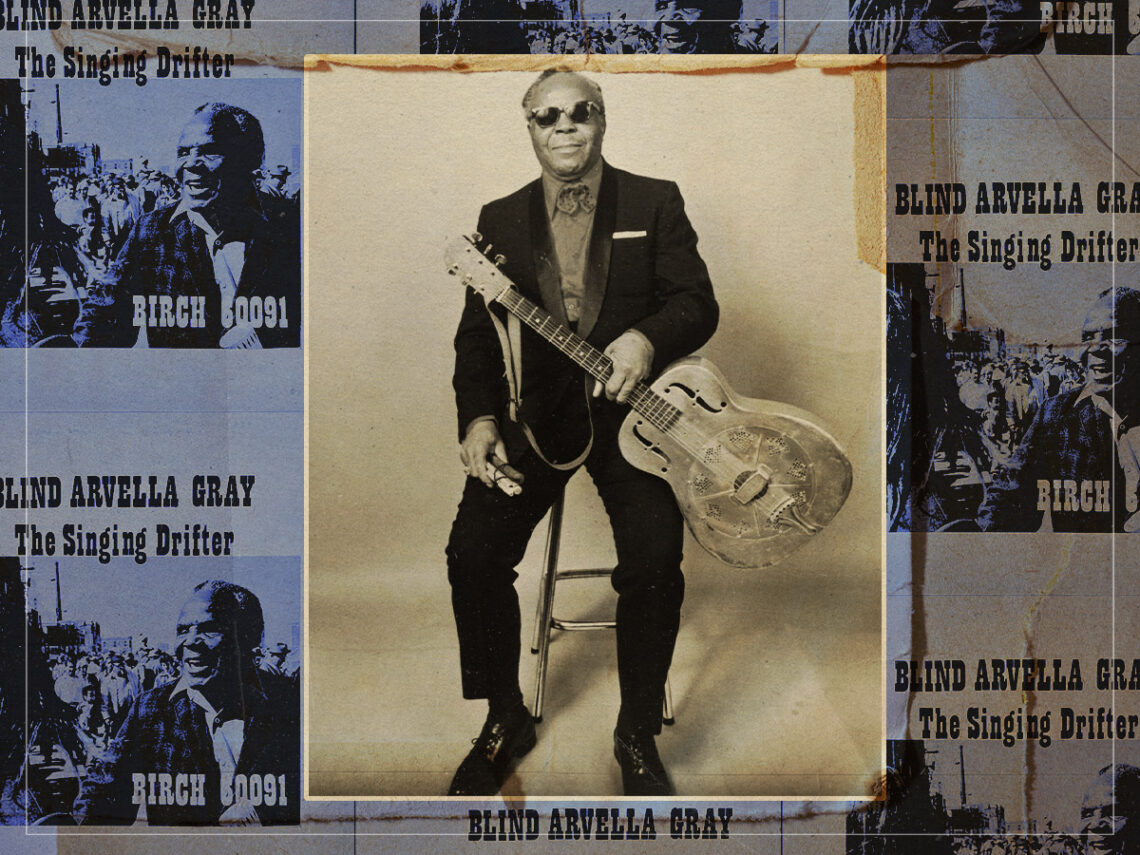
Throughout his life, the musician only formally recorded a handful of songs, the most notable of which, ‘Freedom Riders’, was self-published during the civil rights era of the 1960s. His only album, The Singing Drifter, came and went in 1972, and nothing seemed to make an impact on the musical mainstream.
Undeterred by this great injustice, though, Gray continued to sing for spare change at Maxwell Street Market. In that sense, he is perhaps the greatest encapsulation of the blues, possessing enough talent, drive, and tragedy to fill 20 albums, but choosing instead to keep his music on the streets, where it could be heard by those who needed it most.
