


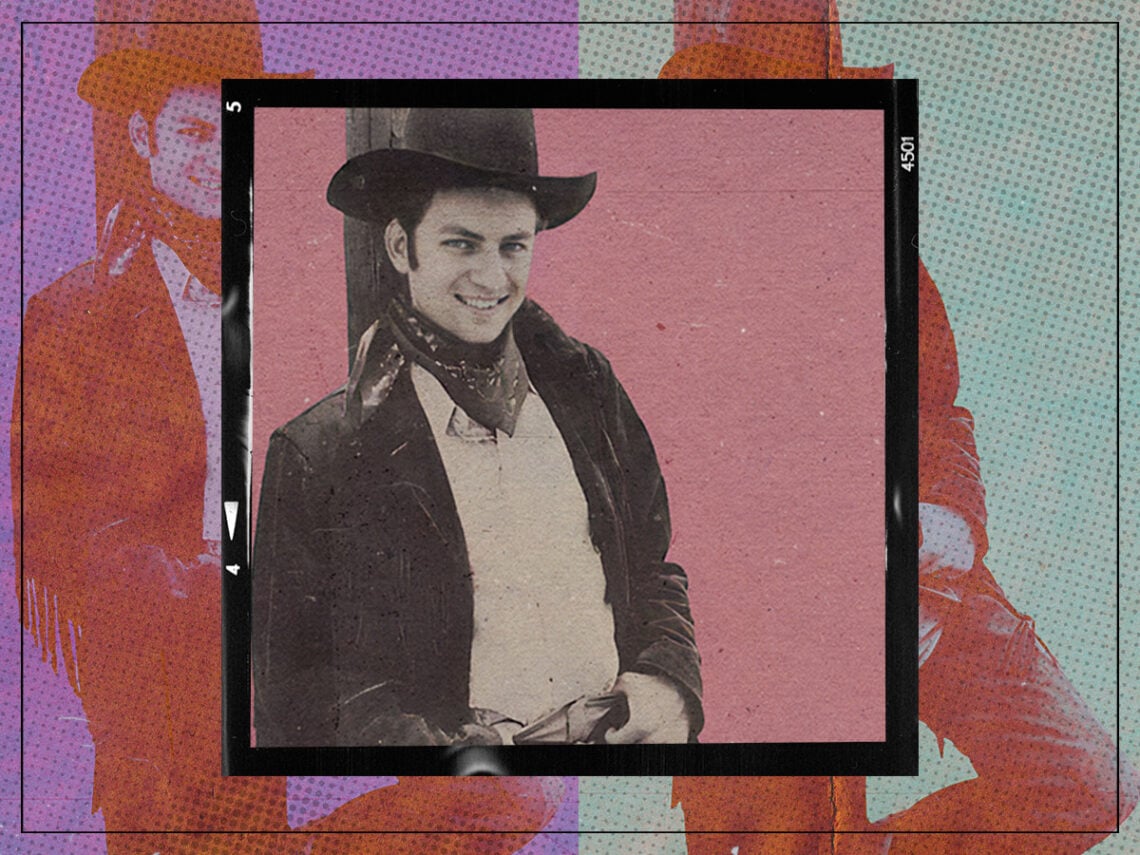
Legendary Stardust Cowboy: the outsider artist who inspired David Bowie album ‘Heathen’

“If it’s wearing a pink hat and a red nose and it plays the guitar upside down, I’ll go and look at it. I love to see people being dangerous.” – David Bowie
This penchant for the peculiar, perturbing and downright puzzling was something that permeated all of David Bowie’s art, and he has his brother Terry Burns to thank for that. The ‘Starman’ proclaimed: “[He gave me] the greatest serviceable education that I could have had. He just introduced me to the outside things,” he said. “I saw the magic, and I caught the enthusiasm for it because of his enthusiasm for it. And I kinda wanted to be like him.”
However, Burns’ explorative influence was tinged by tragedy. He suffered from crippling schizophrenia and seizures. This meant that Bowie not only purveyed the strange lure of outsider art, but he also looked at it empathetically, reconciling its cathartic potential to offer expressive release unshackled to any notion of ‘standards’. Bowie looked to place his own art in this vein: the shocking pizzazz of defiant singularity and the importance of using that to connect and comfort in some way. With that outlook, Bowie looked to reflect the world at large in a vitally weird new way.
Quite what the Legendary Stardust Cowboy was reflecting is anyone’s guess. He’s considered the pioneer of the psychobilly genre, but he seemingly conflated the two constituent part elements of psychopathically driven rockabilly/hillbilly music quite by chance. Another element that came quite by chance is the initialisation of his name, ‘LSD Cowboy’. While many fans assumed he may well have been on acid and posited that his name confirmed this, Norman Carl Odam – the man behind the act – refuted this.
According to Odam, who was born in Lubbock, Texas, in 1947, he simply arrived at his performative name because, as a boy, he dreamed of being the first man on the moon, bottling up stardust, his interest in westerns brought about the cowboy part, and as for ‘legendary’, well, he simply stated: “I am a legend in my own time”. That time certainly wasn’t 4/4 because his rambling one-man-band shows defied most musical rules. His biggest hit, in fact, ‘Paralysed’, just saw him yell, in a barely intelligible fashion, “I’m paralysed” over and over… which was heavily juxtaposed by the fact his body was spasmodically gyrating like the love-child of Mick Jagger and a battery-powered lemur every time he played the song.
Five hundred copies of the song were pressed and released on Odam’s very own Psycho-Suave label. The song gained in popularity locally and slowly but surely snowballed over time. Then, something remarkable happened, in a true space oddity: Odam really did make it to outer space. Or at least his song did. In 1973, NASA deployed it as an alarm call for sleepy astronauts. However, the crew were so distraught by the shock of this madness that it was thereafter essentially outlawed from space.
The beauty of this would not have been lost on Odam, as is hinted by the name of his label. There may well have been a degree of self-awareness behind the peculiar act. This is also signified by perhaps the most peculiar fact of the whole saga from a music nerd’s point of view: the great T. Bone Burnett – the musician known for rubbing shoulders with Bob Dylan, curating music for the Coen brothers, and writing his own masterpieces like ‘The Strange Case of Frank Cash and the Morning Papers‘ – played drums on ‘I’m Paralysed’.
From this unique detail, you can garner that Odam was, indeed, a functional cog in the Texas music scene. However, you can also tell from the sincerity behind his live performances and the few scattered recorded remarks he did make in his life that he simply decided to go about music in his own expressive way, right up until the present day, which is why we’ve reached out to him.
This singular bent was something that profoundly inspired Bowie during a slump in his career when he was without direction and devoid of any critical backing. So, for Heathen, he decided to get back to basics. For the album, Bowie went on to cover The Legendary Stardust Cowboy track, ‘I Took a Trip on a Gemini Spaceship’.
Brian Eno was with Bowie on his return flight to the outside, and he explained that these pariah figures who influenced the album instilled a vital lesson in a creatively bewildered Bowie: they had accepted their own artistic shortcomings. Odam wasn’t an artist. He was quite content with being a Legendary Stardust Cowboy. Bowie had to do the same to find his form: be happy with just being Bowie and create for the sake of creation.
