


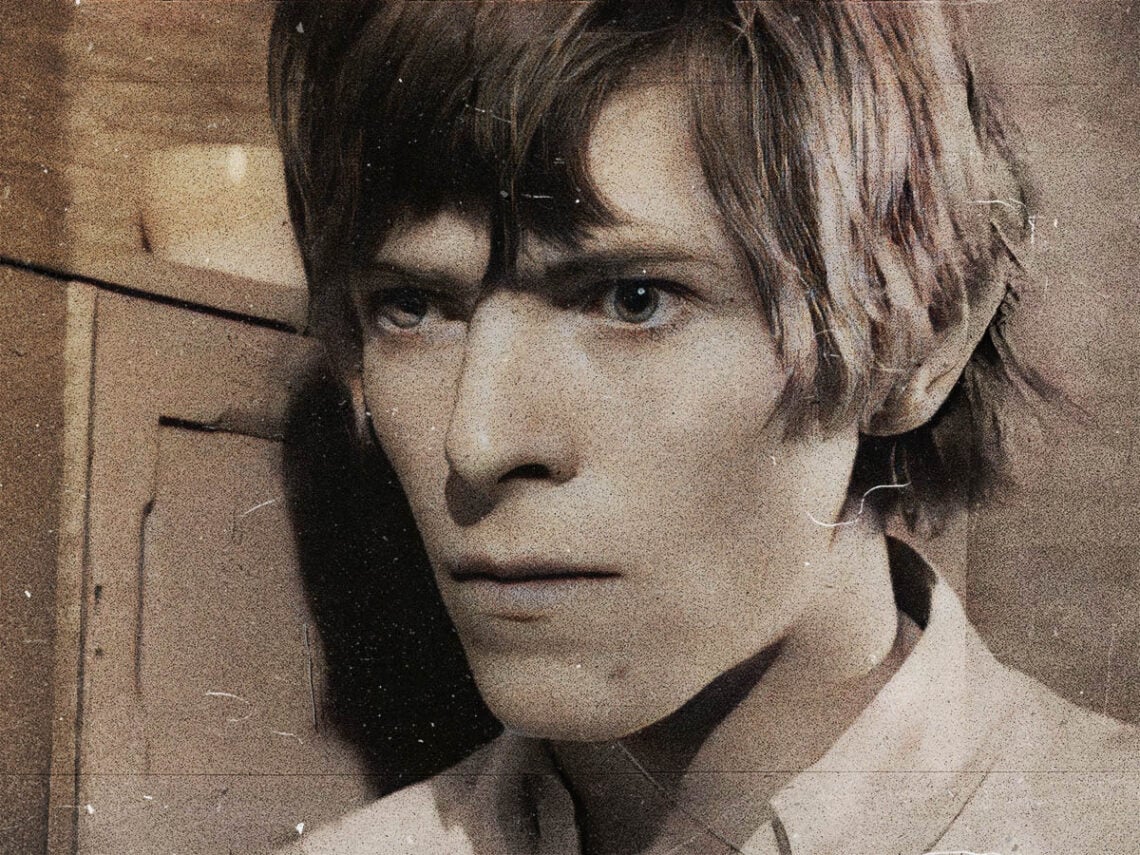
David Bowie and The Angel: A meeting of minds in a Swiss psychiatric hospital

“If it’s wearing a pink hat and a red nose and it plays the guitar upside down,” David Bowie once proclaimed, ”I’ll go and look at it. I love to see people being dangerous.” This penchant for the peculiar and the perturbing was something that permeated all of Bowie’s art, and he has his brother Terry Burns to thank for that. He gave Bowie “the greatest serviceable education that I could have had. He just introduced me to the outside things,” he said. “I saw the magic, and I caught the enthusiasm for it because of his enthusiasm for it. And I kinda wanted to be like him.”
However, Burns’ explorative influence was tinged by tragedy. He suffered from crippling schizophrenia and seizures. This meant that Bowie not only purveyed at outsider for its strange lure, but he also looked at it empathetically, reconciling its cathartic potential. This is the venn that Bowie looked to place his own art in: the shocking pizzazz of defiant singularity and the importance of using that to connect and comfort in some way. With that outlook, Bowie looked to reflect the world at large in some vitally weird new way.
To aid his journey to human otherworldliness, he sought out the far corners of life. When his career hit the skids following the commercial zenith of Let’s Dance, he eventually returned to this world for some inspiration in the “Outsiders’ Wing” at the Maria Gugging Psychiatric Clinic of Klosterneuburg just outside Vienna, Austria.
At the time, Bowie had reenlisted Brian Eno for his 1995 record Outside. This returned his thinking to the notion of isolation and realignment. For some reason, this always proved inspirationally fruitful for Bowie—it’s as though being on the outside of things allowed him to place his art with greater clarity. As Bowie told Moon Zappa, “It was really fortuitous that we got back together in ’92 and realised that we both, again, wanted to approach music the same way we did back in the Seventies.”
Thus, when they were invited to the institute by André Heller, it seemed fate had orchestrated a new sense of impetus. As Bowie recalled, “We kind of had these artistic – at least conceptual – parameters in place before we went into the studio. We sort of knew we were on a mission. Out of the set-ups we gave ourselves, we went to a mental hospital just outside of Vienna and that particular hospital is famous for its artistic wing. Inmates who’ve shown really strong orientation to painting or sculpting or something like that are given their own wing.”
Therein, the “inmates” were allowed to paint and sculpt, and the results were often fascinating. Importantly, for Bowie amid his dower patch, their perfunctory outsider art notion also came to the fore: they were creating these works for an audience of one. It was as though their own canvases offered escape beyond circumstance. This allowed Bowie to get back into music from an entirely individualistic point of view.
Liberated by this escapist viewpoint, art was suddenly exciting to him again. As he continues, “if those walls could talk! [The inmates’] whole process and how they instinctively jumped from symbol to symbol in their narratives and things. One man is called the Angel Man –and in fact, he turns up in one of the songs in the end.” That track is ‘I’m Deranged’. “The rain sets in, it’s the Angel Man,“ Bowie sings in an abstract track that delves into Freudian fugue state themes.
All of which was inspired by Bowie’s fascination with the Angel Man: “He believed he was an angel and said, ‘I was exactly who I was up until the 5th of February, 1948, and then I became an angel… it was just after lunch.’ And from that point, he believed that his old person disappeared and his angel took over him. He was totally reborn at that moment.” Without sounding glib, if that’s not going to artistically inspire you then nothing will. For Bowie, the result was a return to form thanks to a return to the ab-norm.
While, the Angel Man’s legacy is vague, his influence on Bowie was massive. As Eno would recall, this was largely because the Angel Man had accepted his own artistic shortcomings: he wasn’t an artist, he was quite content with being an angel. Bowie had to do the same to find his form: be happy with just being Bowie and create for the sake of creation. So, he began to take inspiration from the happy innocence of outsider art in all sense, as he says of quirky creatives like Daniel Johnston: “[He] reminds me of aspects that made me love art in the first place.“ You sense that he means the very first place here, before the skewing pretense of adulthood gets in the way.
