


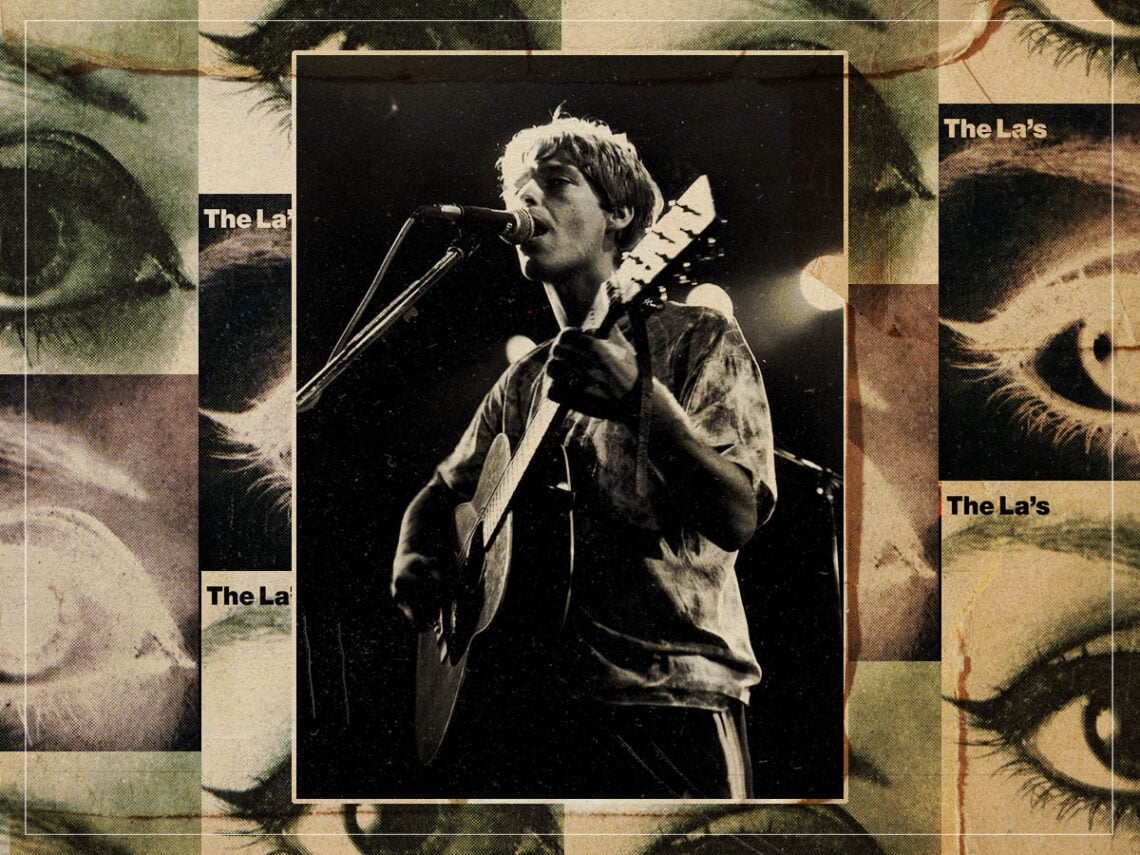
Lee Mavers vs The La’s: the righteous indignation of Britpop’s original sneering hater

“We’re lucky in that, even though it’s a bad record, the competition is nil.” This was how The La’s frontman Lee Mavers chose to promote his band’s debut album to confused American journalists in the summer of 1991, in the middle of what could have been a career-making US tour.
Up to this point, all the chatter around the Liverpool band’s self-titled record, which had reached number 30 in the UK charts, was that it was a very capable and energised modern take on classic 1960s British rock, with touches of The Kinks, The Who, and some other Scouse act called The Beatles. These were nice comparisons and high praise for a 28-year-old, working-class songwriter making his first serious foray across the Atlantic. Unfortunately, Mavers and his bandmates hated their own album and seemed obsessively intent on sabotaging its success.
Over the past three decades, this unusual story has taken on fairly mythic proportions, as the subsequent “disappearance” of Lee Mavers from the mainstream of British music, alongside the increasingly weighty status of The La’s as one of the great debuts and “one-and-done” albums of all time, has led to some predictable distorting of the narrative. Some La’s admirers came to believe that the band’s lone album was, in fact, the magnum opus of a pop genius, and that Mavers, being such an extreme perfectionist, had poured every last bit of his soul into it, leaving him no choice but to walk into the sunset, never to be heard from again.
In reality, Mavers was most definitely a perfectionist of a sort, and perhaps even a hamstrung musical genius. But The La’s album, as everyone knows it, certainly wasn’t his magnum opus. It was a loose collection of re-worked singles at best. And at the time of its release, he didn’t even want to be associated with it.
“I don’t like the record at all. I can’t listen to one song on it,” Mavers told the Chicago Tribune. “We got signed up [to the Go! Discs label] on the strength of demos we did in August 1986, which cost us £15 to do in a day, and it’s our best recorded work to date. Over the next three years, we worked with seven different producers that were forced upon us in seven different studios, and all the music was taken out of it.”
Mavers’ streak of perfectionism, if it exists, was no cousin of the type sometimes attached to Bruce Springsteen or the guys in Steely Dan. This was not a man interested in meticulous overdubbing and fine-tuning. His frustration seemed to be the impossibility of truly capturing the raw and organic sound of a rock band using studio trickery. “When it’s filtered through all this digital technology, it doesn’t sound good,” he said.
Mavers didn’t see The La’s as part of some new retro-minded British pop scene alongside the likes of the Stone Roses, either, even though a lot of critics did. He and his bandmates got together “because the music around us was total rubbish, soulless,” he claimed. “The Manchester fad is already passed in England, because there’s no real content. It’s been a long time since something happened from the street.”
If Mavers’ self-important shit-talking, sneering attitude toward the industry, and general lack of fucks given remind you of anyone, it’s worth noting that both Noel and Liam Gallagher were massive Mavers fans, with the latter calling The La’s and The Stone Roses the “Beatles and Stones of my generation.”
Mavers’ own musical heroes, meanwhile, came from a slightly different lineage: Chuck Berry, Bo Diddley, James Brown… even Duke Ellington and Ella Fitzgerald. Maybe The Who on a good day. “There’s a thing that ties them all together—a raw, rich rrrrrrrr!”, the Tribune quoted him, presumably representing a sort of guttural engine sound with repetition of the letter R. “A growl. A feel that can’t be bought.”
“It’s not a new sound we have,” Mavers added, going into full Gallagher bombast, “but something genuinely ancient. Because what’s right has always been right.”
Unsurprisingly, The La’s album completely flopped in America.
