


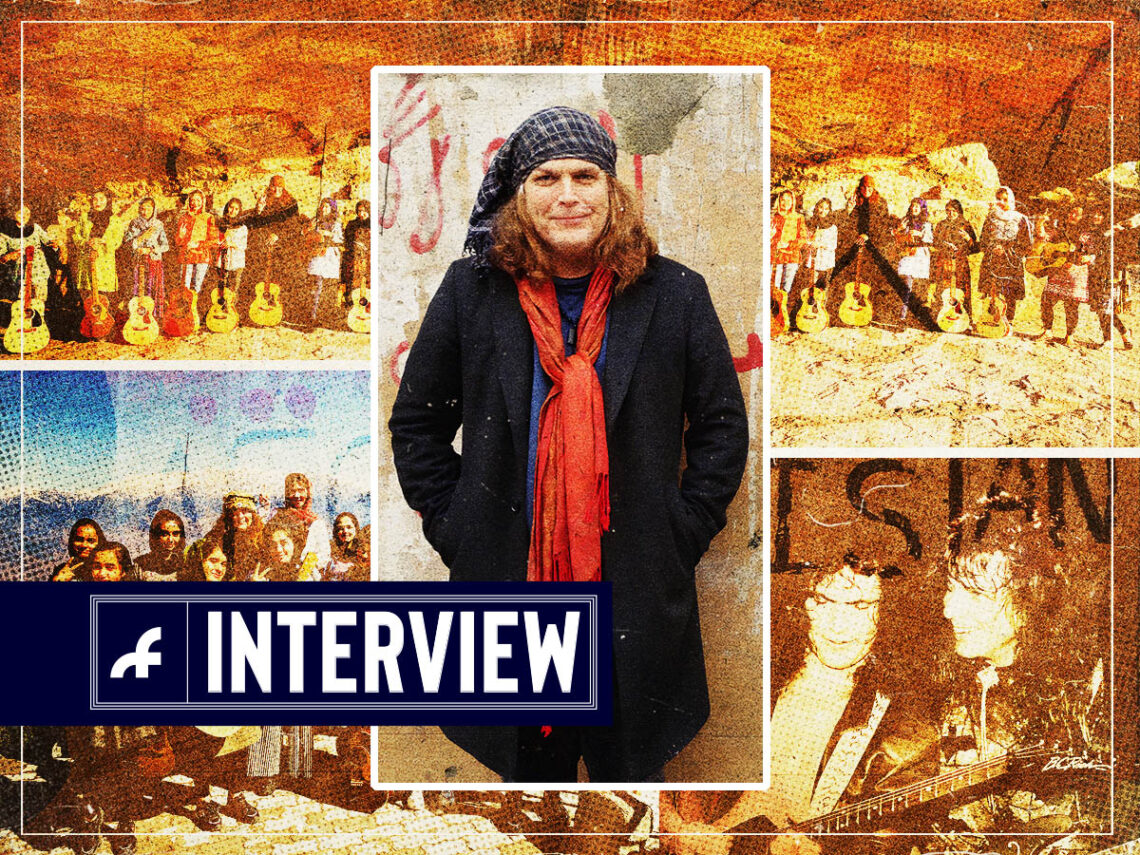
Lanny Cordola: the life and times of the man behind the remarkable Miraculous Love Kids musical charity

“25,000 kids perish each day due to poverty and war,” Lanny Cordola soberly informs me. It is a startling statistic that confounds my Western disposition and makes music journalism seem like a very trivial thing indeed. Worst still, the figure itself is just the fatal tip of an iceberg that hides myriad more tragedies under the waterline of what is observable from a blunt numerical figure. Each of these 25,000 daily losses represents a crisis that ripples down to those children left hanging onto life. And for those, Cordola buoyantly insists, music can be an unlikely miracle.
Cordola, whose The Miraculous Love Kids of Afghanistan most recently teamed-up with Nick Cave, has been chasing down this miracle for over a decade. “I first went to Pakistan in 2010 after meeting the American musician and humanitarian Todd Shea in 2009 through a mutual friend Mark Levine who penned the illuminating book Heavy Metal Islam. Todd had formed a non-profit organisation after travelling to Pakistan in 2005.”
Inspired by Todd’s lead, Cordola wanted to follow in his footsteps. Previously the Californian-born musician had been playing in various rock bands, but now he wanted to pursue something a little different. “My initial motivation was showcasing peace through a music initiative with the aim of bringing together high-profile musicians from the West to collaborate with high-profile musicians from Pakistan,” he says. This musical handshake would demonstrate culture’s capacity to lead the way towards an acquiescence from the currency of power towards the virtues of peace. “It culminated in a benefit concert in New York City that brought together renowned Pakistani singer Atif Aslam with members of Guns N’ Roses and yours truly along for the ride.”
While effective in a fashion, it left Cordola feeling unfulfilled with his humanitarian mission. His planned trip to Pakistan had previously been cancelled due to the worst floods in the nation’s history. “I pleaded that I still wanted to come and help in any way I could,” Cordola recalls. “Todd, who is now a Pakistani hero, agreed to let me continue the trip – this is when the idea of The Miraculous Love Kids was formed.”
“After visiting many flood-affected areas and the camps that were formed to house and help those in need, I was struck by the wild joy of the children. This has become an ongoing theme for me; whether in Pakistan, Afghanistan, Kashmir, Iraq or Kurdistan, children find joy in the most dire circumstances,” he happily explains. “Then, in 2012, I read about the horrific attack on ISAF in Kabul that killed seven innocent Afghans, including two sisters, 11-year-old Parwana and 13-year-old Khorshid—several American troops I subsequently met had befriended these girls and raved about their tenacity, exuberance and bravery.”
“When these girls saw the bomber sent by the Taliban, they ran towards him to protect their American friends,” Cordola tells me. “It was then that the question came to me: ‘How can we live in a world where we sacrifice precious little girls like this at the altar of poverty and war?’ Then a still small voice whispered: ‘What are you gonna do about it?’ I soon made arrangements to visit the family of the sisters who were living in a very poor area of Kabul called Shuda.”

He continues: “The younger sisters of Parwana and Khorshid moved me greatly when they asked if I would be their [guitar] teacher. I said I would do everything I could for them to honour their fallen sisters. So, this is what ultimately brought me to Kabul – after two other trips there to get the family settled into a new home and enrolled at a private school, I decided to officially form The Miraculous Love Kids to assist with their well-being and education, and share the wonders of the guitar with other war-torn Afghan girls.”
“Why girls?” Cordola posits before I ask. “Because even though their rights are guaranteed in the Afghan constitution, in actuality, they had little to no rights and were being married off as young as six years old.” As the WHO stated in their most recent report on women in areas with refugee encampments: “As camps become increasingly militarized, women and girls are particularly at risk of rape and domestic violence. More than a quarter of the women interviewed reported having forced sexual intercourse over the past year.” And aside from the harrowing figure, even those that escape such brutality are left with utterly diminished opportunities. In fact, they represent more than 80% of refugee camp populations.
Cordola saw this devastating fate firsthand and sought to bring the oft-observed salvation of music to these girls to serve as an engine of hope and change. He just needed to define how he would do this. “It was some kind of fever dream that led me to the name The Miraculous Love Kids,” he says. “When a trusted friend said that he thought the name sounded like a band, I said, ‘YES! I want to form the biggest band in the world consisting of war-torn kids and some of the most well-known musicians in the world’. When 25,000 kids perish each day due to poverty and war, one must dream big.”
So, the miraculous dream of musical deliverance was afoot. “My first trip to Kabul was March 6th, 2014,” he says. “I flew there from Islamabad. It was a five-day whirlwind to meet the family of Parwana and Khorshid. The guy that I stayed with, who sadly turned out to be a scoundrel, operated an underground rock club. So, I kicked out the jams with some locals and expats till the wee hours. I also met Malalai Joya, the author of A Woman Among Warlords. It is a very compelling book not only about her life but also a short history of Afghanistan – she was very welcoming and curious about my aims – she was the youngest woman ever elected to the Afghan parliament and was fastidiously banned after she called out all the warlords for their egregious deeds in a parliamentary session.”

Regarding that first meeting, he recalls: “We spoke about Martin Luther King, John Lennon, and girls playing guitars which she was fully supportive of. Meeting her was quite an ordeal—driving through winding streets and backroads where she was hiding underground due to all the threats she had been receiving. She is a brave and visionary soul.” She proved to be one of the many beacons on Cordola’s journey that showed him that blazing a positive trail was possible under the steam of defiant hope.
This hope was never far from presenting itself and emboldening Cordola, no matter how obfuscated it may have appeared at crooked times in tempestuous places. “Kabul, at this time, felt very oppressed. There was a palpable ominous feeling. There was also a peculiar hope, but very fragile. And as I experienced a house of cards ready to collapse due to many factors; corruption, poor planning, arrogance, ignorance, tribalism and patriarchy; there were glimpses of what things could be if the energy went in the right way, but tragically it didn’t.”
Despite this, Cordola pushed on with his singular rock band vision. “Because The Miraculous Love Kids model is based on 1. Wellbeing 2. Education 3. Life skills 4. Music—it became quite popular as parents were happy to have their girls learn English and earn money to keep them off the mean streets of Kabul. I couldn’t keep up with the demand. If we would have had the resources, there would have been tens of thousands of girls onboard, of course, the terrorists would have made this untenable, but the thirst was there,” Cordola recalls.
He had set up a small institution, and slowly but surely, it was delivering better lives to masses of disenfranchised girls in the region. “All the people that came to our centre were super grateful for this program,” he says. “One father came to me in 2018 and told me he didn’t have much time left as he was gravely ill and asked would I be the father of his three children, two daughters and one son. I excused myself and left the room to gather my composure”.
Adding: “As you can imagine, I had never experienced anything like this before. After a small prayer, I went back in the room and told him I would do this one condition: that he would always be father number one, and I would be father number two. I hoped he would live a long time and we wouldn’t have to be concerned about this, but sadly, several months later, he passed, so I became their father in the sense of support and guidance—they are truly Miraculous Love Kids and what an incredible gesture by their father to entrust me with his beloved children.”

It was a gesture that essentially solidified Cordola’s calling in a principal sense. He was now rooted to the area, getting used to the strange cultural quirks like Afghan’s love for Charlie Chaplin, the theme from The Deer Hunter and Dan Hill’s ‘Sometimes When We Touch’, or the wink and wildly inflated price you would have to handover to get under-the-counter beer and wine. Amid this strange culture, he tried to make a home. All in all, as he settled, he tried to offer a utopia for the children – allowing them to be young and enjoy the frivolities of theme parks, malls, and excursions – or, as many in the advantaged West would call it: normality.
“My favourite place was Wazir Akbar Hill near the green zone. It has a 360-panoramic view of Kabul. When the girls were younger, we used to practice up there with permission from the Warlord/Vice President General Rashid Dostum. He liked music and approved of my efforts. I used to write poetry up there and gaze into the wounded soul of Kabul.” This landscape was pocked with the spiritual scars of that wounding too, and Cordola looked to draw art from these harrowed spaces. “There was also an Olympic pool that the Russians built in the 1980s,” he soberly continues, “That the Taliban would use to execute their prisoners. I made a few videos there playing guitar by myself”. It was where he filmed ‘Mother, Mother’.
His mission was one of transcendence, to transfigure these places and the grim situations around them with a degree of beauty that might illuminate an alternative not just for the girls of the area but the whole region in general. This was proceeding successfully. Through the guitar, the kids were learning English and broadening their horizons via knowledge of other cultures and countries. They also earn a stipend to support their families, instilling a sense of self-worth and opening up avenues to an autonomous future, not to mention the fact that they got to be a part of songs with some of the biggest names in music.
The prosperity of the endeavour, however, served to shelter Cordola from some of the warning signs around him. In the weeks prior to a scheduled flight away from Kabul to attend to some routine visa admin, he had noticed an increased military presence. “To my great dismay, on the way to the airport, it was much more tense than usual, and inside the airport flights were getting cancelled one after another except two—the last one was to Islamabad, Pakistan. This was my flight.”

As far as Cordola had been informed, talk of the Taliban taking over Afghanistan had been mute, with several authorities informing him that it would never happen. “I still didn’t think that the Taliban were coming,” he said even then. “However, the girls knew, and they told me empathically. I asked how did they know, and they just replied, ‘We know’. I take this as something instinctual or, as Carl Jung referred to as the collective unconscious.”
Now, he tells me the situation is dire: “The state of affairs in Afghanistan is abysmal. What little rights girls and women had have been obliterated by the Taliban. Poverty has grown, the number of terror groups based in Afghanistan has grown, hunger is rampant, childhood marriages omnipresent, suicides spiking. And hopelessness pervades in most segments of society.”
Facing up to these fears while stranded outside of the country, he clung – despite the odds – to the notion that he could help. He continues: “Immediately after, I was working literally day and night without sleep trying to get them out. That is an entire story in and of itself. After three months of futility, I flew back to LA and regrouped”.
Adding: “In April, I flew back to Islamabad and began to evacuate the girls and their families. One came via visa through the Torkham border, the rest very dangerously via another border called Spin Boldak with smugglers. We now have a space where I teach the girls daily and a studio where we record and where I work to get them relocated.”

Here, they are once more reconciling the tragedies that seem all too ever-present in their lives. “The girls have experienced the absolute worse of humanity and life,” he explains. “They have experienced surviving suicide bomb attacks, working on the mean streets of Kabul, dodging bombs, bullets and forms of violence, threats of childhood marriage – I was able to prevent some of these marriages, but sadly many were married off and are now living in desperate and horrible circumstances – loss of family members due to no access to proper medical care and on, and on…” But still, hope arrives with this new musical lease.
Although this enterprise has been pushed through painful rigours, Cordola still insists, “music to me was, and still is, inexplicable,” and he looks to share that miraculous little flame of liberated passion with the children who need it most. “What I’ve learned is that the highest form of music sings of justice and aims for transcendence. I was initially exposed to the music my mother played, which was The Beach Boys, The Doors, Bob Dylan and Elvis Presley. Those magical frequencies – mystical melodies – glimpses of another world.”
Waxing lyrical about the lifeblood of his operation, he continues: “Later, John Coltrane bestowed upon me the scared recipe from his jazz prayer A Love Supreme. The frequency – the intention – the concentration led me to seek those higher modes and codes of being.” And he speaks of his own passions with good reason, as his latest collaborator Nick Cave concurs; music has the capacity to open up worlds to us. It illuminates a liberated republic with a greater understanding and empathy with the world. In a very literal sense, research shows that children who learn music are healthier, happier and have higher brain function than those who aren’t exposed to it.
“In Afghanistan, I found my zen,” he says, “And began to put it all into practice with war-torn, poverty-stricken girls. In this, I found salvation, and each day I find it more and more. The Nick Cave song exemplifies this for me; this soul-extolling and holy virtues of spiritual beauty profoundly elevated my spirit. Working with Nick was remarkable in every sense. He was moved by the girls and the song and how we set it to his exquisite words.”
Everything about this, he says, embodies The Miraculous Love Kids. As Nick Cave says himself: “What they do speaks volumes as to what music can give, but also what can be taken away.” He adds: “The story behind the Miraculous Love Kids / Girl With a Guitar is a tragic one but also one of great hope.”
People can help by donating at the website miraculoslovekids.org
