


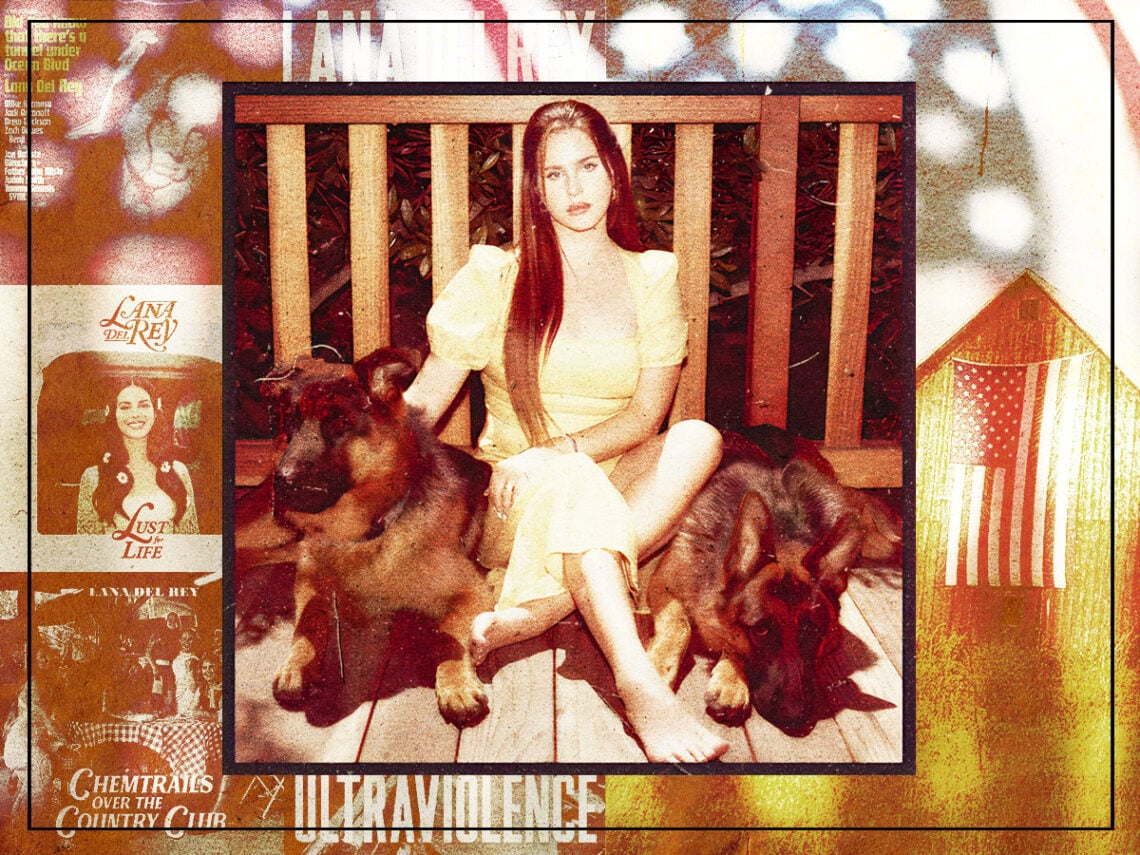
Lana Del Rey: the embodiment of the Americana dream

Lana Del Rey has always had her foot on the cultural pulse, embracing 1950s nostalgia and the nihilism of Russian poets, much to the delight of sad girls everywhere since Born To Die. The mood of every album dictates a new aesthetic, so expertly honed that it feels knowingly cultivated, but so effortlessly carried off it still feels relevant. But Del Rey’s affinity for old-school Americana, fevered patriotism, and the American dream endure through every moment of self-reinvention.
On Born To Die, it was more opaque – in the album’s visuals, she was draped in the American flag and practically dripping in red, white, and blue. Channelling a tortured Marilyn Monroe, Del Rey’s vocals were dubbed baroque-pop, laced with a yearning for the old guard, repressed American sensibilities, and adventure. Her love interests are likened to James Dean, gangsters and kings of oil empires. She aligns herself with these men at great personal cost, often in the pursuit of love, but more often than not, money and diamonds.
Love is a stand-in for rampant capitalism, and what sounds like romantic neediness is really a lunge for financial security. On ‘National Anthem’, she sings: “Dark and lonely, I need somebody to hold me, he will do very well, I can tell, I can tell – keep me safe in his belltower hotel”. There’s no love in Born To Die that’s preceded without some kind of exchange, she barters her own attention and beauty in the hopes of finding something stable and secure.
Historian Sarah Churchwell says the American Dream was continually repurposed by each generation until the Cold War, until it morphed into an argument for consumer capitalism, essentially freezing our idea of it in the 1950s. This nostalgic setting is also where Born To Die’s aesthetic world is fixed, a world replete with glass Coca-Cola bottles and Lolita-esque sunglasses. But on follow-up, Ultraviolence, Del Rey moves away from American suburbia and into its big sprawling cities.
On ‘Florida Kilos’, the diamonds she yearned for on Born To Die are replaced by drugs: “Cooking up a dream, turning diamonds into snow.” The dream has morphed and shifted, moving into America’s dark underbelly. Tonally, it takes on a fuzzier, psychedelic rock sound than the cinematic drama of Born To Die but still hearkens back to an America of old – this time to pre #MeToo seediness, groupies, drugs, and overdoses.
But the need to evolve means subsequent albums Honeymoon, Lust for Life, and Norman Fucking Rockwell! take on a sunnier outlook while still exploring what it means to Del Rey to pursue the American dream. On ‘Lust For Life’, she declares us “masters of our own fate” and “the captains of our own souls” in a surprising moment of agency. The version of America she distils in these albums is brimming with hope, which is quickly quashed by the arrival of Did You Know That There’s a Tunnel Under Ocean Blvd.
On that album, the American dream seems to have crumbled, nowhere more so than on track ‘A&W’. It’s a sprawling seven-minute track split into two parts: ‘Part I: American Whore’ and ‘Part II: Jimmy’. The song nods to the root-beer-drinking Americana its title evokes but manages to rifle through old hallmarks of her image and emerge reinvented. Backed by a restrained but rousing piano, Del Rey’s signature breathy, old-Hollywood vocals open the song, conjuring the kind of melancholic glamour the Born To Die years evoke. But around the five-minute mark, the song subverts her usual flair for cinematic outros by slipping into a trappy, frantic exit with cries of: “Jimmy only love me when he wanna get high” set to a thumping bassline.
As Del Rey guides us through the life of an “American whore” – the original name of the track, according to co-producer Jack Antonoff – her unflinching look at its monotony and emptiness feels somehow new. So does the pointed shift away from writing about the daddy issues that famously colour her songwriting. In a tongue-in-cheek pivot, she effectively lets female figures fill the boots of the absentee fathers and James Dean lookalikes she used to sing about.
A resigned sadness about her mother clouds the song’s opening – “I haven’t done a cartwheel since I was nine, I haven’t seen my mother in a long, long time” – but she leverages that same painful relationship to taunt her lover Jim in the song’s closing line: “Your mom called, I told her, you’re fucking up big time.”
Jim is a mythic man who has long haunted Del Rey’s discography as a stand-in for JFK, abusive lovers, and the Lizard King himself. But his return on “A&W” wasn’t just a call back to Ultraviolence; it was a cathartic end to her preoccupation with emotional damage and older men providing for her. It’s a more aggressive commitment to the personal freedom flirted with on ‘Lust For Life’, and Del Rey’s most frank account of the death of the American dream, all of which she delivers in a world which feels every bit as Budweiser-soaked as her early work.
