


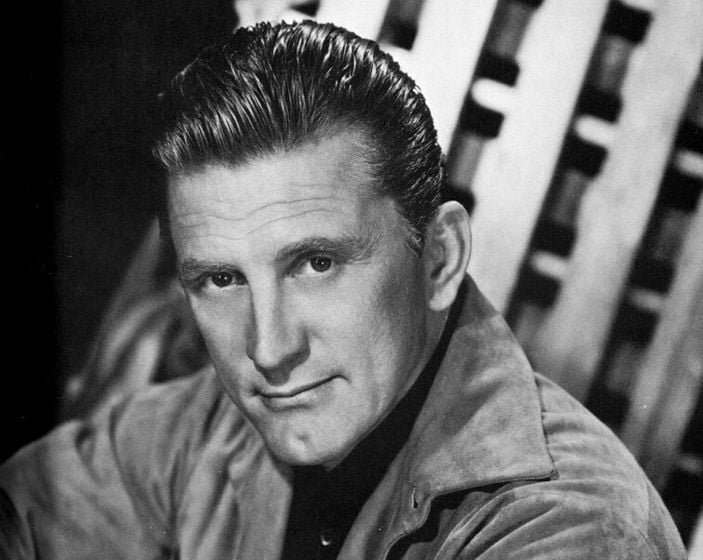
Kirk Douglas on the biggest disappointment of his career: “Goddammit, I tried”

Kirk Douglas had few things to regret in his career. The actor lived to the ripe old age of 103 and was one of the most bankable stars in Hollywood during his peak. He earned three Academy Award nominations – for 1949’s Champion, 1952’s The Bad and the Beautiful, and 1956’s Lust for Life – and earned an honorary Oscar in 1996.
His career started with a bang when he played opposite A-list star Barbara Stanwyck in the 1946 film noir The Strange Love of Martha Ivers. Within a few short years, he was one of Hollywood’s top stars. In 1949, he became one of the first actors to start a production company, which landed its first major success in 1957 with Douglas’ anti-war drama Paths of Glory, directed by a then-little-known director named Stanley Kubrick.
Douglas also played an influential role in breaking the blacklist, a list of writers, directors, and producers in Hollywood who were banned from working due to often spurious accusations of Communism. Douglas made a statement by hiring Dalton Trumbo, a prominent member of the list, to script his movie Spartacus under his real name. The decision helped dismantle the blacklist altogether and lift the threat of politically motivated attacks on the film industry.
Despite this impressive legacy, Douglas did admit to having one major career disappointment. Speaking to Esquire in 2007, the then 84-year-old revealed that it had to do with a film that he just couldn’t get off the ground.
“One big disappointment in my life was One Flew Over the Cuckoo’s Nest,” he said. “I bought the rights to the book, but no one wanted to make it into a movie. So I paid to have it made into a Broadway play.”
The actor purchased the rights in 1962, outbidding Jack Nicholson, who had also wanted to produce the story. Douglas played the lead role of Randle McMurphy in the Broadway adaptation a year later, but when he tried to get it produced as a film, no one wanted it. Supposedly, studios just thought he was too old to play McMurphy, a patient at a mental institution who rallies the other patients to revolt against the tyrannical management.
Douglas eventually hired director Miloš Forman and gave the rights to his son, Michael, to get the film over the line, still expecting to play McMurphy. However, Forman had other ideas, and Douglas was dropped from contention. The move soured Douglas’s relationship with his son for years to come and left a lingering bitter taste. Gene Hackman, James Caan, Marlon Brando, and Burt Reynolds were all considered for the role, but it ultimately went full circle when Forman cast Nicholson.
Looking back on the disappointment, Douglas sounded as though he had found peace with it at last. “There was one line in [the stage adaptation] that was so beautiful,” he said, describing a scene in which McMurphy tries and fails to pull a sink out of the wall. “As he was leaving the room with all the guys watching,” Douglas recalled. “He turned around and said, ‘But I tried, goddammit, I tried!’ Sometimes, I think I should have that as my epitaph.”
