


The key to Christopher Nolan’s adaptation of ‘The Odyssey’ is everything he left out

Adapting a classic work of literature is almost always a bad idea, but when it comes to a text as ancient and deeply ingrained in Western storytelling as The Odyssey, the task is a fool’s errand.
Luckily, Christopher Nolan is as indifferent to such truths as he is masterful of his medium, and with The Odyssey, he defied the gods (and Homer) to unabashedly reinvent a classic for modern times. This deeply moving film succeeds not through fidelity to the source material but through deviation from it.
The original Odyssey is hardly sacred. Set around 1200 BCE, it was passed down orally before being committed to text some five or six centuries later. No one knows who Homer was, and many historians argue that he was more than one person. Written in an ancient language that all but disappeared nearly 2,000 years ago, its many, many translations have spanned centuries. Cultural mores of Ancient Greece are unrecognisable to the modern world, which makes Odysseus, as written, a complicated and confounding figure. He is the hero of the story, but he is also a seemingly unrepentant mass murderer, a gleeful liar, and a serial adulterer.
It may even be that his desire to return home has less to do with his yearning for family than with his yearning for glory. As Emily Wilson writes in the introduction to her 2017 adaptation of Homer’s epic poem, Odysseus’s decision to leave behind an immortal life with the goddess Calypso after seven years on her island may stem from pure personal ambition. If he had stayed with Calypso, he would not have been able to return home as a conquering hero who defied Poseidon to reclaim the throne. Such a homecoming would cement his place in the pantheon of mortal heroes, a far greater triumph than simply disappearing into eternal life with a minor goddess.
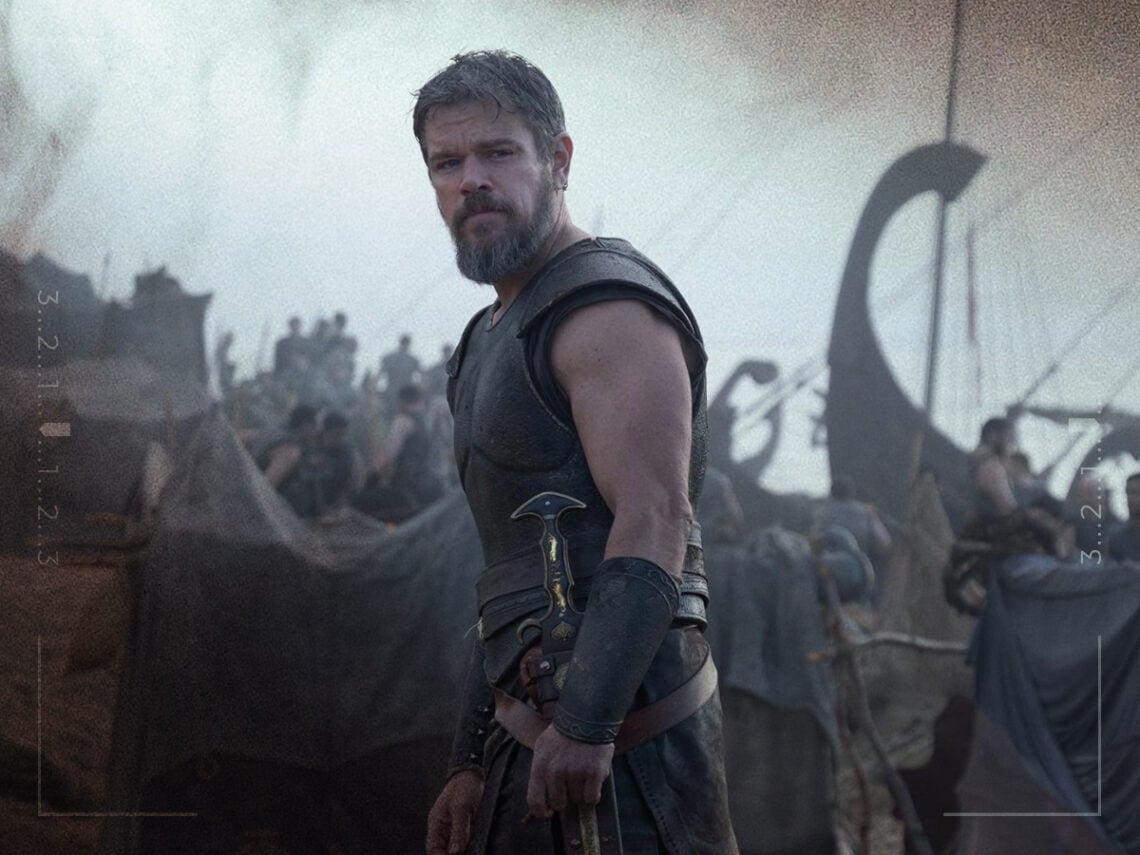
Nolan’s Odysseus, played by a soulful Matt Damon, is different. He is a warmonger and a crafty one, but it becomes his destruction, not his glory. This is clear not just in the lines he speaks, but in the parts of the original story that Nolan has removed. Most of the epic poem takes place during banquets in which Odysseus, having washed up on the shores of foreign lands, is pampered by the local royalty and plied with wine and meat as he tells of his adventures. In Nolan’s version, there is no carousing, except back home on Ithaca, where Odysseus’s palace is overrun with greedy suitors competing for his wife Penelope.
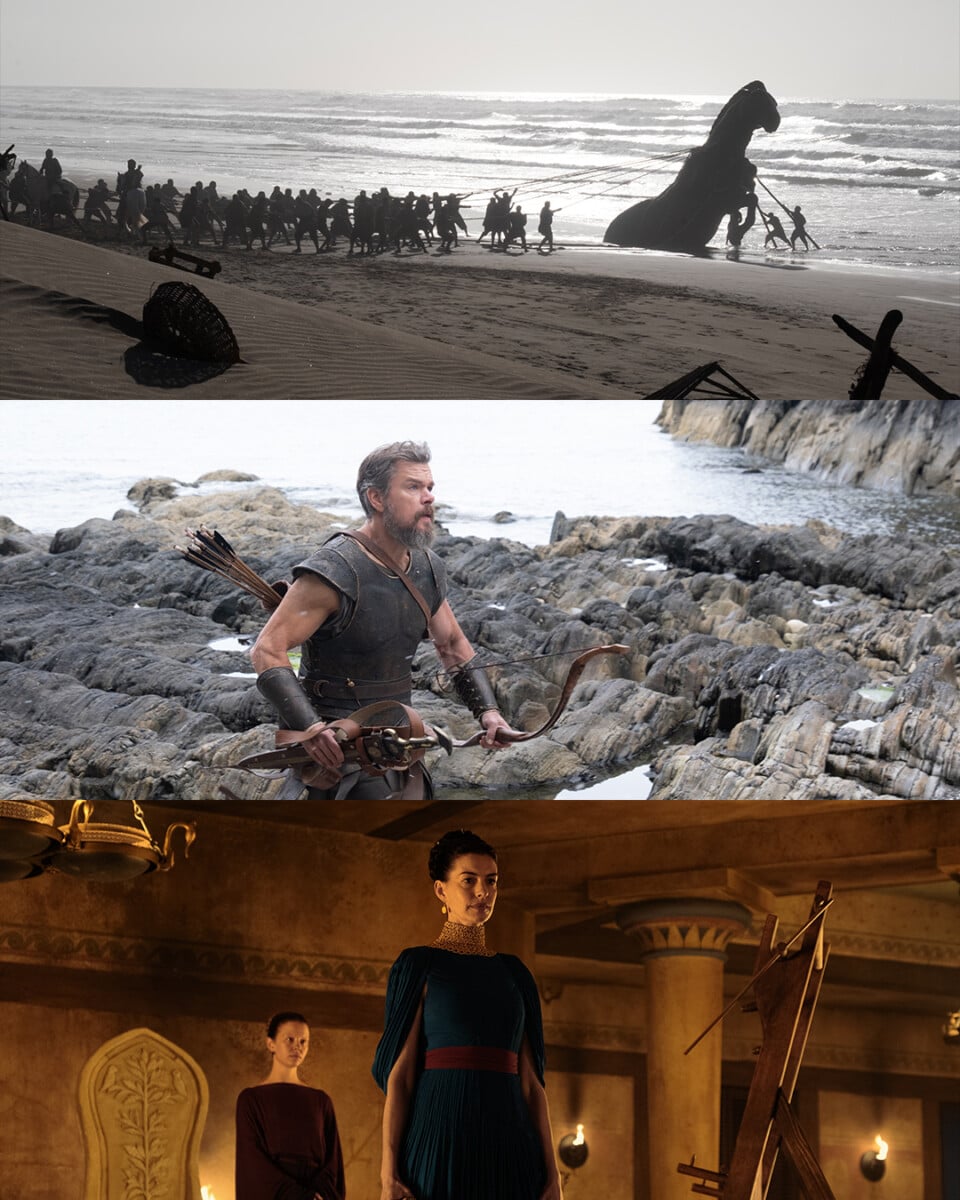
Instead, Nolan isolates his hero on the island with Calypso (Charlize Theron), his memory clouded by the amnesiac effects of the lotus flowers that the goddess feeds him (in the poem, he stays there without the mind-altering plant). Instead of telling his story to a hoard of well-fed royals while he wears their gowns and is showered with treasure for his journey home, he tells it haltingly to Calypso as the memories shudder back into focus. Sitting with her in the sand, he remembers each detail, the lucidity seeming to drain him of strength rather than fill him with it.
When he journeys into Hades, Odysseus does not reunite with his adoring mother. He meets Sinon (Elliott Page), a soldier who was recruited as a boy and who believed Odysseus’s lie that the Trojan horse was a peace offering, not a vessel for hiding his avenging army. He is further confronted by the darkness of his past when the soldiers who followed him into battle descend upon him, rushing him in a great wall of fury and despair, a direct manifestation of his guilt.
Gods, too, are different. In the original text and in most of Greek mythology, the gods are a physical presence in the lives of mortals, either disguising themselves as humans or making themselves unmistakable through natural phenomena. Athena plays a pivotal role in Odysseus’s journey, finding a kindred spirit in this brilliant strategist and fighter. She appears frequently in the poem in various guises to direct his actions or influence the actions of others. At the end of the poem, it is she who quells a potential uprising in Ithaca and puts Odysseus back on the throne.
But in Nolan’s film, Athena only takes the form of a beautiful young woman (Zendaya), who, we learn near the end, was brutally slaughtered by one of Odysseus’s men during the siege of Troy. The implication is that she is not appearing as a concrete person at all and may simply be a figment of his own imagination, a haunting reminder of his unshakeable culpability. The gods in this story do not choose winners and losers. Odysseus, despite his survival, is a tragic figure whose only company after the death of his crew is the ghostly memory of his own brutality.
The point to which Nolan returns again and again throughout the story is the idea of xenia, the Ancient Greek custom of hospitality. Treat every stranger with generosity, the rule went, because you never knew when they might be a god in disguise. Xenia is dead in Nolan’s version of The Odyssey. Odysseus is not bathed and fed by the people he meets, nor is he sent home on a new ship laden with treasure.
Nolan removed all of these moments, focusing instead on the places Odysseus and his men venture and are driven away. There is the man-eating cyclops, the towering Laestrygonians, and the sorceress Circe, who turns them into pigs. Meanwhile, in Ithaca, Penelope (Anne Hathaway) believes that her time has come to marry one of the suitors, saying that, without a man on the throne, the feared Sea People may sack their country without provocation and turn them all into slaves.
The revelation at the end of the film is shattering. When Odysseus returns and seeks bloody vengeance on the suitors, Penelope finally understands, saying to him, “You are the People from the Sea.” The lack of xenia – what the characters call “Zeus’s law” – wasn’t about everyone else losing touch with the ancient ritual, but about Odysseus’s original sin of the Trojan horse.
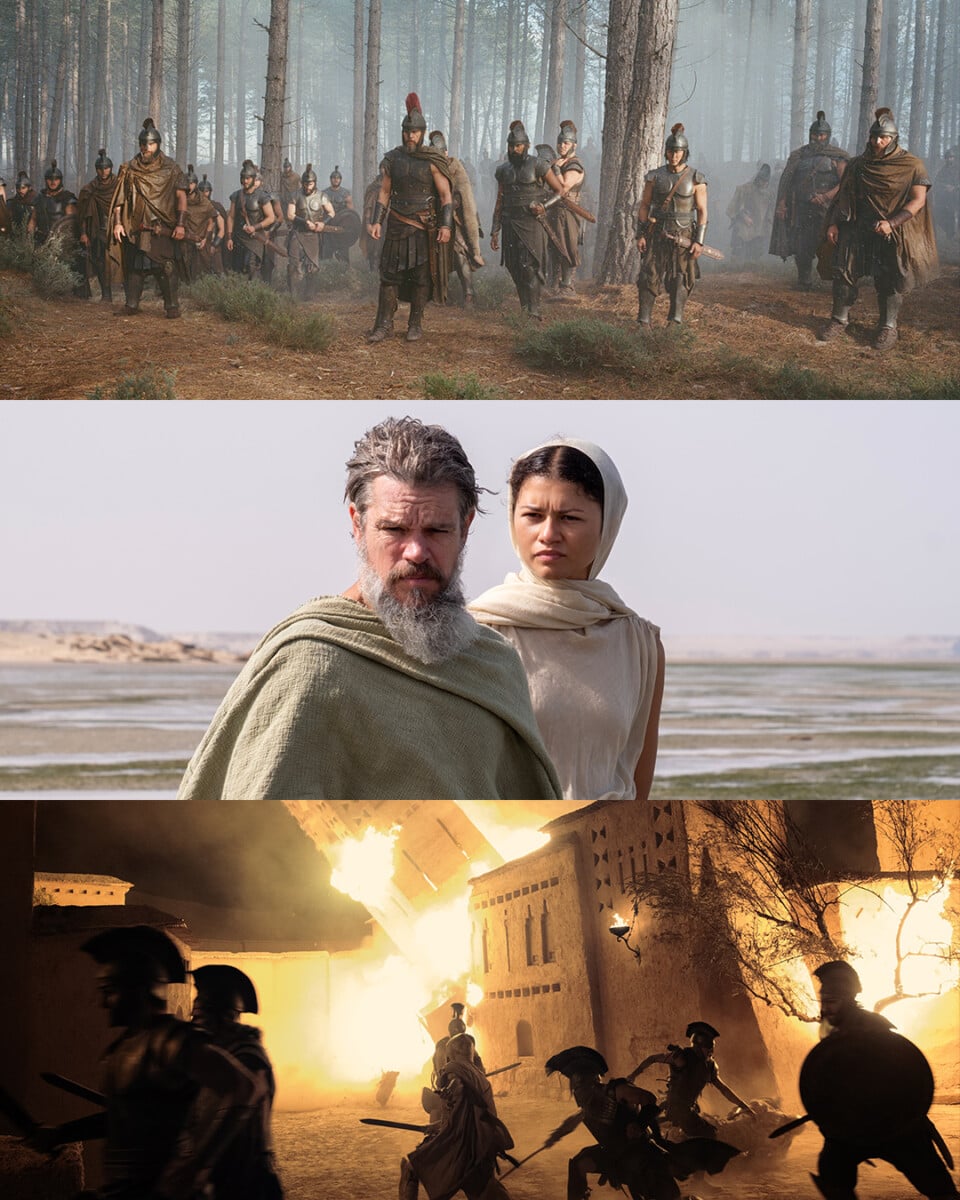
By disguising a weapon of war as a peace offering, he broke Zeus’s law forever, setting in motion a pandemic of fear of the other that made his journey home a bitter and lonely struggle. No wonder he was met at every port with violence, and no wonder that, when he sat with Calypso and finally remembered this journey, the prospect of going home was anything but triumphant.
In the poem, Odysseus returns to Ithaca, murders the suitors, slaughters the slaves who either helped or were raped by them, and regains the throne after Athena puts an end to a potential coup. Nolan’s film is, in many ways, about taking responsibility for actions that cannot be undone. Instead of taking the throne again, Odysseus exiles himself with Penelope, leaving the kingdom to their son, Telemachus (Tom Holland), who is notably not a warrior or even a competent fighter. Where the poem and the culture of Ancient Greece prized war heroes above all else, the film shows Telemachus to be something of a pacifist. When Odysseus tells his son that he is proud of him, he may be telling him that he is proud that Telemachus did not follow in his footsteps.
There are plenty of other changes the director made to the source material. The women have more agency, and Odysseus spends a lot less time lying about his identity. But Nolan decided not just to streamline the story and make it more contemporary, but to put forward a thesis: It takes very little to burn the world down, to turn peace and trust into war and fear. This is just as true in 2026 as it was in 1938, as it was at the end of the Bronze Age. Homer’s poem gives us a hero who fights and kills his way to a glorious homecoming. Nolan’s film gives us a hero whose brilliance is so destructive that it takes him ten years to find the will to return home.
“What if the Odysseus you knew lost his way?” Odysseus asks Penelope before he reveals his identity. “What if one night, in a strange city, he saw things that made him think that the home he knew couldn’t possibly be there anymore… To burn the walls of Troy was to burn the world entire.”
Nolan’s Odyssey is ultimately a story about unintended consequences and the limits of redemption. It is also about the destructiveness of fear and mistrust, the way the same people can go from welcoming to reviling each other. It is not a faithful adaptation, and it is all the better (and more timely) because of it.
