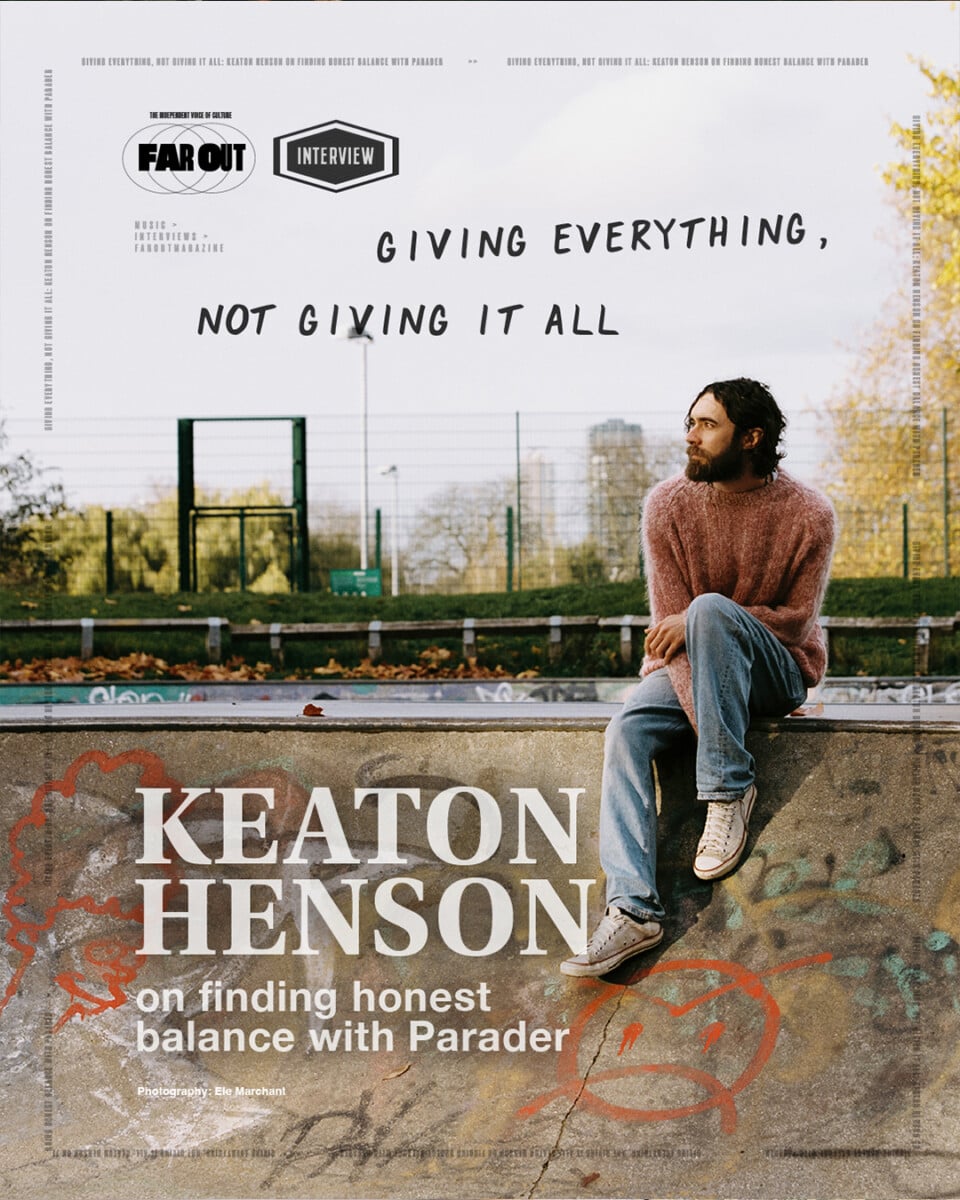
Giving everything, not giving it all: Keaton Henson on finding honest balance with ‘Parader’

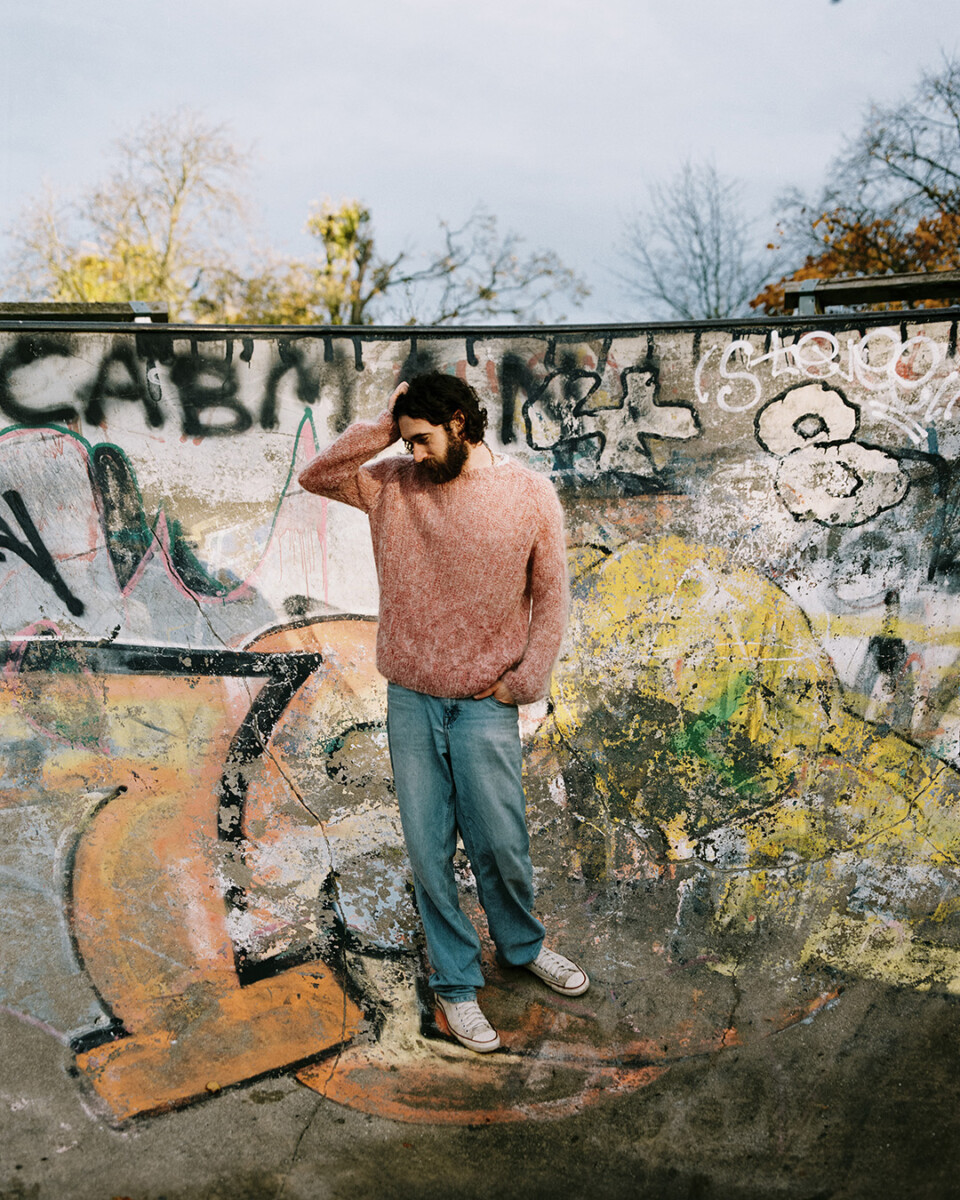
“I would love to live in a world where the only way that people who don’t know me, the only thing they know about me is what I put in those records,” Keaton Henson says as we sit on a bench in the park. But by now, I do know him.
In 2023, I got an email – ‘To Lucy Harbron, From Keaton Henson’. Anyone with any awareness of the artist would know that historically, he’s shied away from the press completely. With the release of House Party, he’d decided to try and embrace it. Suddenly, I found myself in his garden not only interviewing him, but eating lunch, chatting idly.
In 2024, almost exactly a year to the date, we were back. Myself, our photographer Ele Marchant and Keaton Henson, eating lunch in the garden again. When we said our goodbyes, we joked that he better start working on the next thing in order to keep up our yearly tradition.
A year and a few months later, we were back, this time in a park, catching up once more. By now, there’s a degree of familiarity, a friendship. Henson asks Marchant about her degree, we ask the artist about the garden he was beginning to work on in year one.
Before, I’ve written at length about the more personal elements of that. Henson’s public brand is that of the ‘sad man’, dogged by stage fright, crippled with anxiety. In the past, I’ve written a lot about the reality of the man as a person and the strangeness of how that interacts with his art, seemingly sending him in and out of what he called the “mine” of his emotional self. This time, as prompted by his desire to simply be known through his art, I won’t do that.
The longing to leave the rest alone and let the music speak is overarching on Parader, his newest effort. I resist the urge to psychoanalyse his movements. When we last met, during the release of Somnambulant Cycles he reflected on his prior album, House Party, as “exhausting” as for one album, he essentially told the world he was playing the role of the artist and doing it ‘properly’. After, he characterised his fully instrumental album as a retreat.
I could question him about what that says for Parader, as musically, he pushes it even further out of the box into a louder, rockier, grungier place. What that might mean for his mental health is no longer the story; Henson is freeing himself from having a weighty conversation surrounding his every move.
“I’m incredibly grateful that I’ve been allowed to do that,” he said instead, reflecting on his varied career with joy. “I always thought I was a total one-trick pony of just like, sad stuff,” he continued, but lately he’s been reflecting on his own work and seeing what so many see: an artist of incredible breadth.
“I need to keep myself interested in writing songs and making music, and I think the way that I tend to do that is by doing something new to me,” he said. But on Parader, it was less something new, and more something nostalgic.
“I think it’s maybe an age thing. I think I was naturally going back to music from my youth. I think it was like my younger memories of like entering into my songwriting,” Henson said of the genesis of this project, and overwhelmingly those memories were of his first ever bands.
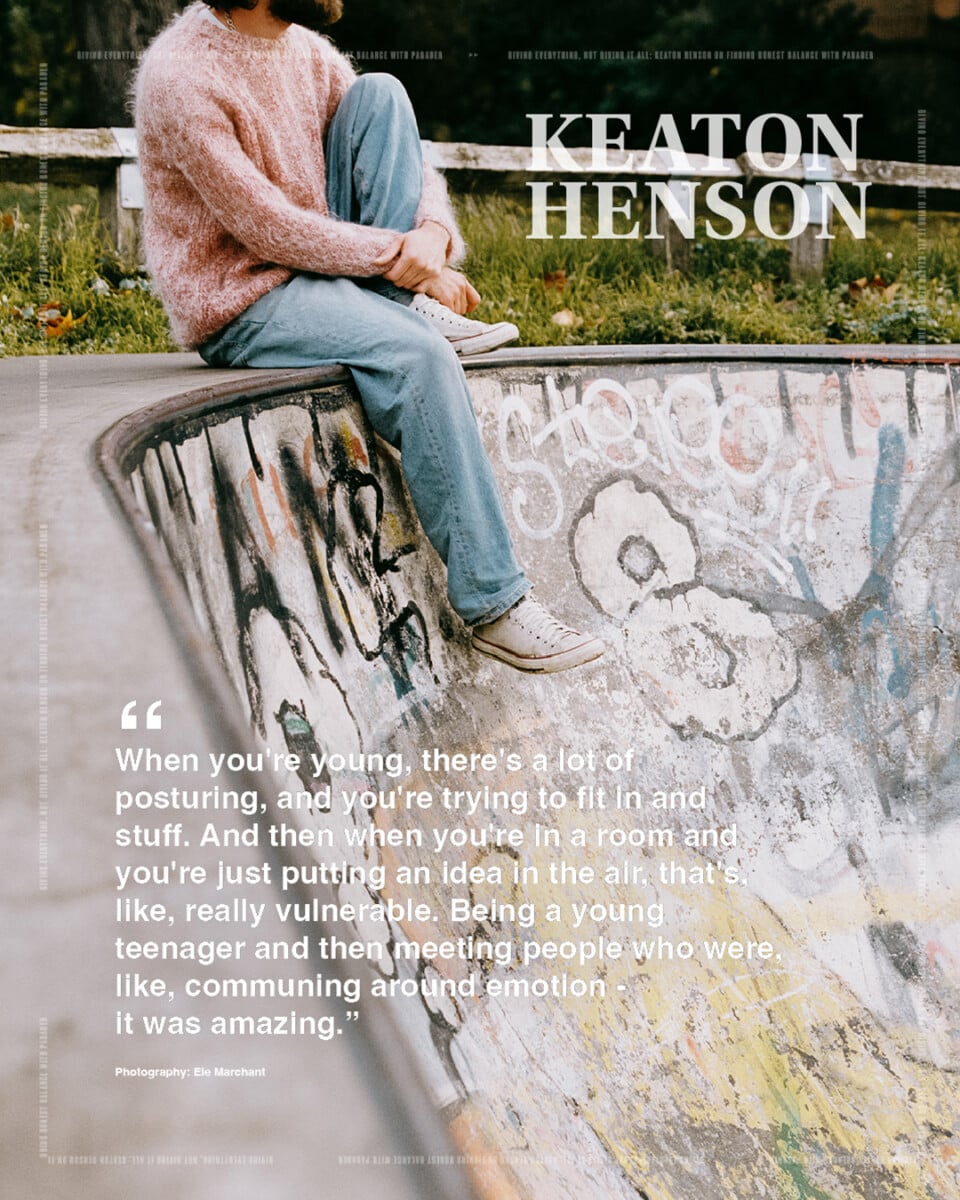
“It’s sort of one of the first opportunities to be vulnerable with friends when you’re young,” he reflected, as young boys in rock bands are often mired with the idea of ego, when in reality, it’s quite the opposite. In his recollection, his childhood bands are characterised by tenderness, adding, “When you’re young, there’s a lot of posturing, and you’re trying to fit in and stuff. And then when you’re in a room and you’re just putting an idea in the air, that’s, like, really vulnerable. Being a young teenager and then meeting people who were, like, communing around emotion – it was amazing.”
It’s part of the reason why it’s taken Henson himself so long to clock onto the fact that he is such a varied artist, because to him, there is a clear path between his sonic worlds – and always, it’s simply himself. “I think it’s really interesting to hear people doing loads of different things, but seeing that the essence of that person is still there,” he explained.
Parader captures that perfectly as it holds onto the poignancy of his lyricism, but also admits that heavier music soundtracks his essence just as much as acoustic stuff, or classical stuff. “The majority of my life was spent listening to heavier music,” he said, recalling how his days spent in rock bands don’t suit the depiction of him as a tragic lone wolf forever cast in the isolation of his mind.
It brings us back around to the point – Keaton Henson has no desire to be trapped as the poster boy for sadness, or the tortured artist the world has had him cast in for so long. Having often been made to feel like a disappointment somehow when people meet him and he is in fact cheery, Henson is tired of being boxed into the parasocial prison of ‘sad’ as a one-size-fits-all image he’s expected to match.
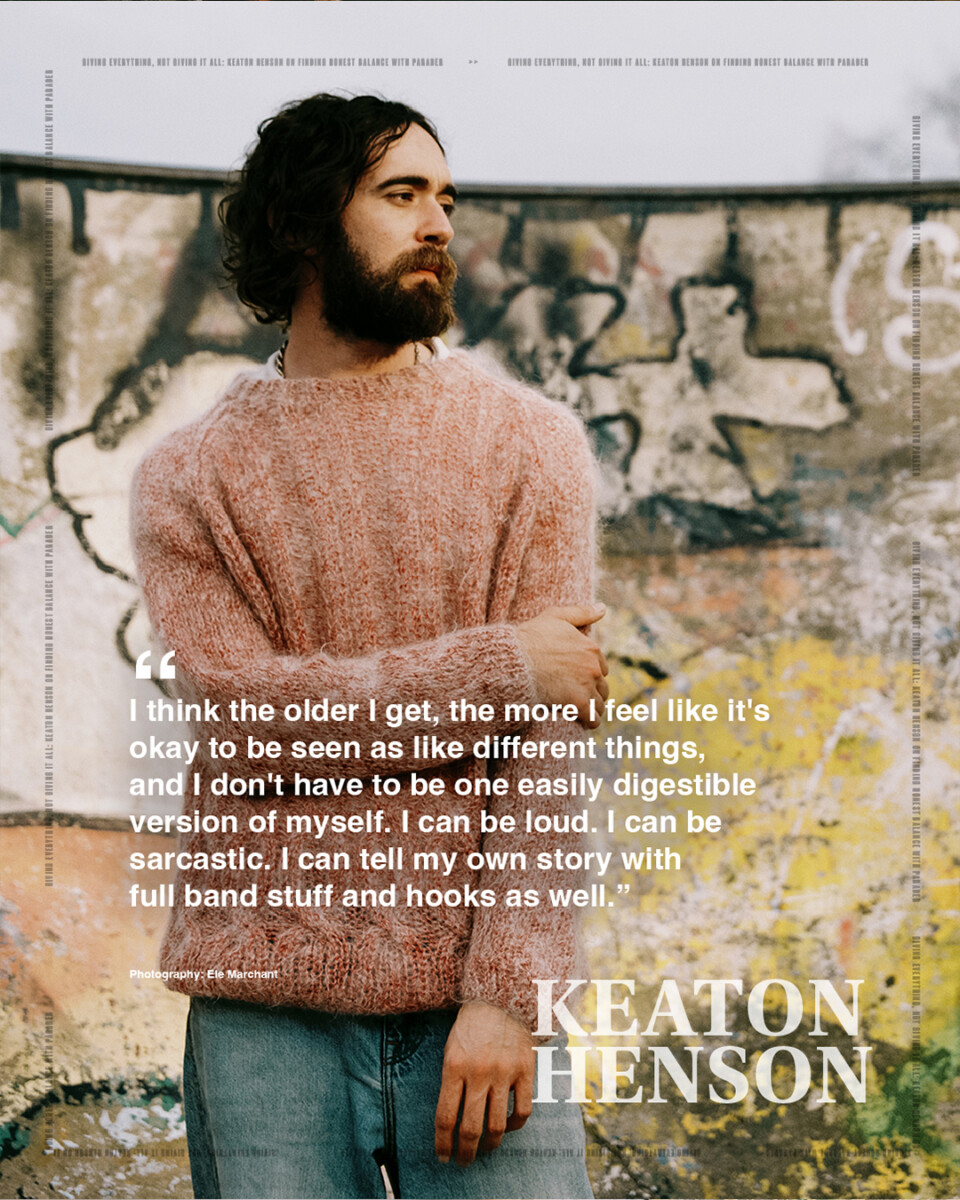
He’ll admit now that when he made House Party, claiming the heavier sounds on that album were under the guise of a character, he still wasn’t quite brave enough to break out. But now he is. “I didn’t feel like I had to hide behind anything,” he said. “I think the older I get, the more I feel like it’s okay to be seen as like different things, and I don’t have to be one easily digestible version of myself. I can be loud. I can be sarcastic. I can tell my own story with full band stuff and hooks as well.”
Parader is presented with incredible gratitude that his career has allowed to be and do everything. It’s an album that strikes a balance. In 2024’s conversation, Henson spoke warily about his relationship with lyrical records, telling me, “The more time you spend in the mine of yourself, the more of your life you lose. The longer you spend digging around for sadness to use, the more good days like this you miss out on.”
But on Parader, with the addition of a band and the louder sounds that honour the “young emo kid” in him who wanted to finally thrash, the familiar vulnerability of his work doesn’t feel exploitative, it feels true to himself – allowing him experimentation, space and a voice beyond the soft, sad one his stifling ‘brand’ might expect.
In the end, Parader all came down to a question of what Henson wants to offer. While his last album was made in a moment of really wanting to give nothing, now he’s realised that his response is more nuanced and requires respect from his listeners to honour the balance.
He wants to give them the depth, but that doesn’t mean he has to give everything. “I think that’s a fascinating social relationship to have somebody who you don’t know and the only thing you know about them is the most personal stuff,” Henson mused. “I love the idea that somebody doesn’t know what I sound like or like, what I find funny, and what I eat or like any of that surface stuff, but they do know my deepest, darkest fears and self loathing,” he said.
“Radical Intimacy” is what he’ll call it – you can have the depths of his 3am thought, but I won’t tell you what sandwich he ate, or the jokes he cracked. That’s private.