


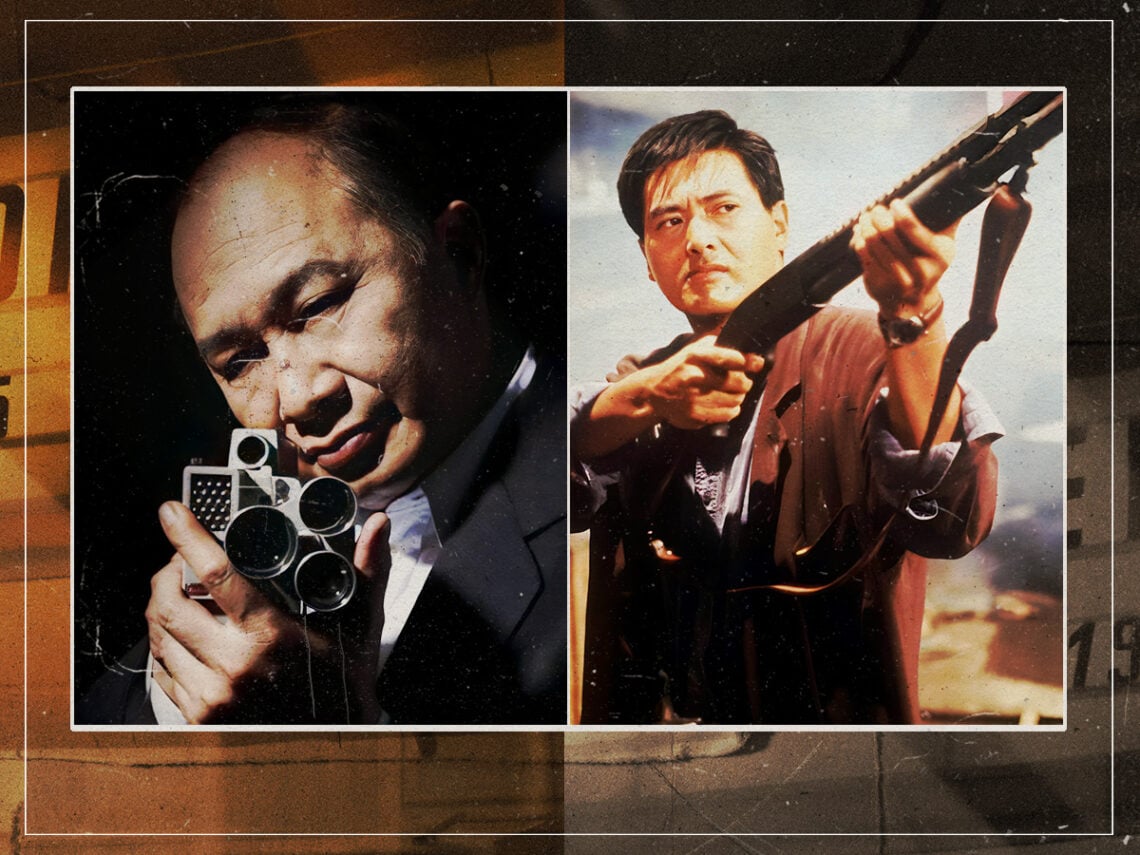
John Woo and Chow Yun-fat: cinema’s most influential director/actor partnership

The debate over the greatest recurring partnership between an actor and director is one that doesn’t have a definitive answer, but when it comes to nothing but the shadow cast over the entirety of cinema and the legacy left behind, a compelling case can be stated for John Woo and Chow Yun-fat being the most influential.
The pair collaborated five times between 1986 and 1992, but that was all they needed to change the action genre forever. A Better Tomorrow, sequel A Better Tomorrow II, The Killer, Once a Thief, and Hard Boiled popularised heroic bloodshed, reinvented how set pieces were staged and executed, and left an imprint on a number of filmmakers themselves responsible for a generation of greats.
Nobody in their right mind is going to deny that Martin Scorsese’s ongoing work with either Robert De Niro or Leonardo DiCaprio has yielded cinematic greatness, and the exact same can be said for the iconic professional marriage of John Ford and John Wayne, the decades-long bromance between Quentin Tarantino and Samuel L. Jackson, the thrills generated by Alfred Hitchcock and James Stewart, or the seminal work of Akira Kurosawa and Toshiro Mifune.
However, despite the number of inarguable classics the aforementioned duos have concocted, the majority of them have resulted in the distinct work of an auteur and an actor working at the top of their respective games. Their shared work is regularly phenomenal to the point of greatness beyond a doubt, but beyond Kurosawa and Mifune, their specific collaborations haven’t yielded a cinematic sea change.
In the case of the latter, their legendary 16-film stint inspired innumerable filmmakers and countless thinly-veiled remakes, but digging deeper into the domino effect created as a direct result, and how it spiralled and dovetailed across the medium, Woo and Yun-fat have their fingerprints all over everything.
Quentin Tarantino changed the entire landscape of independent cinema in the 1990s, and he’s been happy to admit that the titans of Hong Kong’s action arena were pivotal influences. His close friend Robert Rodriguez echoed those sentiments, and he’s gone on to become a one-man production army who owns and operates a production company, film studio, and television network.
Speaking of multimedia conglomerates, La Femme Nikita and Léon: The Professional marked Luc Besson’s mainstream breakthroughs, both of which were heavily indebted to Woo and Yun-fat’s revolutionary filmography. By extension, it’s clearly not a coincidence that his sprawling EuropaCorp empire has specialised in the action genre, launching countless careers and serving as the springboard for Jason Statham’s first foray into the artform he’d call home for the next two decades.
The Wachowskis altered the face of the blockbuster forever when The Matrix exploded out of the gate in 1999, with Woo a noted touchstone for the action sequences, something that can also be applied to star Keanu Reeves’ billion-dollar John Wick franchise, which itself has given rise to a new breed of hard-hitting, intimate actioners with vulnerable heroes that favour realism over visual trickery, tracing all the way back to Yun-fat.
In a similar vein, Gareth Evans’ The Raid was another movie firmly imprinted with Woo’s DNA that launched an international boom and a cavalcade of spiritual successors, to say nothing of James Gunn, who name-checked the Hard Boiled director as someone who heavily inspired the action sequences in Guardians of the Galaxy Vol. 3. Not only was that film part of the biggest and most lucrative franchise there’s ever been, but its director is currently the co-CEO of an entire studio specialising in action-packed epics with a superheroic slant.
Yun-fat didn’t end up starring in Woo’s two-part historical epic Red Cliff, but he was set to play the lead role of Zhou Yu, which was ultimately filled by Tony Leung when he dropped out, in what was the most expensive Chinese production ever mounted at the time. Before 2008, no local movie had ever cost more than $45 million, but that benchmark was nearly doubled.
When it shattered box office records and even managed to dethrone James Cameron’s Titanic as the top-earning release ever in Chinese cinemas, budgets suddenly began to rise nationwide in the aftermath. Today, the country’s biggest movies can often carry Hollywood-level budgets and comfortably post box office numbers significantly higher than their Stateside counterparts, and it can’t be overlooked that Woo was at the forefront of that movement, too.
As mentioned previously, it can’t be said that with the utmost certainty that Woo and Yun-fat are unquestionably the greatest director/star partnership there’s ever been. However, examining their lasting legacy across cinema as a whole – and the ripples it created – offers an indication of just how far-reaching their influence has been.
