


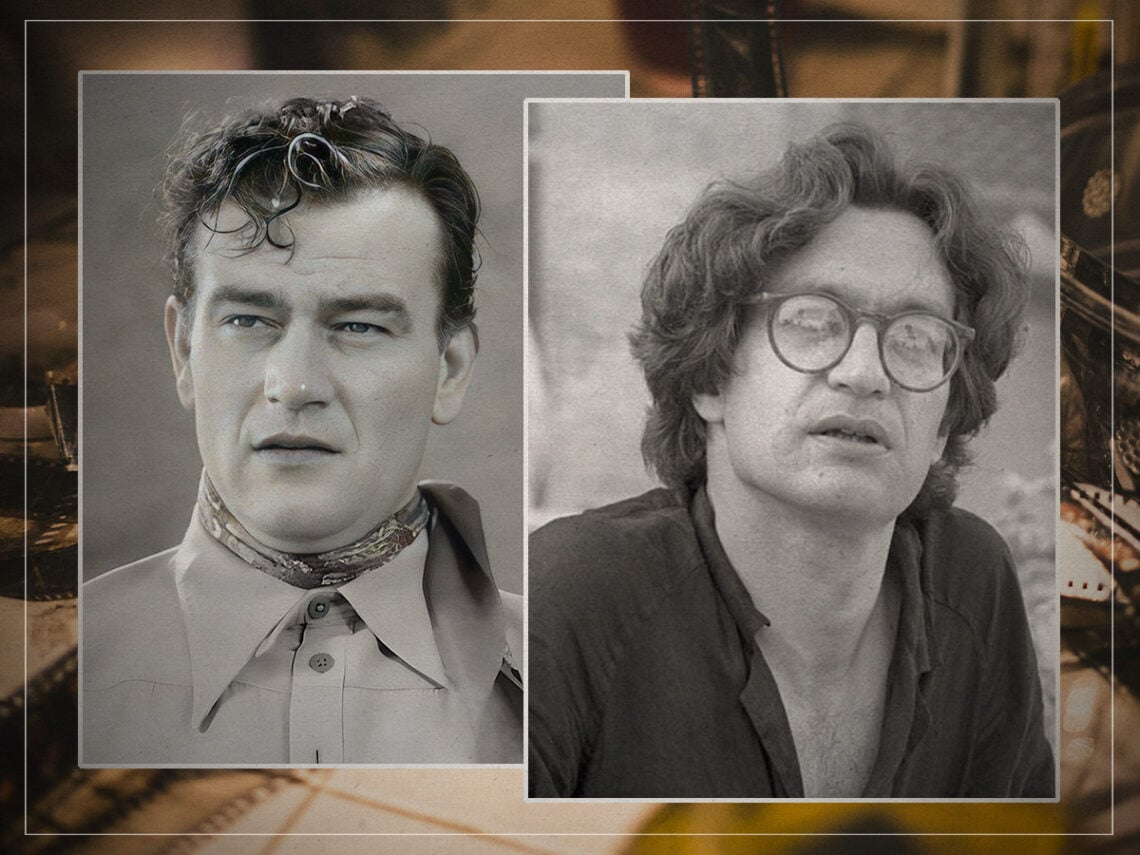
The John Wayne movie Wim Wenders used to sum up his entire career

We’re all born into this life clueless, left to figure out how to get by as easily and enjoyably as possible. It’s difficult, and Wim Wenders knows that. This is why he has dedicated his career to making movies that dig into those quiet moments of trying to figure it out.
In Hollywood, we’re bombarded by strict binaries and archetypes. There’s the characters who personify good and those who represent evil, storylines loaded with strong moral messages, and happy endings designed to seek justice. Not in Wenders’ world. When he won the Palme d’Or for Paris, Texas in 1984, the German filmmaker emerged in the mainstream for the first time, widely praised for his masterpiece.
The ambiguity at the heart of the film’s main character, Travis (played beautifully by Harry Dean Stanton), makes for a compelling watch, because, while it’s revealed that he has acted far from perfectly, you can’t help but feel a degree of empathy for him. He has done bad things, but here is a man trying to repent for those sins, and his decision to reunite his son, Hunter, with his estranged wife, Jane, is like a spiritual journey, albeit one illuminated by neon road signs and gas stations off dusty roads.
This wasn’t the first time that Wenders had utilised the road movie genre to convey a metaphorical journey of self. He began a road movie trilogy in 1974 with Alice in the Cities, a Paper Moon-esque drama which follows an unlikely pairing between a struggling writer and a young girl entrusted to his care. Played by Rüdiger Vogler, Phillip finds himself feeling alienated as he travels through America and Germany, grappling with feelings of insecurity, with the true meaning of art, tradition, truth, and the changing of times all coming to inform his journey from the beginning to the end of the film.
Wenders thinks the overarching theme of his work can be related to a certain John Wayne movie, a western that reflects the multifaceted nature of the American Dream. “There’s a film of John Ford called The Searchers, and sometimes I think that’s [my] main topic…. It’s searchers,” he told NPR. While Wayne’s character goes searching for his niece, who was abducted years earlier, one of the overarching themes is the search for belonging among a landscape of alienation and division.
“It’s people who are searching, trying to define what they live for, trying to find [the] meaning of their lives, trying to find their role in life, looking for love, searching searching searching. That seems to be the key thing my characters are doing,” the director added.
This has been a constant theme throughout Wenders’ career, something that he has never been able to shake. Look at his most recent film, Perfect Days, which earned an Academy Award nomination. Here, Wenders follows a character who is searching for the best way to live his life, finding that in simplicity and appreciating those small things that we often take for granted.
It’s a beautiful film, and one that proves that Wenders explores the complexities of the human experience like few others – in all of its contradictions, its hardships, and the innate desire to search for something greater than ourselves, a sense of meaning and purpose.

Never Miss A Tale
The Far Out John Wayne Newsletter
All the latest stories about John Wayne from the independent voice of culture.
Straight to your inbox.