


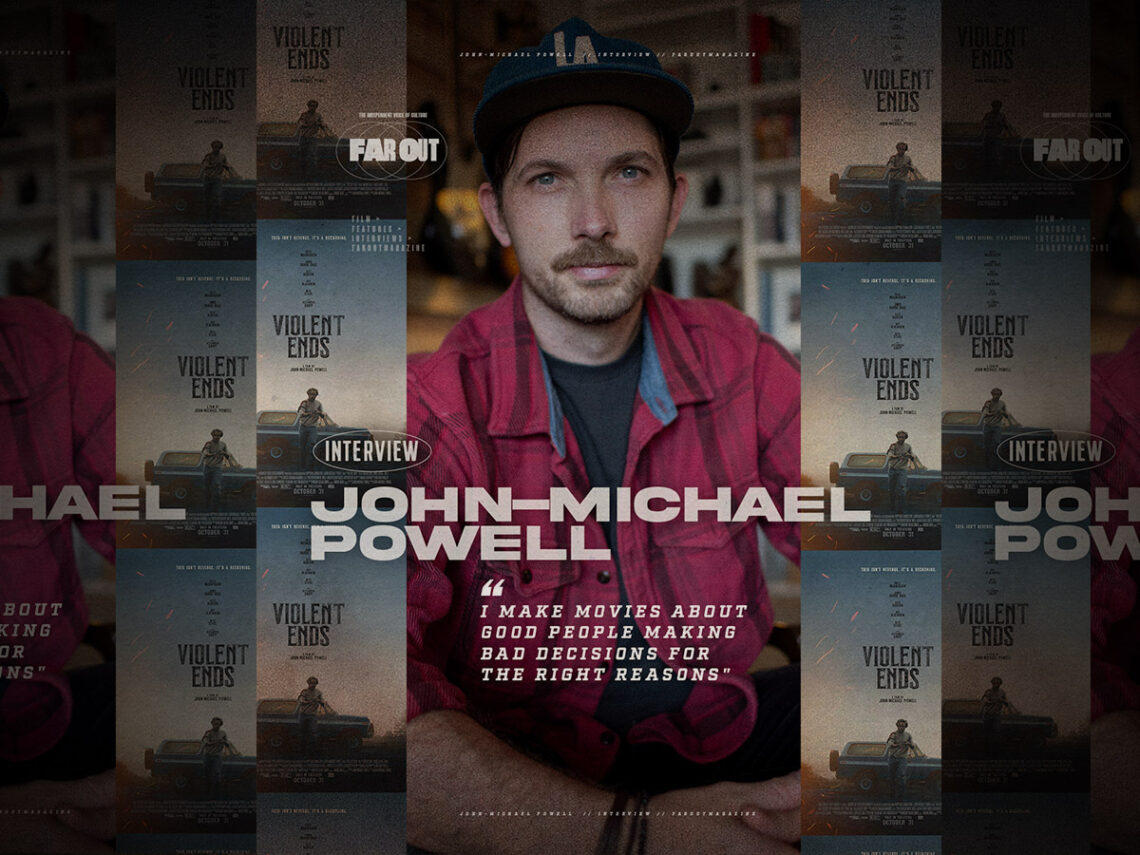
John-Michael Powell: “I make movies about good people making bad decisions for the right reasons”

At first glance, writer and director John-Michael Powell’s second feature, Violent Ends, could be construed as the sort of hard-boiled revenge thriller that audiences have seen hundreds, if not thousands, of times before.
After all, Billy Magnussen’s protagonist, Lucas Frost, is the latest generation of a crime family that’s overseen the Arkansas drug trade for years, with cracks forming in the clan’s established power dynamic that threaten to break apart completely. He wants to free himself from that legacy and start a new life with his fiancée, Alexandra Shipp’s Emma Darling, but these things rarely go to plan.
Once a botched robbery orchestrated by one of his relatives leaves him staring down the barrel of despair, Lucas commits himself to exacting retribution on those responsible. So far, so familiar, and that’s kind of the point. With Violent Ends, Powell both embraces and deconstructs the southern-fried thriller and the revenge story, painting a brutal portrait of how there’s no such thing as having nothing left to lose.
It’s a script he’s been holding onto for a long time, and it’s been almost two years since the end of principal photography, but with his latest movie releasing in cinemas on October 31st, 2025, the filmmaker found himself in something of a fugue state now that his latest directorial effort is ready for the world to see.
“It’s crazy,” he admitted. “I mean, it’s also confusing and exciting. It’s like a whole host of feelings. I keep saying that I feel like I’m in the fog of war right now. So, I don’t know up from down. I think the most validating thing is, in any creative endeavour, whether you’re a filmmaker or not, how long it takes to get your craft to a place that you feel confident and also just to achieve the small, little career goals that you set for yourself.”
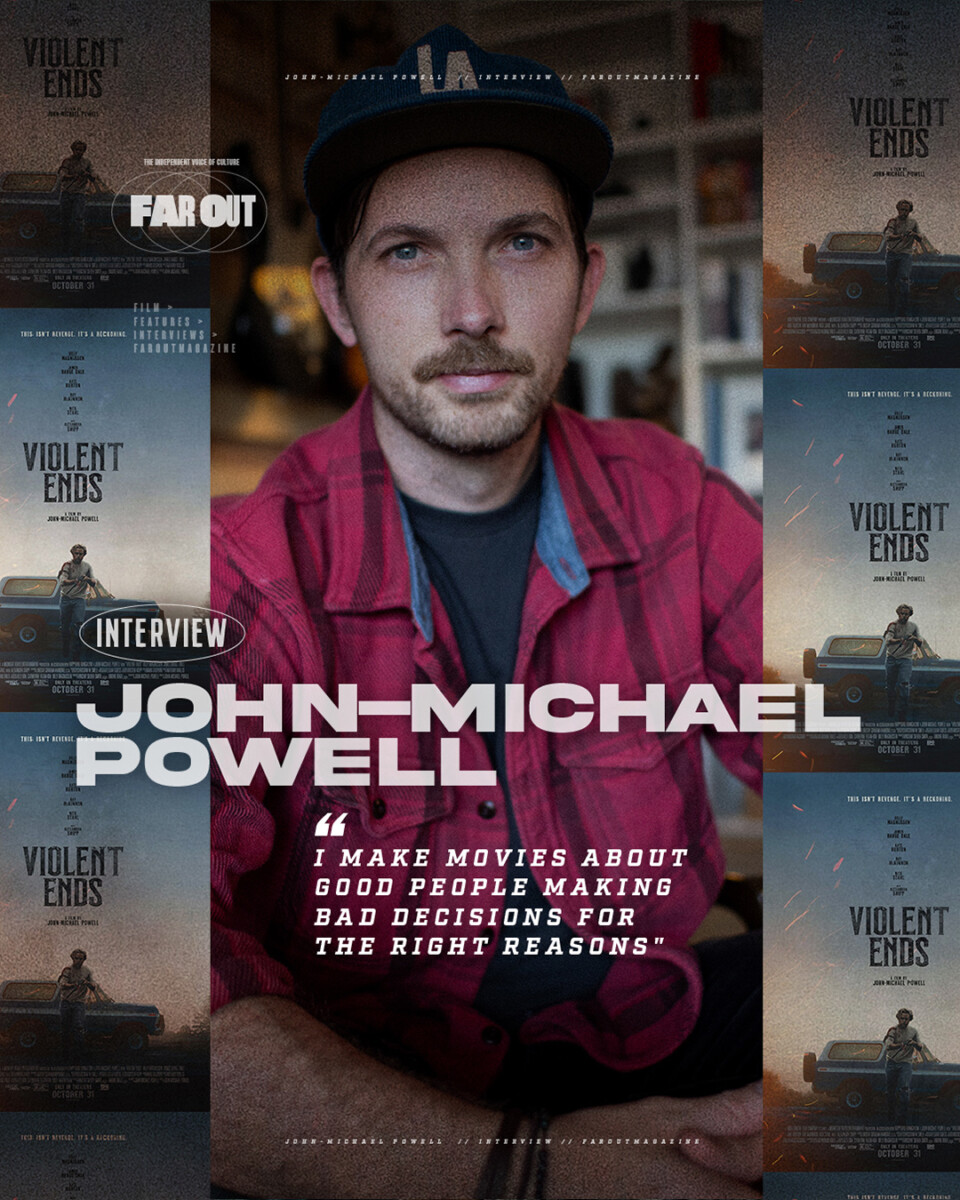
It’s been 20 years since Powell first moved to Los Angeles to “make a career as a filmmaker,” and in that time he’s gotten married, had two kids, and, in his words, “worked my butt off just to get the opportunity.” Now, at 42, “it just feels like now I’m finally starting to inch towards the place I wanted to be.” He wasn’t always behind the camera, though, having risen up the ranks as an editor.
For his work on the Netflix docuseries, American Manhunt: The Boston Marathon Bombing, he shared a win for ‘Outstanding Editing: Documentary’ at the News and Documentary Awards, while his eclectic credits also include the premiere episode of Sausage Party: Foodtopia, and five episodes of the third season of Justin Simien’s Dear White People series, based on the film of the same name.
“Most of the time when you’re editing, you spend all this time crafting something, and then you set the little paper boat in the water, and you push it away, and it does its thing,” he explained. “This is very different. I’m very much a part of the backend, and the distribution, and the theatrical release; we have a pretty robust theatrical, which is exciting. A lot of electricity right now.”
Shortly after the release of his feature debut, 2022’s The Send-Off, he said his next picture would be “something very meticulously crafted, but with the dark irreverence that is very much me.” He doesn’t remember saying it, but still divulged whether he thinks Violent Ends hit that particular nail on the head.
“Wow, you’re good,” he remarked. “I don’t even remember that quote, but I do remember being in that headspace. Yeah, absolutely, I think so.” The Send-Off, which follows an actor who throws an impromptu party for his closest friends before revealing ulterior motives, was a completely different undertaking from Violent Ends, for a number of reasons.
Recalling how “that movie was made in the midst of Covid,” Powell admitted that “there was a lot of frustration, creatively.” He wrote the script in seven days, and four weeks later, he was calling action on his first day of shooting as a feature film director. “That experiment and that exercise, was one of not waiting and not overthinking things, just being very instinctual and seeing what came of the process,” he added. Or, to put a finer point on it: “We were just literally flying by the seat of our pants.”
“Violent Ends, certainly, is a major leap forward for me as an artist,” Powell continued. “One of the things that I think we achieved with Violent Ends is just meticulous world-building. That was something I really wanted to do. You know, I set the movie in Arkansas. That’s where I grew up. So obviously, it’s a world I know very well. When you live in these places that are very small and insular, it’s the dialect and the way people talk, the way people interact, the dramas, the rivalries, the, you know, the sort of superficiality of things; you just know it so intimately.”
Having spent his formative years in Arkansas, he “wanted to show people a world that, quite frankly, often doesn’t get put on cinema.” He’s right in that it’s not exactly known as a filmic hotbed, and he could only think of Jeff Nichols as fitting the bill for whom “most people, if they even think of Arkansas as it pertains to film,” would think of. Still, there was a classic that sparked his imagination.
“The first act of Thelma & Louise is set in Arkansas; that’s where it sets off,” he reflected. “And I remember, dude, I can’t even tell you the excitement I got when I was watching that movie and I saw the licence plates on the cars, knowing that those were licence plates I saw every day of my life.” It sounds trivial, but it was a huge moment for the aspiring auteur.
“You’ve got to understand, up until that point, all I’d been watching was like, E.T., The Goonies, these movies that I grew up with in the ’80s that were so Hollywood,” Powell said. “And for that movie to come along, and see it, and be like, ‘Whoa, those people talk like the people I know’. There’s something extraordinarily liberating about that. Suddenly, it excites you.”
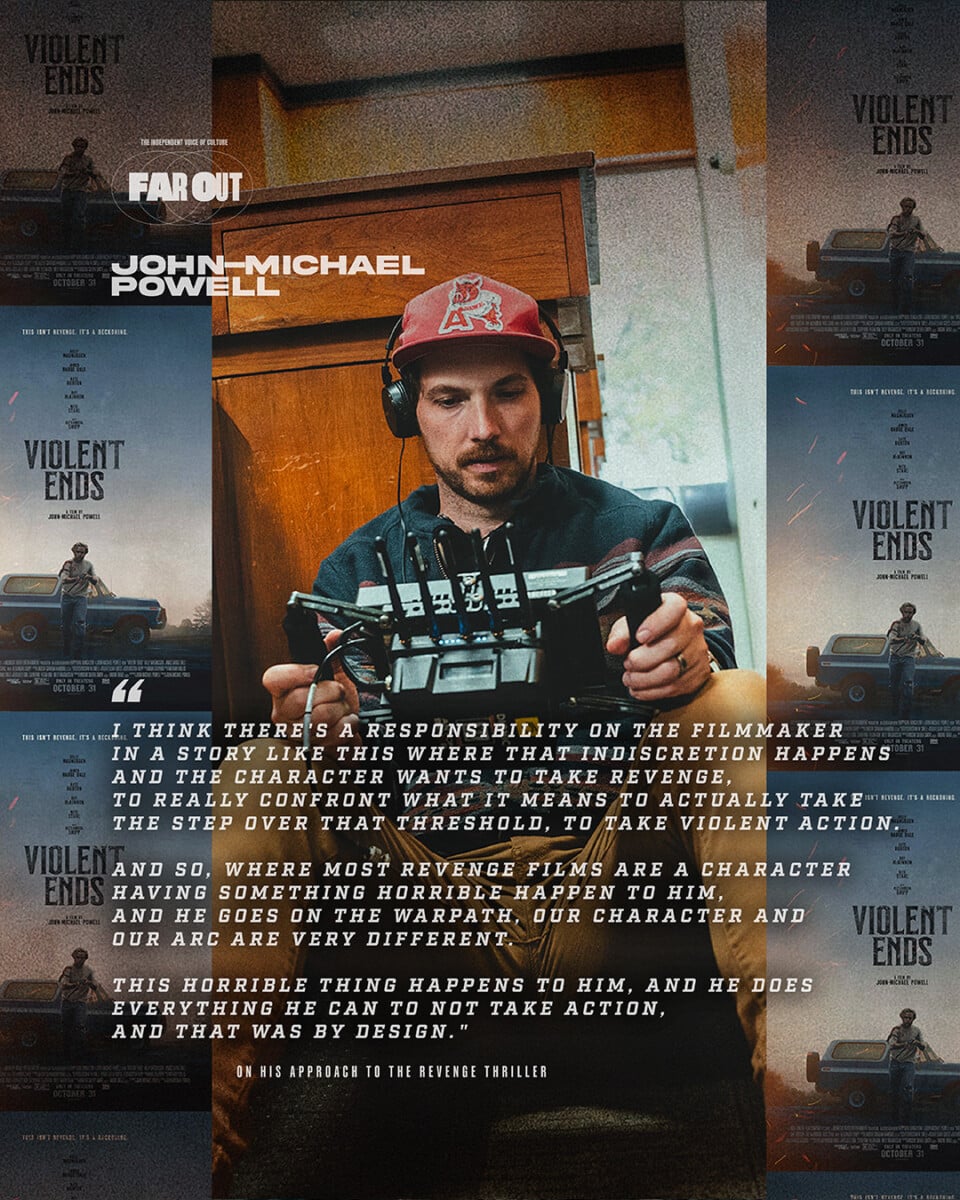
As a result, he’d “always wanted to set a film in my home state, and photograph the world in such a way that was, you know, epic.” Violent Ends is an ode to Arkansas, but also “a throwback to a lot of the westerns” that he grew up watching, while simultaneously doubling as “a condemnation of some of those westerns” in the way that it doesn’t shy away from the spiralling consequences of violent actions.
As mentioned, you might think you know where Violent Ends is heading based on the basic outline of the plot. Powell also knows that you might think you know, and as much as he appreciates the basic tenets of the genre he’s operating within, he used a completely different kind of picture to illustrate how the most simple of storytelling devices can be one of the most malleable.
“I love a revenge film, there’s something primal about revenge,” he surmised. “When I think of movies like Death Wish, or even Gladiator, which is an extraordinary revenge film, there is something so propulsive about having the thing you love most in life taken away from you. And, on a very basic level, like most revenge films, there is an indiscretion.”
Using Ridley Scott’s Academy Award-winning epic as the jumping-off point, Russell Crowe’s Maximus “fights in the Germanic wars, and he comes back to find his family has been murdered, and then he’s taken hostage and taken to Rome, and then, obviously, spends the rest of the movie fighting his way to the point where he can seek his revenge against Joaquin Phoenix’s character. OK, so that’s a pretty basic situation: ‘something bad happens, character goes on the warpath for revenge’. Ours is different.”
In the case of Violent Ends, Powell knew he wanted an inciting incident, but that was where the similarities ended. “We have that indiscretion, but what I feel most revenge films don’t really ever address is the responsibility to put on the audience when it comes to violence.” In most cases, viewers are supposed to root for the hero and hope the villains get their comeuppance, but he didn’t want to be that straightforward.
Magnussen’s Lucas doesn’t want to get dragged into the family business, but he’s left with no choice. From Powell’s perspective as a filmmaker, “when it does lean into the genre tropes, I want those genre tropes to mean something.” Whether that’s picking up a gun, using it, or destroying the Frost legacy from within, he and his team “were mindful of wanting to portray violence as this consequential thing.”
As you can probably infer from the title, Violent Ends has violent moments, but “it’s quite shocking and messy, and as quickly as it comes, it’s over.” Powell’s goal was to “disorient the audience and make them feel this awkward pit in their stomach when things happen,” and by subverting expectations, he hoped that his goal “to make a genre thing but try to slip in something smarter and have a conversation underneath” would be accomplished.
Violent Ends opens with a series of introductory title cards, which set the scene, establish the main players in the narrative, and inform audiences of the basic premise before a single word of dialogue has been spoken. Powell confirmed Far Out‘s theory that it was done to avoid weighing viewers down with too much exposition and narrative table-setting to focus on the characters, before a familiar topic reared its head.
“No, you read that exactly right, you’re very discerning,” he concurred. “I mean, honestly, Gladiator does something similar. We referenced Gladiator when we were building those cards, because those weren’t scripted.” During post-production, Powell realised that “it’s very easy to get lost between the Dougs, the Daves, the Susies, and the Jakes” in an ensemble piece, so he streamlined the entire process.
The title cards outline who the Frost family is, how they became mired in the drug trade, and how they splintered off into different factions. Instead of relaying that information through dialogue, Powell “didn’t want to get lost in the weeds of who every cousin is,” so he decided to focus on what he called “the Star Wars of it all.”
“So that everybody, right off the bat, knows what’s what, where the world is, what’s going on, and then you don’t even have to address it the rest of the film. It’s the subtext of everything,” he elaborated. “And, again, Gladiator. Go back and watch Gladiator. Those opening cards are like, seven minutes. It’s crazy.”
“I remember when I was writing the opening titles, thinking, ‘Well, how much can you really capture?’ And these days, audiences don’t want to read, which I get, but I was like, ‘How long could I really hold people’s attention, and how precise and how economical do I have to be with my words to get the points across without?’ And when I was watching Gladiator, I was like, ‘Good lord, this is a tome of information, and it’s also historically complex.'”
With Violent Ends embracing its throwback nature, and being “a bit of a period piece” that’s set in 1992, Powell thought “opening it with those titles felt like an homage to those older films that used to do that, and so it just felt right.” Not to further the Gladiator comparisons, but that would technically make Magnussen’s Lucas his version of Russell Crowe’s Maximus, and anyone familiar with the Game Night and No Time to Die star may be surprised to find out that this is the first time he’s played the lead in anything.
They’ve known each other for a while, and first crossed paths when they both worked on 2012’s fantasy comedy, The Brass Teapot, with Powell acknowledging that Magnussen “generally gets these roles where he’s the handsome, cocky, smarmy kind of guy who comes in, as like two or three scenes, and steals those scenes every time,” using Adam McKay’s star-studded The Big Short as the example.
“When I was editing that movie, I just saw in the dailies, I was like, ‘Wait a minute, this guy has so much in the well that he’s not even tapping into here,'” the filmmaker opined. “That was years ago, but I knew, I was like, ‘If that guy ever got the potential to do something dark…’ You can just feel it.”
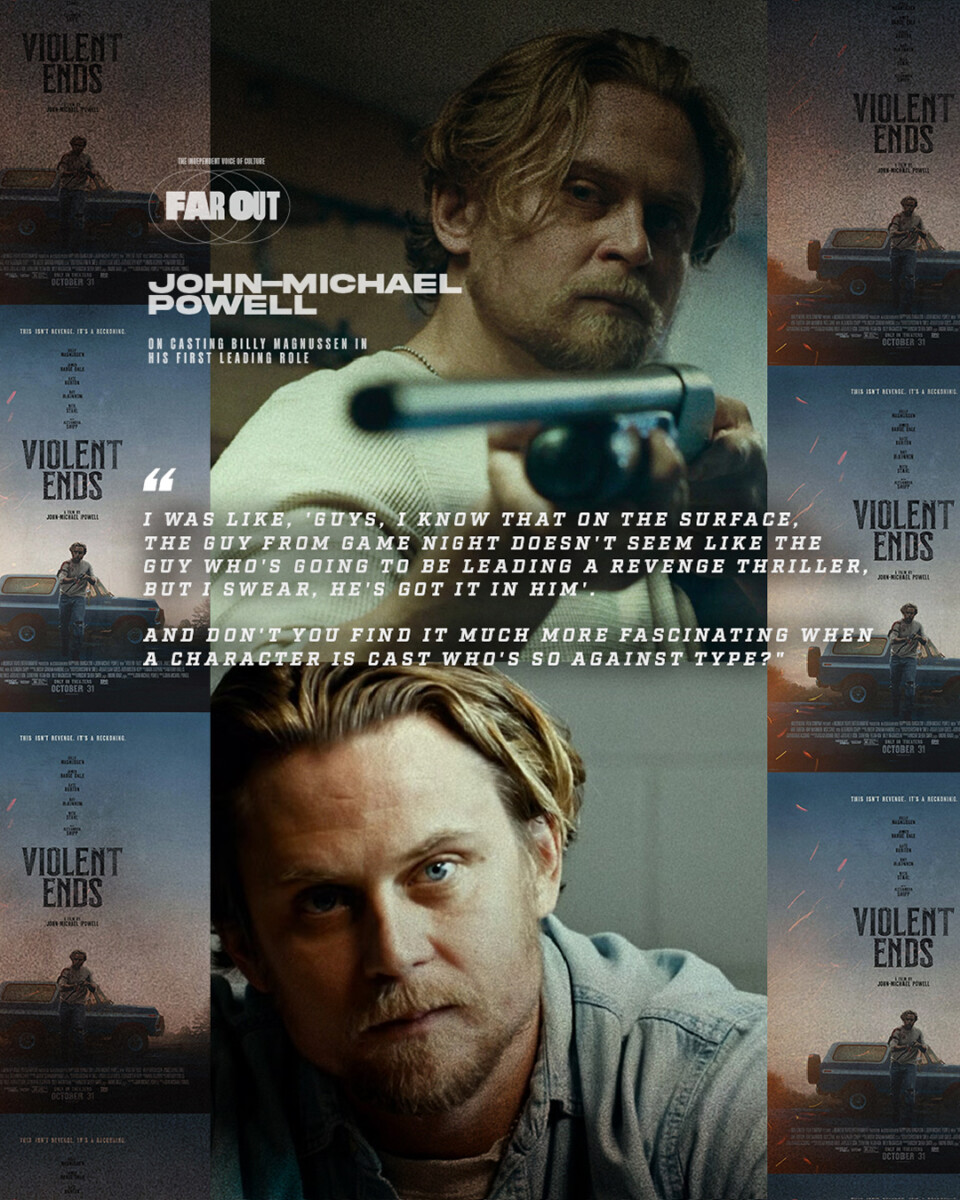
Once his name came up during early casting conversations, Powell “proselytised” to get him on board. “I was like, ‘Guys, I know that on the surface, the guy from Game Night doesn’t seem like the guy who’s going to be leading a revenge thriller, but I swear, he’s got it in him,'” he recalled. “And don’t you find it much more fascinating when a character is cast who’s so against type?”
There was an element of kismet, too, with the leading man only able to shoot the film due to the writers’ and actors’ strikes. Violent Ends received a waiver to go ahead with production, and Magnussen shot his first-ever leading role in a movie when The Franchise, HBO’s short-lived superhero satire, was on hiatus.
“You’ve seen him in a million things, but this is his first time being number one on the call sheet, which was really exciting,” Powell appended. “And from day one, from the second Billy landed in northwest Arkansas, my nickname for him is ‘Billy the Bronco’ because he goes 110%, he was so ready to roll up his sleeves and be creative.”
Magnussen is also an executive producer of Violent Ends, and with Lucas’ character arc being “pretty well-rendered” before a single frame had been shot, it allowed the actor to focus on his performance. Powell was reticent to give away spoilers, but there’s an intense scene inside a barn that stands as one of his proudest moments from the shoot.
“It really is the threshold for his character,” the director teased. “And that moment was such a big moment. Not to spoil anything, but it’s a big, big monologue moment for Billy. And it’s all Billy, it’s all that character, so a lot of our work was really reverse-engineering everything leading up to that moment to really make that moment his as hard as possible.”
“It’s not easy as an actor to sit there at three in the morning, going to the darkest places possible with a shotgun in your hand, and we’re spraying you in the face with blood. It’s hard. It’s difficult. So, yeah, Billy was instrumental. He’s such a great collaborator.”
John-Michael Powell
Of course, a hero is only as good as their villain, and Magnussen’s onscreen adversary in Violent Ends is James Badge Dale’s cousin, Sid Frost. An actor who always does a great line in playing charming shit-heels, there’s a slightly exaggerated nature to the character, but it’s done with a quiet and simmering menace that, for Powell, evoked one of cinema’s all-time great sociopaths.
“The proxy for that character was Anton Chigurh from No Country, who’s obviously a sociopathic shark, who’s just out for blood,” he offered. “Sid isn’t quite that. He’s much more, and Badge’s portrayal of him is much more. He needs the attention. He gets off on the attention,” with the filmmaker also naming Lee Marvin’s title character from The Man Who Shot Liberty Valance as another touchstone, as well as another nod to classic westerns.
“If Billy’s gonna be playing the man in white, the man in black has to be the peacock of the movie,” Powell pointed out. “You’ll see he has a very distinct haircut. That was Badge’s choice. I remember he showed me a photograph, I want to say it was a mugshot, like Australian mugshots from 1908 or something, and they had these kind of Peaky Blinders vibes,” not that the director was entirely on board with his coiffure.
“When he showed me this picture of this haircut, which required him shaving half his head, by the way, I was a little reticent,” he admitted. “And I said, ‘OK, well, Badge has intent, and he had the idea’. And I thought, ‘This is a guy who’s been in The Departed. This guy’s worked with Scorsese, he’s worked with the best filmmakers on the planet, I think his instincts are probably pretty dead on.'”
The first time Powell saw Dale in character, he knew the actor had made the right call, because he’d brought to life “the character that I didn’t see on the page.” There is a certain excessiveness to Sid, but as much as the director and star embraced it to a certain extent, they knew when to pull back to stop the antagonist from inhaling the scenery whole.
“One of the things I’m most proud of in this movie is that he doesn’t ham it up every scene, whether or not he’s being hammy, and I do write things in the movie that are hammy,” with the actor the perfect conduit. “I knew that if I cast someone like Badge, he could ground that hamminess, because it’s a special skill to be able to write something heightened and then have an actor ground that heightenedness. To me, when you can do that, when you can blend heightened and grounded, it becomes so unique.”
There were still risks, since Powell was aware that “if you’re not careful, and you cast the wrong actor for those roles, suddenly it becomes a caricature.” In a movie like Violent Ends, which has realism seeping out of every pore, the filmmaker was cognisant of leaning too far into the ham of it all.
“By the time you get to the end of the movie, and suddenly, as you know it’s going to be good guy versus bad guy, well, then there’s no stakes, because you don’t take the bad guy seriously; he’s so flamboyant and ridiculous that it’s like, ‘What is there to be afraid of?’ I guarantee you there’s a lot to be afraid of. James Badge Dale is terrifying in this role.”
John-Michael Powell
Continuing to dance around spoilers, one of the recurring and most prominent themes in Violent Ends is how difficult it is for any family to break the negative cycles that have plagued them for generations. There’s an argument to be made that Lucas does exactly that in the final act, but it took a minute for Powell to settle on that conclusion.
“You’re good, man, you’re smart. You know cinema,” he replied to further theorising, which Far Out will happily wear as a badge of honour. “No, this was not always the way it ended. You’re so astute. Billy’s character basically says he wants to be nothing like his father, who is in prison, right? In very early drafts, the movie actually ended with Billy’s character going back to visit his father, and so he’s a changed man by this point.”
That made Violent Ends “literally a mirror; a cautionary tale of his father saying, ‘You will always be who you are.'” As Powell continued refining the script, he decided it was “so bleak, and that wasn’t the conversation that I wanted to have, really,” and he’d prefer if it were tied to the message he always wanted to put across.
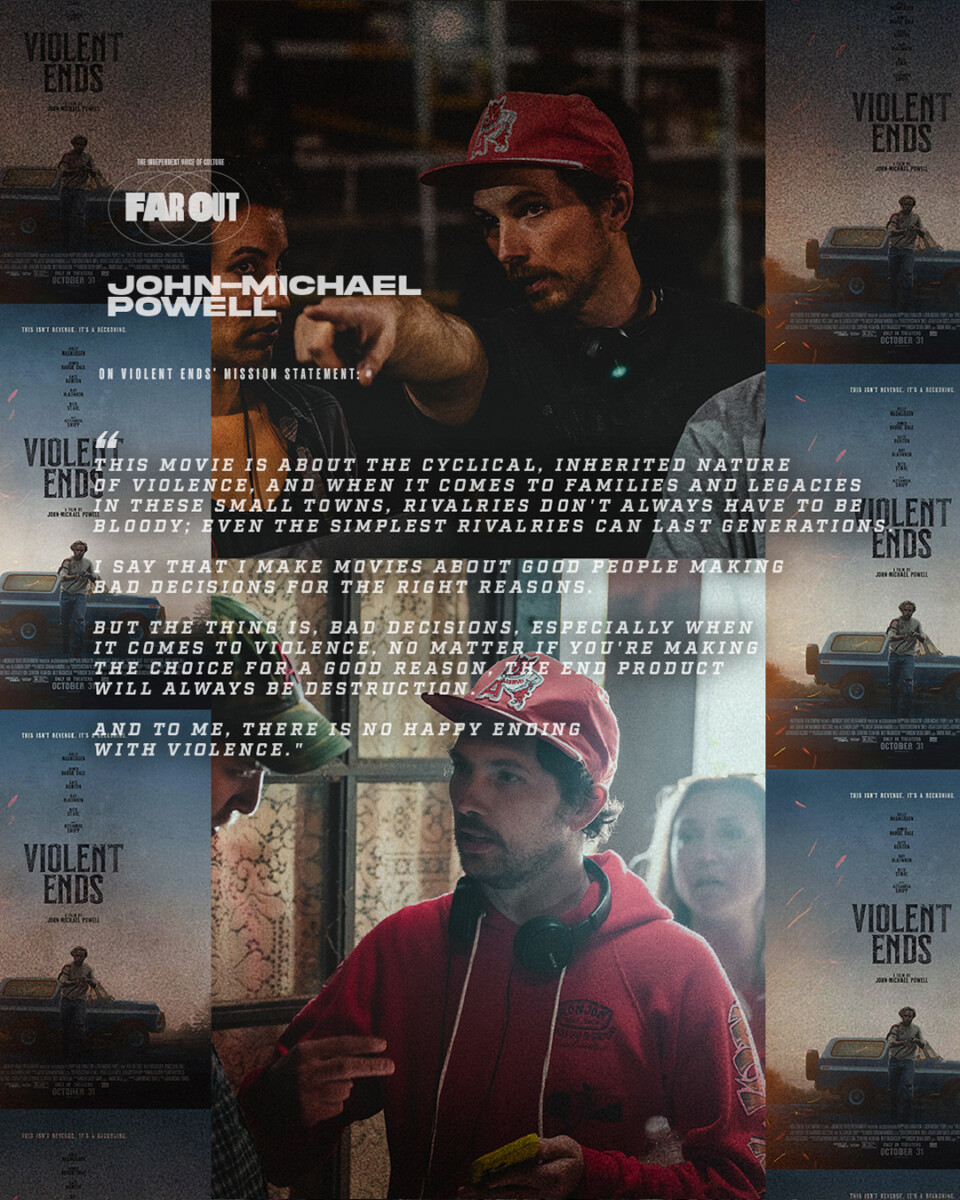
“This movie is about the cyclical, inherited nature of violence, and when it comes to families and legacies in these small towns, rivalries don’t always have to be bloody; even the simplest rivalries can last generations,” he elucidated. “I say that I make movies about good people making bad decisions for the right reasons. But the thing is, bad decisions, especially when it comes to violence, no matter if you’re making the choice for a good reason, the end product will always be destruction. And to me, there is no happy ending with violence.”
That spurred Powell to devise a new ending, one he seems much happier with. “I do see the end of the movie as hopeful. Maybe melancholy is the right word, I don’t know, but I think at the end of the day, I wanted to leave audiences with the thought,” with the director hoping his mission statement will be fulfilled: “Hopefully, people will change their perspective slightly and come to a place where they realise that these rivalries and this violence actually serves nothing other than to destroy light.”
