


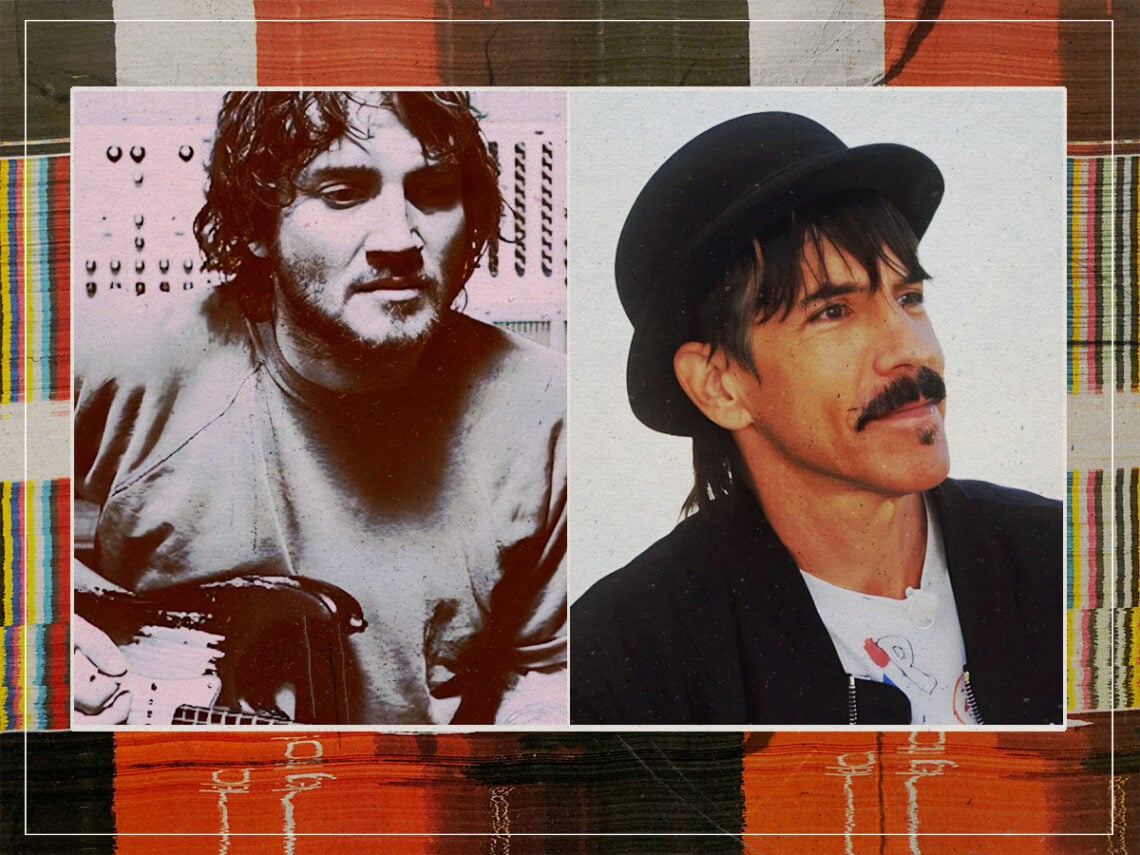
John Frusciante on Anthony Kiedis’ lack of musical ability: “He doesn’t know anything”

The Red Hot Chili Peppers were never interested in being the greatest musicians in the world. Especially in their early days when music would even take a backseat to hijinks, drugs, parties, and the general anarchy that seemed to follow the group at every turn. To put it simply: if you name your group Tony Flow and the Miraculous Majestic Masters of Mayhem, and then decide that a more mature name change would be the Red Hot Chili Peppers, then you’re not overly concerned with people taking you too seriously.
That’s not to say they had no idea what they were doing. During their four-decade-long career, the group saw a number of talented musicians walk through their doors and into their band. That included future film composer Cliff Martinez, future Bob Dylan sideman Jack Sherman, Parliament-Funkadelic guitarist DeWayne McKnight, Dead Kennedys drummer D.H. Peligro, Morrissey collaborator Jesse Tobias, and Jane’s Addiction guitarist Dave Navarro, to name just a few.
A band couldn’t possibly attract that much talent without knowing what they were doing, but Anthony Kiedis and Flea skated by in the early years with an almost idiot-savant-like attitude. Flea was a phenomenally talented bass player, picking up intricate techniques like slap bass entirely by ear. But by his own admission, Flea didn’t start to take music theory seriously until he was already roughly 20 years into his musical career. As for Kiedis, he rarely sang at all on the band’s initial material, uncomfortable with his own melodic abilities.
Instead, Kiedis decided to get by on energy and enthusiasm. That meant a lot of rapping, which was on the upswing around the time that the Chili Peppers got started. Before that, Kiedis initially didn’t even attempt to sing – he would often tell jokes and monologue over the music being played by his bandmates. As songwriting became more of a concern, Kiedis still didn’t have a firm grasp on his own singing abilities by the time the group had to make their first major change in direction.
This somewhat hindered the band. They were now serious enough about their craft to start creating songs of their own, but Kiedis had to get his own angle fixed down before they could truly push on. John Frusciante had brought a necessary centre to the music of the Red Hot Chili Peppers. Before his arrival, the Californian outfit were completely enthralled with the punk-funk-quasi rap that bands like Faith No More and Living Colour arguably superseded them with.
Flea was a monster slap bass player, but the band had little cohesion or refinement to them as they approached a crisis point upon the death of founding member Hillel Slovak. They were in disarray and on the brink of disbandment. Alas, they had known little else in their life but being in a band, so they simply had to persevere.
In comes Frusciante, a teenage wiz at musical theory with a deep understanding of melody, who, perhaps somewhat incongruously, was also a massive fan of the Chili Peppers brand of hard-hitting funk. Even though he was pressured into retaining some of the thornier edges on his debut with the band, Mother’s Milk, his skills at sparseness soon forced the rest of the band to think about melody, especially lead singer Anthony Kiedis.

Kiedis was, to put it mildly, not the most gifted singer when it came to range and melodic capabilities. For most of the band’s existence, he rapped as much as he actually picked out musical notes in his vocalisations, hitting beats along the bars as opposed to typical vocal melodicism. He mostly got by on energy, charm, and ridiculous bravado, and when the band’s punk-funk was the style of choice, it worked for what they were doing. But it wouldn’t do with someone like Frusciante in the band.
“I think the original idea of having a singer like Anthony was that everybody saw him as being very much like a non-musician,” Frusciante explains in a 2003 interview. “He comes at it from a standpoint of someone whose feelings for music are very concise, and he has a big capacity for feeling music, but he doesn’t know anything about music, or notes, or anything of these things.” He was the proverbial punk, but his band were no longer a ‘punk band’. So, he had to adapt for their second chapter.
Frusciante explains that the juxtaposition of Kiedis’ relatively rudimentary knowledge of music and his other bandmates’ more specific understanding is what leads to the best Chili Peppers songs. Certainly, Kiedis has improved as a melody maker, crafting consummate toplines on the likes of ‘Dani California’ and ‘Californication’. On albums like By the Way, which Frusciante was promoting at the time, he became more comfortable dispensing his more manic MC persona for something more befitting of a melody-based alternative rock band.
Frusciante certainly doesn’t take on any pretensions when it comes to Kiedis’ knowledge (or lack thereof) of theory and melody. He acknowledges the progression that Kiedis has made over the band’s career, from “rap type movement” to “pretty much almost exclusively melodically singing,” and ends by stating that Kiedis “has grown into a very mature songwriter”.
While Kiedis might, of course, fail to stack up alongside his favourite singer, Mama Cass, he took from her a sense that you simply have to find your own belonging in music and style it out. So, he has now transmuted rap beats into a crooned topline syncopation that gives the track’s an idiosyncratic groove, while his writing drops satirical depth into the still punkish melee of sounds. As John Lydon says, “For me, personality and bravado and endevour are far more important than musical skill, because musical skill is learned.”
Check out the interview down below.
