


Jessica Pratt’s music is so beautiful it might have ruined my life: The strange science of comfort albums

It’s Jessica Pratt season again, and I’m in trouble.
With a voice as soft as buttered silk, creaking, candlelit compositions, and melodies that drift like autumn leaves dropped from a celestial firmament, as soon as the nights draw in, year after year, I find myself trudging back towards Jessica Pratt records. By this stage, they are more well-thumbed than David Attenborough’s passport, and I’m concerned.
‘Is this it?’ I wonder prematurely, at the age of 32, ‘Is this the last of the artistic infatuations?’ The worry is two-fold: firstly, am I missing out on the magic of discovery by continually returning to records I know so well I can time kettle boils around them – in essence, am I becoming boring?
Secondly, am I somehow unhealthily addicted – if my Pratt records were stolen and she pulled her music from Spotify, how would I cope? Is my mind in a mire of melancholy, mellow, magical Pratt?
I decided not to face these questions alone and sought the psychological help of Dr Michael Swift, the founder of Birmingham-based Swift Psychology and Head of Counselling at the Uprawr Mental Health Foundation. His illuminating insight assured me that I am not alone. There is a strange psychological quirk to what have become known as ‘comfort’ albums.
With great relief, I learnt that my repetitive mornings (and evenings and showers for that matter) were scientifically explainable. “Familiarity reduces uncertainty, which calms the nervous system,” Dr Swift explains. “Knowing exactly what emotional arc we’re about to experience creates a sense of control that becomes predictable. This is powerful in times of stress, almost like returning to a safe place in the mind.”
While I was relieved that habitual listening was perfectly normal, I was less keen on the implication that I was perhaps routinely responding to unaddressed anxiety. I work from home in the non-too-consequential world of music journalism, so the revelation of latent morning stress would be news to me. But as I found out, there is truth to this for anyone who works from home.
When you work from home, ‘transitional rituals’ are lost. Good old time-sapping commutes actually serve a vital human function, preparing you for task-oriented thinking on the way in, and unwinding on the way out. When you simultaneously start your day at home and at work, a strange cognitive dissonance can lead to a build-up of low-level stress.
So, in some way, that same old album, podcast, or background playlist is actually a form of self-medication. It’s a way of priming your thought process. As Dr Swift explains, “Research shows that repeated exposure to the familiar can reduce cortisol, our primary stress hormone, which explains why comfort media is so often revisited.”
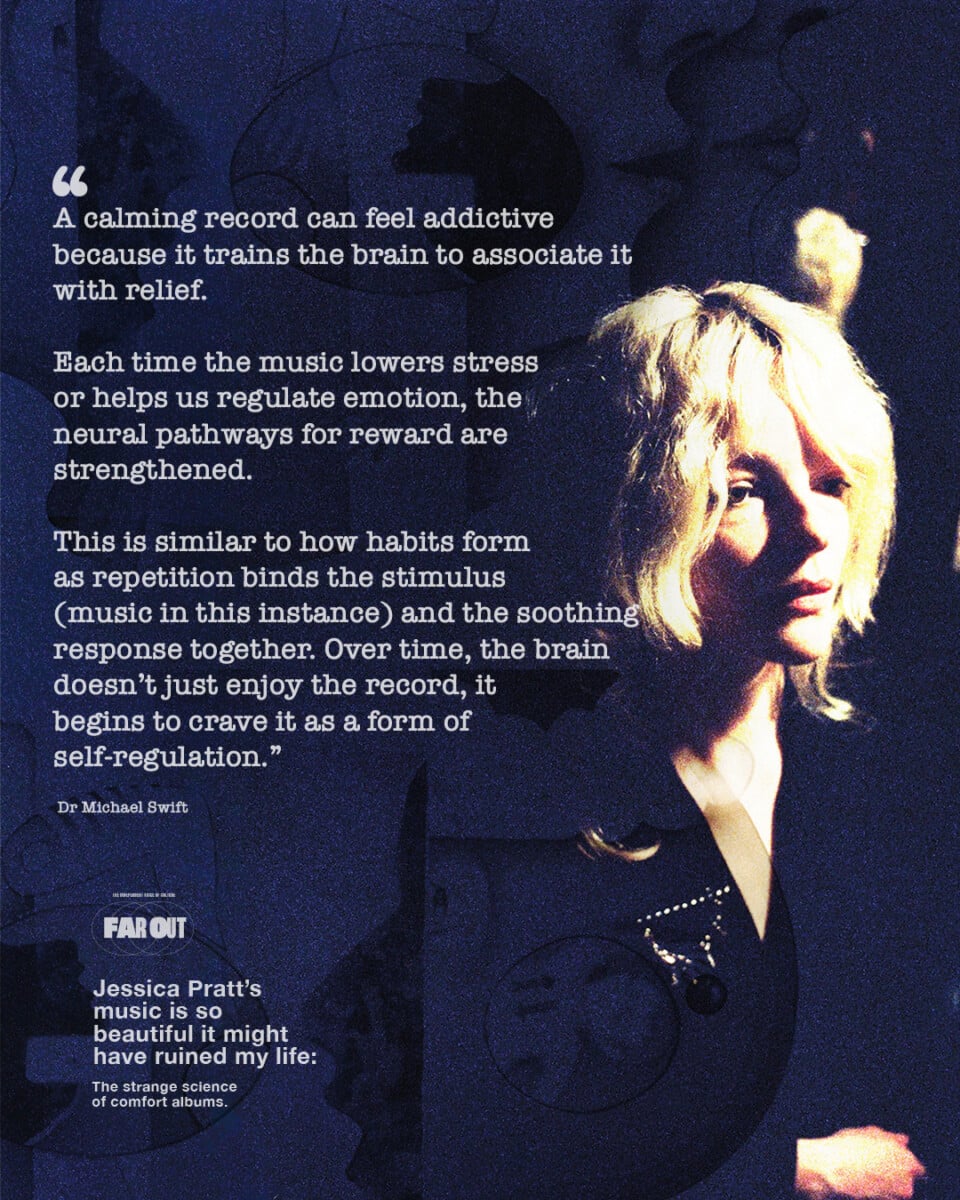
Maybe that explains why the effortlessly calming ways of Pratt appeal so endlessly, too. “A calming record can feel addictive because it trains the brain to associate it with relief,” Dr Swift continues. “Each time the music lowers stress or helps us regulate emotion, the neural pathways for reward are strengthened.”
He adds, “This is similar to how habits form as repetition binds the stimulus (music in this instance) and the soothing response together. Over time, the brain doesn’t just enjoy the record, it begins to crave it as a form of self-regulation.”
So, it seemed as though I had been overthinking the threat of staleness, and stressing over nothing – maybe I hadn’t been listening to enough Pratt? After all, it’s a harsh world out there, and if something brings you comfort, then you ought to let it consume you. But I still thought I’d pass this assumption by the psychologist.
“Repetition can absolutely be a healthy ritual, much like meditation or a morning coffee routine,” Dr Swift thankfully confirmed. “These rituals provide grounding and rhythm in daily life. But…” there was a stinging caveat, “psychology also tells us that when rituals are used to avoid discomfort (for instance, looping the same podcast to block intrusive thoughts), they can become a form of avoidance.”
He concludes, “The difference lies in intention: psychological enhancement versus escape.” After a promising start, this felt like a crushing blow to my wintery Pratt cycle – how was I to know whether I was escaping or psychologically enhancing?
“Leaning too heavily on one comfort album can narrow our cultural diet, limiting opportunities for novelty, which is crucial for psychological growth,” Dr Dwift damningly declared. “On the other hand,” he thankfully continued, “our ‘go-to’ pieces often reveal something essential about what we seek from culture: intimacy, stability, or self-awareness. Research suggests both novelty and familiarity are important for wellbeing, so the healthiest approach is balance – returning to comfort while remaining open to discovery.”
That, like Pratt’s albums, was music to my ears. I return to her sound so frequently because I need it in my life. We all need our little culture crutches, it would seem, and as long as they’re beautiful and meaningful, they’re worth giving yourself up to. There’s always the summer to blast Geese and board a booze cruise in Benidorm for a novel shake-up.
We owe it to ourselves to do both now more than ever – not specifically a balance of brooze cruises and acoustic folk, but maybe an endless Chatabix podcast in the bath and a spot of wild camping on the weekend – the bravely novel and the belovedly known.
As Dr Swift concludes, “Our hectic lifestyles make comfort culture particularly appealing. When we are bombarded with news, notifications, and endless choice, the brain becomes fatigued by decision-making. Familiar media cuts through that overload by offering certainty and reducing cognitive demand. It’s less about laziness and more about conserving mental energy in a world that rarely slows down.”
So, as I stare through the wisps of smoke lifting off a fresh brew to the whirling beauty of a beaten-up copy of Here In The Pitch beyond, I feel assured that it is not ruining my life, it is bringing it much-needed routine. I thrive off the New York apartment saudade that it serves up, and it seems I always will. Now I know that the obsession is psychologically safe, just so long as I never lose sight of the next Jessica Pratt in my life… and I may well have found it in Studio Electrophonique.
